


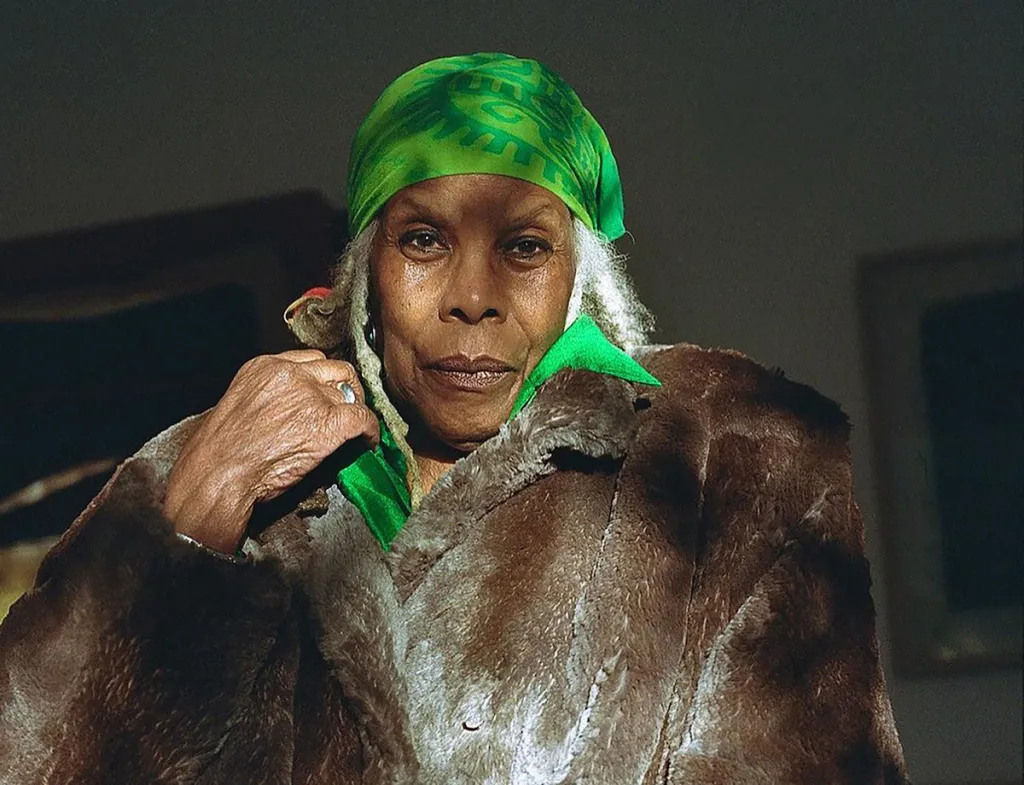
Mary Lovelace O’Neal, whose gestural abstractions consistently ran against the grain, defying the demands placed upon Black painters by critics and artists alike, died on Sunday in Mérida, Mexico. She was 84. Her galleries, Jenkins Johnson and Marianne Boesky, announced her passing on Wednesday.
Lovelace O’Neal produced sprawling paints defined by tangles of drippy, roiled strokes. This was a style that placed her outside the orthodoxy of Minimalism, the dominant movement when she was maturing as an artist during the 1960s. She also arrived too late to be classified as an Abstract Expressionist.
But she did not consider herself an adherent of either movement, anyway, and in interviews, she said she enjoyed standing apart from any fashionable style or school of artistic thought. “I’m reluctant to call myself an abstract expressionist or a minimalist. I call myself a painter,” she told the New York Times in 2020, adding, “Being unruly is my nature.”
Many of her most famous works were produced during the ’60s, when Lovelace O’Neal walked into a paint store in New York and purchased five bags of lamp black, a dark powder. She was an MFA student at Columbia University at the time, and one of her professors, Stephen Greene, had previously taught Frank Stella, himself an artist closely aligned with painting blackness. Having failed to please Greene with her abstractions, Lovelace O’Neal applied the powder directly to her white canvases, covering it in black pigment that became a background to pastel squiggles.
“I would take that black stuff and rub it into the canvas with a blackboard eraser and get the flattest painting ever,” she told the painter Suzanne Jackson in a 2021 Bomb interview. “And it would also be the blackest painting.”
Lovelace O’Neal was also punning the word “blackness,” in an attempt to satisfy an argument wielded against her work by some of her Black colleagues. “They were always on me about my work not being Black enough,” she told Jackson. “They refused to deal with the whole question of abstraction that comes out of Africa, and I made the argument with them that this is exactly what I was making, what it was about for me. But my painting also answered the social question of Blackness, and it also answered the theoretical question about Black painting.”
She then veered in an entirely different direction during the late ’70s. In 1979, she made a series called “Whales Fucking,” a group of abstractions influenced by the sight of whales migrating, which she had witnessed firsthand while standing on a beach in the Bay Area, where she was based for much of her career. “I started to wonder what huge amounts of water would explode in the air when they were fucking,” she told Hyperallergic. “I couldn’t get that out of my head.”
The “Whales Fucking” works appeared in the 2024 Whitney Biennial, which contained few other painters. Not long before that exhibition, she had been a relatively obscure figure, even though she was well-connected among activists and artists during the 1960s. A 2020 Mnuchin Gallery exhibition for her in New York helped to change that.
Mary Lovelace O’Neal, WON–BY A NOSE, 2021–23.
©Mary Lovelace O'Neal/Courtesy Marianne Boesky Gallery
In his Artforum review of that exhibition, critic Jan Avgikos noted, “O’Neal’s art is important on many fronts, not least because it insists on the aesthetic integration of experiences and styles once construed to be mutually exclusive.”
Mary Lovelace O’Neal was born in Jackson, Mississippi, in 1942. Her childhood was itinerant, in part because her father chaired the music department of several universities, including Arkansas State University.
At the urging of her family, she begrudgingly attended Howard University as an undergraduate. There, she met Stokely Carmichael, who became her romantic partner. Together, they formed the Non-Violent Action Group, a group that drew its inspiration from the Student Non-Violent Coordinating Committee (SNCC). Lovelace O’Neal recalled in her interview with the Times that James Baldwin became a mentor and a friend to her during her time at Howard. Her experience as an undergraduate coincided with a political consciousness raising period for Lovelace O’Neal, who recalled that she had been “born protesting” in Jackson.
David Driskell, one of her Howard professors, recommended that she take a residency in 1963 at the vaunted Skowhegan School of Painting and Sculpture in Maine, where she first encountered lamp black pigment. Then she attended Columbia’s MFA program, from which she graduated in 1969.
Through SNCC, she met John O’Neal, whom she married in 1965. She remained involved in activism and told Hyperallergic that she “went to jail a couple of times.” But she knew her paintings were different from the creations of her most politically engaged colleagues. “I was extremely thrilled by the beautiful political artwork that Chilean, Mexican, and South American printmakers were making, but I couldn’t do that,” she said. “All I could do was put my body on the line.”

Mary Lovelace O’Neal, KISS MY—WATERMELON LOLLIPOP, 2021–23.
©Mary Lovelace O'Neal/Courtesy Marianne Boesky Gallery
In 1969, Lovelace O’Neal left New York, finding that the city had gotten “scary,” as she put it, and relocated to San Francisco, where she took a job at the San Francisco Art Institute. She also said she needed a studio, her first marriage having ended in divorce.
In 1978, Lovelace O’Neal began teaching at the University of California, Berkeley, a job she held until her retirement in 2006. In 1984, she met Patricio Moreno Toro, the man who would become her second husband, during a trip to Morocco. He survives Lovelace O’Neal.
While some painters might feel scorned for being passed over for so long, Lovelace O’Neal said that her late-career recognition was in some ways a blessing. “I think my art has been given a wide berth until now,” she told the Times. “You know, when you achieve stardom early on, you feel you cannot change your style. It was not that way with me. I could follow any thread I found. I could sit on something for months or years; something would come out of that incubation.”
Her advice to those still hoping for critical attention: “Don’t wait.”
