


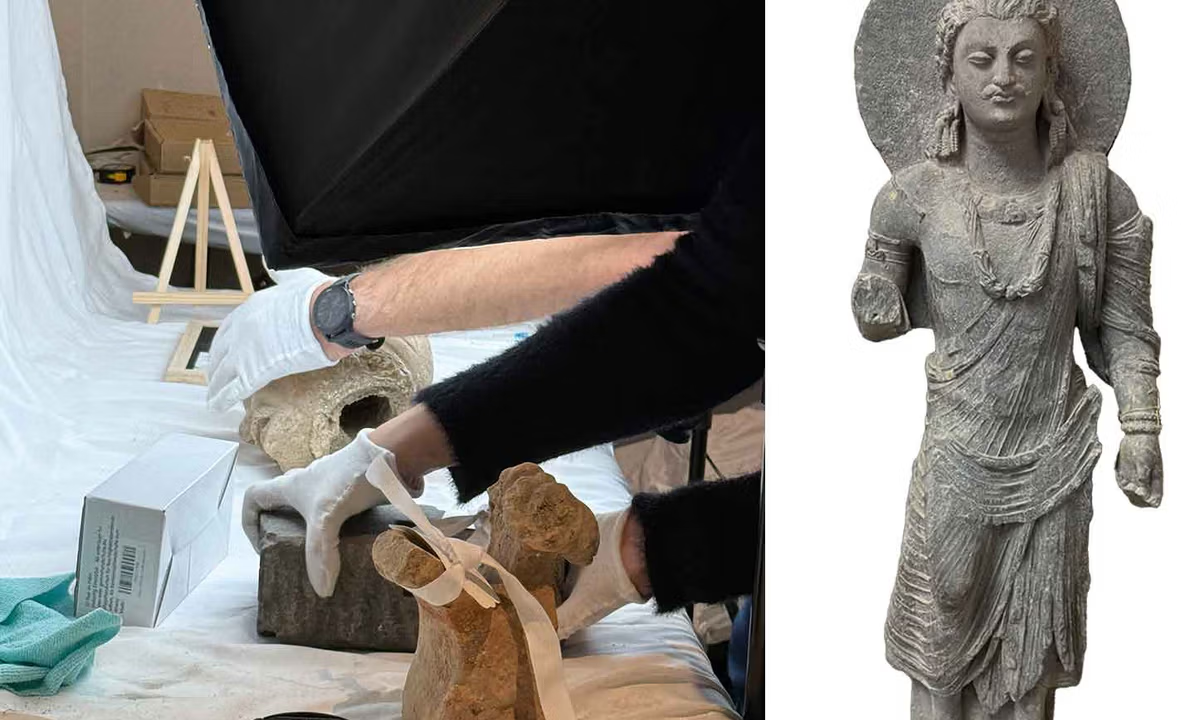
There were too many recovered objects to fit inside the London Metropolitan Police’s (the Met) processing room. Boxes were carefully rolled in and out by experts, one by one revealing statues, frieze fragments, frescoes, chainmail armour, stucco heads and more. The Met had called in a global team of specialists to sort and identify them, and The Art Newspaper was invited to witness the process up close.
Two days of meticulous labelling, forensic analysis, crime-scene photography and a preliminary archaeological assessment resulted in 323 pieces being logged by the Heritage Crime Task Force (HCTF), which was set up by the Organisation for Security and Co-operation in Europe (OSCE).
Cameron Walter, the head of the HCTF, says initial findings suggest a Shiva statue may date to the Angkor Period of the Khmer Empire (9-15th century) in Cambodia, alongside ceremonial bronze objects from the same era, and a large Bodhisattva statue and several other objects may originate from the Gandhara region of Pakistan and Afghanistan. Other artefacts could be from the Indus Valley civilisation (3300-1300BC), while wooden decorative elements may have come from a mosque in Syria or Iraq.
“Analysis and research is ongoing and we are also of course looking into the possibility of forgeries,” Walter says, noting that traffickers sometimes introduce fakes to “muddy the background”, generate extra revenue and make law enforcement’s job harder.
The Met first learned of the items in the summer, when detective constable Sophie Hays of the Art and Antiques Unit took a call from an individual offering to hand over artefacts in his possession—some of which he had kept for over a decade. Even to a seasoned detective, the scene she encountered was startling: countless objects scattered across shelves, boxes and even plastic bags. Officers declined to give further information about how the individual, who is not under arrest, came to possess so many artefacts, noting only that they aim to encourage people to hand over stolen cultural property so it can be returned to its rightful owners.
A shift to criminal networks
Hays’s unit is one of the Met’s oldest, formed in 1969 to tackle violent robberies targeting high-value stamp collectors. As London grew into the world’s second-largest art market—worth more than $10bn and accounting for 18% of the global market—the unit’s focus shifted to criminal networks exploiting vulnerabilities, says Detective Sergeant Mark Hoddinott, the head of the unit. Today, the unit consists of two full-time detectives led by Hoddinott.
Faced with a vast trove of potential antiquities, the team concluded that assessing authenticity and origin required extensive specialist expertise. To avoid diverting detectives from other investigations, they called in the HCTF at the OSCE, the world’s largest regional security organisation with 57 members states, including the UK.
Hays says the HCTF moved quickly. By November, when the objects were formally handed to the Met, HCTF specialists were at their side to assist. “This part really is the beginning, there is so much to do,” Hays says. “The hard stuff is to come.”
“What’s happening now is a joint investigation for repatriation purposes,” Walter says, adding that further experts will be brought in over the coming months to trace the objects’ origins using standard heritage-forensic methods, including tool-mark examination and soil, flora and fauna analysis.
The HCTF began in 2016 as a pilot project, Walter says, aimed at getting law enforcement agencies and heritage institutions to recognise the scale of cultural property trafficking and “just to get those agencies to talk to one another”. Its success led to it becoming an official OSCE programme in 2021, now with 80 officers from 46 countries and organisations. Designed to help participating states strengthen their ability to tackle art and antiquities trafficking and its links to organised crime, terrorism and money laundering, members have, over the past three years, seized more than 3,400 objects valued at over €150m ($175m). “The requests for assistance are going up,” Walter says.
Alongside rapid-response work, such as the London case, the task force prioritises regional capacity-building by training diverse groups, from law enforcement and military personnel to prosecutors and heritage professionals.
Special Agent David Keller of US Homeland Security Investigations (HSI), a member of the task force since its early days, says the training is essential and has directly contributed to saving cultural property.
In February 2023, Keller led HCTF training in Bulgaria on cross-border intelligence partnerships for art and antiquities counter-trafficking, which included frontline Ukrainian officers. Just months later, the same Ukrainian State Border Guard Service intercepted an attempt to smuggle 18 artworks—a success they attributed to the training.
The US is the largest art market in the world and combating illicit trafficking of arts and antiquities and repatriating stolen items remains a major concern. It has been “an obsession” for Keller since 2010, he says. Now one of HSI’s primary cultural heritage experts, he says the HCTF’s global pool of specialists has significantly contributed to the speed and quality of investigations.
In 2024, a California case involving a marijuana grower led to the discovery of around 1,000 artworks, antiquities and cultural objects in his possession. Keller faced the daunting task of identifying them. “The first painting I unwrapped was a sketch by Egon Schiele,” he says. Within two days, HCTF experts from around the world were online helping to identify Roman and Egyptian pieces, works by Gustav Klimt, Andy Warhol and more. “We had probably about 40 or 50 people online,” Keller says. While the Schiele sketch was quickly confirmed as a legitimate purchase, provenance issues were uncovered with other items.
Sharing theft information
Vernon Rapley, the chair of the Icom International Committee for Museum Security and former head of the Met’s Art and Antiques Unit, is another key trainer. He focuses on information sharing—an area he says both law enforcement and heritage professionals often struggle with. He stresses the importance of quickly and openly circulating details of stolen items.
“It might sound really obvious, but actually isn’t commonly done,” he says. Museums and heritage sites, especially in conflict areas, are often “shy” about reporting thefts, fearing reputational damage or exposing vulnerabilities. “Some don’t have a choice, like the Louvre, and you can see what happens, the media get all over it, and basically tell the world that the Louvre is a pushover and easy to steal from,” he says. However, open circulation increases the chances of recovery.
A box containing statues and friezes. All items have to be carefully unpacked, meticulously photographed, examined, logged and repacked for further analysis
Photo: Sarvy Geranpayeh
The HCTF’s awareness-building, Rapley adds, has also linked museum professionals with frontline investigators in Ukraine and prompted more institutions to prepare for war scenarios and emergency evacuations. He has assisted London’s Victoria & Albert Museum with wartime planning and is currently advising another museum.
Yet even with improved training and international co-ordination, Walter says a major obstacle remains a lack of regulation that allows illicit objects to reach the market. He argues that stronger international rules could help close these gaps. The EU regulation 2019/880, fully implemented in June 2025, is a step in that direction, requiring import-export registration and more demanding documentation for cultural property.
“The new regulation will make it much more difficult for illicit cultural artefacts (of non-EU origin) to enter the EU market,” says Emily Gould, the assistant director of the Institute of Art and Law and a lecturer at Queen Mary University of London. However, Gould cautions that it may push trade underground or into other unregulated markets, and that its full impact remains to be seen. Although the law does not apply to the UK, it covers Northern Ireland. “It’s
possible that trade which might have gone through the EU might now come to the UK instead,” she says.
Gould notes that prosecutors need to meet a high burden of proof, including “proving dishonesty and knowledge that the artefacts are stolen and this can prove very difficult in practice”.
Hoddinott favours making civil remedies faster, cheaper and simpler overnew criminal laws. He says items are often held by people who purchased them in good faith or inherited them. While his unit will not hesitate to prosecute those who deliberately exploit the art market, he stresses they are open to working with people who “want to do the right thing”, and encourages anyone who may be in possession of stolen cultural heritage to contact the police.
Once the London items are formally identified, the process of returning them to their countries of origin will begin—and can take time, depending on the state involved. But, Hays says, “as a police officer, there is no greater feeling than returning cultural property.”
