






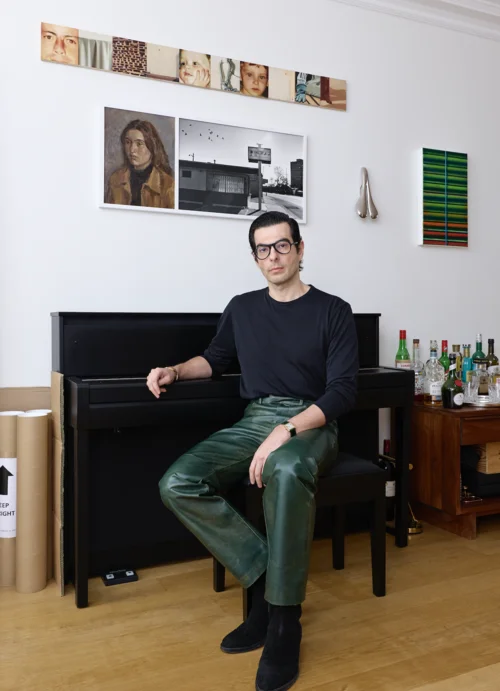

When Dr. Dimitrios Tsivrikos walks into someone’s home for the first time, he looks at the walls.
“You know how people say that when you start dating someone, you go to their home and look at their bookshelf?” he told Artsy. “I do the same with art, and it doesn’t need to be expensive. It could be a poster. What matters is how someone enriches their environment visually and emotionally.”
Art and psychology are part of the same inquiry for Tsivrikos, an academic psychologist at University College London (UCL), founder and director of London-based gallery and advisory The TAGLI, and an avid art collector. Both fields for him ask the same question: what moves us, and why?
“I have always been fascinated by the relationship between the visual and the emotional, and how those experiences triangulate with who we are, how the information around us influences us, and how those stimuli make us feel,” he explained.
Raised in Thessaloniki, Greece, he was drawn early to the visual world and, eventually, to the question of what aesthetic experience does to us. “I was interested in whether those [artistic] interactions are beneficial to us or simply random,” he said. “Whether something is just aesthetically pleasing, or whether it actually offers emotional enrichment.”
For Tsivrikos, art is more than something to admire or acquire; it is a way of understanding identity, emotion, and the environments people build around themselves. Living with art, for him, can deepen self-knowledge, shape feelings, and widen access to culture.
How psychology led Tsivrikos to art collecting and curation
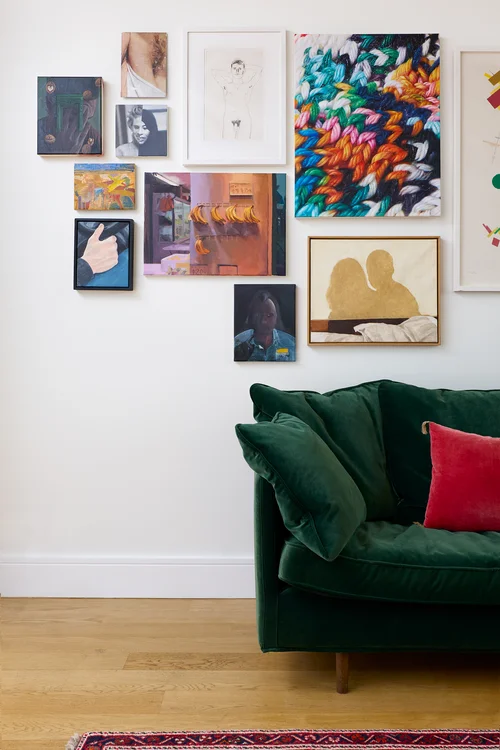
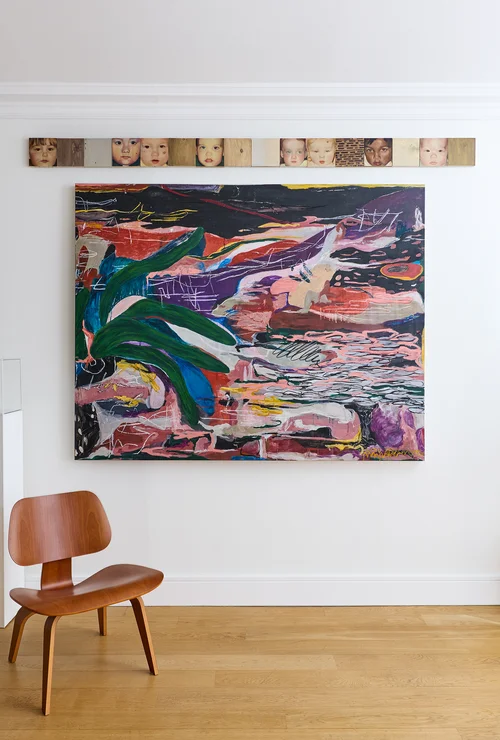

Tsivrikos came to London to study, eventually earning his PhD and building a career at UCL. Many of his friends were at art school, and he spent his spare time in studios, at openings, and in galleries across the city. “I was not talented enough to be part of that ecosystem [as an artist], but I was always around it,” he recalled.
Collecting became his way of staying close to the creativity he admired. Over time, that exposure became expertise, and expertise became a wider mission: to support artists and widen access to art.
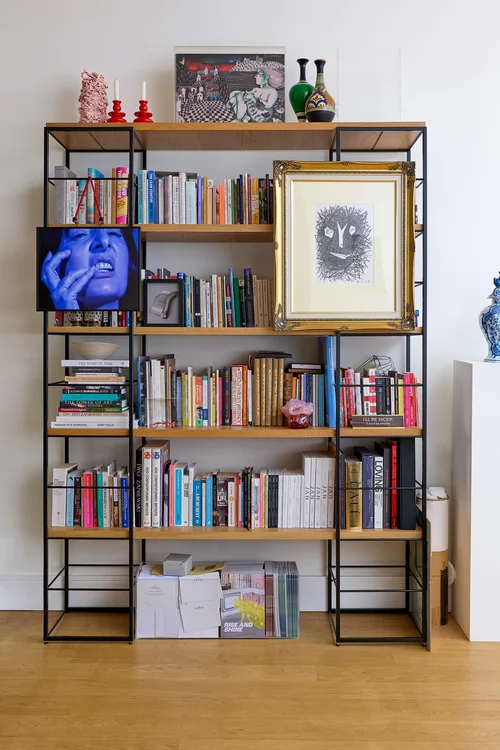
In his home, works by artists across generations commingle. Works by Charlotte Colbert, Pablo Picasso, and Ju Young Kim bring together inquiries into the fractured self and the unconscious. This conversation shifts entirely, though, when presented near paintings by Tristan Pigott, David Hockney, and Tai-Shan Schierenberg, who together make the collection’s more figurative works. Works by Holly Hendry introduce a biological undercurrent wherever they are placed, whilst Vietnam-born artist KV Duong’s latex paintings, meanwhile, introduce a very different kind of surface tension through his exploration of queer identity politics.
Tsivrikos regularly rotates the work on view. “Works speak to each other differently depending on what they are paired with, just like we are slightly different people with different groups of friends. The environment shifts the conversation,” he said.
His curatorial sensibility is informed partly by his master’s degree in curation, but also by a psychologist’s understanding of how environment shapes mood, behavior, and identity. In many respects, curation is a form of applied psychology.
Why living with art can change how we feel
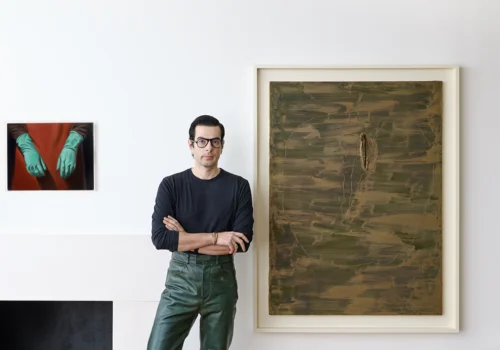

That perspective informs how Tsivrikos thinks about art as a way of understanding ourselves and others. His advice for anyone curious about their own relationship with art—or someone else’s—is straightforward. “Go on a date in a museum,” he advised. “Ask each other about artwork. The way someone describes an artwork, the lenses they use, and the emotions they express. It is such a beautiful entry point into who they are, how they perceive the world, what they dream about.”
That perspective comes through most clearly when he speaks about the works he lives with. Asked which piece resonates most, he points to a small painting titled Resurrection by the Scottish artist Ken Currie. Roughly the size of his torso, it shows two blue, disembodied gloves gravitating downwards, entering into the pictorial field. The gloves could belong to a surgeon or a fisherman; he likes the ambiguity. “It is almost like deus ex machina,” he said. “Two arms coming through to save someone.”
He added: “For me, as a psychologist, human relationships often function like that—someone stepping in to help, to resolve a situation.” The work resonates not just visually but psychologically. There is no gender, no face, no context in the Currie painting. “These two hands are agents of action, of change,” he said.
Tsivrikos compares the painting to Lucio Fontana’s notion of tagli—cuts that open new dimensions, often on canvas. His gallery takes its name from that gesture, and is built around a similar idea: that art should cut through, create depth, and shift perspective.
What Tsivrikos looks for as a collector and advisor
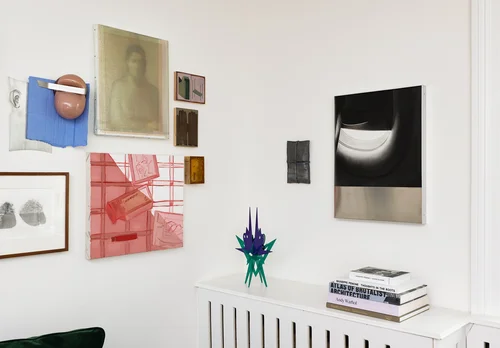

Tsivrikos is less interested in the value of art than in the response it elicits. “I’ve always felt that art is an asset,” he said, “but primarily a cultural and emotional asset rather than a financial one.”
That conviction shapes how he collects. First, the work must resonate. He is drawn to materiality and to Arte Povera, for instance, with its integration of raw surfaces and political charge. Second, he wants to know the artist. “I do not believe artists are responsible for defining the narrative of their own work,” he said. “But I enjoy hearing their perspective. They have done the hard job of creating something. The work then lives in the hands of the public, institutions, and collectors. We each bring our own meaning.”
Third, the work must make him feel something. “That feeling does not have to be positive,” he told Artsy. “It can be anger, discomfort, curiosity, joy. I am not looking for a pseudo-euphoria of constant happiness. I am looking for emotional engagement…There needs to be some emotional friction, something that presses a button.”
His recent acquisitions reflect this range of emotional registers, including sculpture by German artist Alexandra Bircken, valued for “the lightness and symbolism in her sculpture,” which sits alongside a vibrantly colored painting by Tommy Harrison from a recent show at GRIMM Gallery. “His work is full of color and vibrancy. The whole show, curatorially, moved me.”
Why Tsivrikos believes art belongs in everyday life
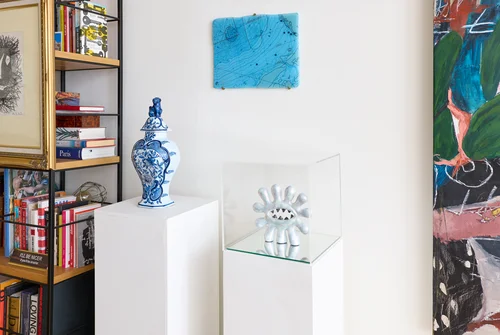

For all his enthusiasm, Tsivrikos is realistic about the barriers to art. “It would be a lie to claim the art world is accessible. It is not, but we’re improving,” he said. “The idea that art should only live in institutions or museums is extremely elitist. Art grows through interactions, conversations, and the everyday presence of people encountering it.”
For Tsivrikos, the choices we make about what surrounds us shape who we become. Art is a form of self-knowledge: “I see collecting art as assembling a kind of puzzle of who we are at particular moments, as reflected by the works we bring into our lives,” he said. “Art helps us live better.”


