


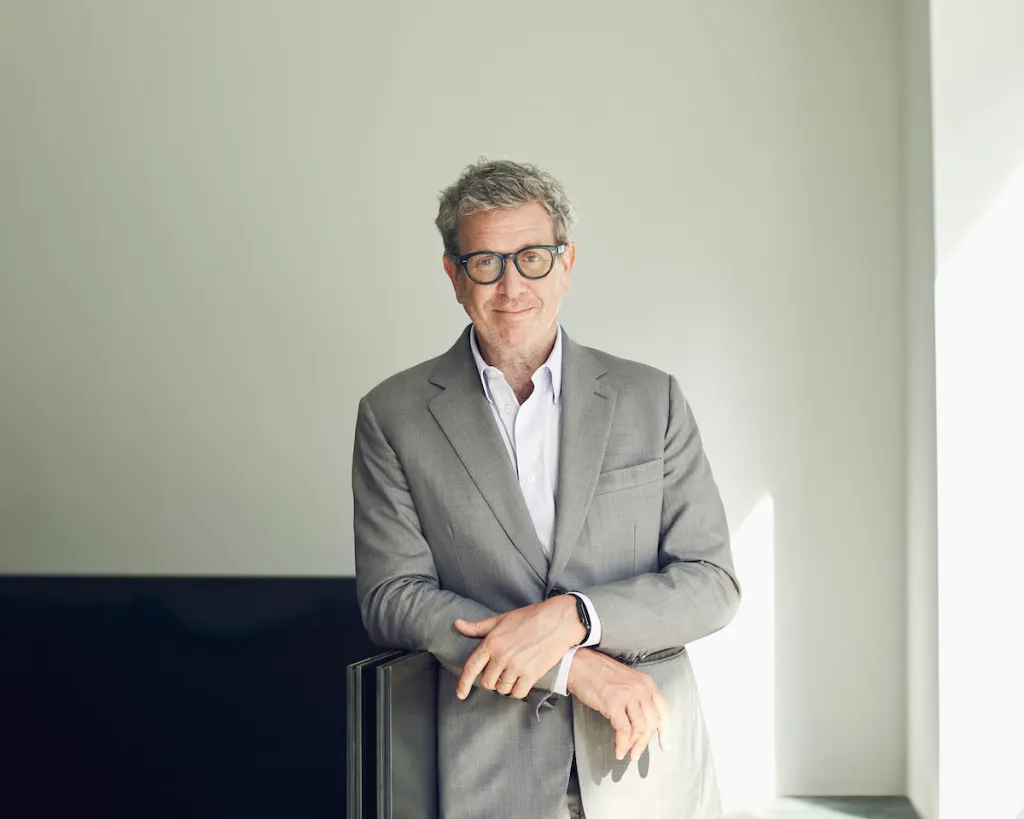
Pace Gallery, a mega gallery with seven locations worldwide, is laying off some 50 staff and dropping about 50 artists.
In a statement to ARTnews Thursday, CEO Marc Glimcher said that the gallery will now focus its roster on 85 artists, after growing to 135 and will “continue to be a global gallery” with plans to “ground their programs in the character of the local art scene.”
“Galleries need a model correction,” he said. “For Pace, this means returning to our roots, recentering and reasserting our historic mission: We’re going back to the future, connecting younger artists to their spiritual fathers and mothers, focusing on a group of around 80 artists, which represents an intergenerational mix of new and established artists and estates.”
The news of the layoffs was first reported by the New York Times on Wednesday night. However, sources at Pace told ARTnews that the Times story ran early, before the gallery had actually conducted the layoffs, leading to confusion amongst gallery staff. A town hall is planned for 9 a.m. Thursday morning.
In the Times story, Glimcher blamed an art system that has become “too big, too commercial, too impersonal, and too corporate.” “We all know it’s true,” he went on. “But you actually have to do something to adapt to it. You have to make some substantial changes.” An accompanying photograph shows Glimcher holding the viewer’s gaze, his right hand outstretched on the desk, clenched in a tight fist.
It is not clear which artists have been dropped, and gallery has not released a list of those it will no longer represent. The roster will be cut by about 30 percent. Staff cuts will amount to a roughly 20 percent reduction to 200 from about 250.
Some artists now missing from those listed on the gallery website include Keith Coventry, TeamLab, John Gerrard, and Glenn Kaino. The latter spoke to the NYT and did not seem surprised by the news, which follows industry speculation about the gallery’s finances. “It’s been clear to me for a while that their model was optimized for a vision of the art world that never materialized,” Kaino said in an email.
Pace’s downsizing comes after several years of market contraction driven by economic and global uncertainty, high interest rates, Trump’s trade war, and conflicts in the Middle East and Ukraine. Numerous long-standing galleries closed in 2025, most prominently Blum, who collaborated with Pace on some artists and who also blamed the current gallery system.
In an interview with ARTnews, Glimcher said the cuts were not simply a response to a weaker market, but an attempt to break what he described as a self-reinforcing cycle of rising costs and rising prices. Pace has generally avoided the aggressive price hikes seen elsewhere in the market, he said, but galleries with large overhead face mounting pressure. “If you’re not super responsible about your operating expenses and the overhead of your business,” he said, “the overhead of your business will force you into that loop. If you don’t pay attention to it and just let rampant competition and thoughtlessness drive your business strategy, that’s the spiral.”
Arne Glimcher, Pace’s founder, who turned over the business to his son, Marc, in 2010, has long criticized the inherent flaws in the model of the “mega” gallery, marked by a constant need to expand operations, set up shop in multiple cities, and take on large numbers of artists.
Those smaller, more nimble operations in Berlin and Asia, along with Arne Glimcher’s project space 125 Newbury, that helped inspired the decision to slow down the gallery’s commercial velocity. Pace’s newer spaces in Berlin and Tokyo, rather than serving as satellites of New York, have developed programs tailored to local audiences and collecting communities, according to Glimcher, who added that the gallery plans to lean further into that strategy. The goal is to allow each location to develop a stronger regional identity while remaining part of a global network and creating clearer connections between Pace’s contemporary artists and the estates that have defined the gallery for decades. Glimcher framed this change as a focus on shared artistic lineages and influences across generations.
Glimcher argued that the changes should not be viewed as a rejection of the gallery’s long history of expansion and experimentation. “Our constant searching should not be confused with this phenomenon of getting too big and getting too corporate,” he said, describing that searching as “100 percent the legacy of my father.” The issue, he said, was not ambition but the overhead required to sustain the mega-gallery model.
As ARTnews reported in 2023, Pace scooped up more than a dozen artists over roughly a 12-month period between 2022 and 2023, who also ranged significantly in stature. Last month, the gallery announced it would represent the estate of Constantin Brancusi, and in March, added artist Anicka Yi was joining their roster. Glimcher noted the gallery would continue representing new artists, and that it was holding onto its newly renovated flagship headquarters on Chelsea’s West 25th Street, which reportedly costs about $9 million in rent per year, for a 20-year lease.
Last year, the gallery also joined forces with dealers Emmanuel Di Donna and David Schrader to create the new Pace Di Donna Schrader Galleries (PDS), a collaboration that will continue, and which is debuting at Art Basel this month. At the time, Glimcher told ARTnews in an email: “The obsession with competition has gotten us into a low margin, high overhead arms race that benefits neither the artists nor the clients.” As an alternative, “Pace, Di Donna, and David have pioneered a collaborative model which embraces the art world networking relationships. That’s the future.”
The changes at Pace will necessarily mean fewer exhibitions and fewer art fairs. “Definitely less shows, period, everywhere,” Glimcher said, “there is only so much you can do if you want to do it well.” He added that Pace had become stretched across too many projects and events. Asked about calls during the pandemic for galleries to scale back their fair schedules, Glimcher laughed at his own role in the debate. “That was me,” he said. “And what did I do? Went back to doing all the same stuff I was doing before.” Now, he said, “I am finally making good on it.”
While Pace has not released a list of artists cut from its roster, the following artists, who appeared on their February 2026 artists page, have since been removed:
Richard Avedon
William Christenberry
Keith Coventry
Tim Eitel
john gerrard
David Goldblatt
Paul Graham
Kevin Francis Gray
Hai Bo
Hong Hao
Virginia Jaramillo
JR
Glenn Kaino
Nina Katchadourian
Acaye Kerunen
Grada Kilomba
Josef Koudelka
Liu Jianhua
Damian Loeb
Rafael Lozano-Hemmer
Hermann Nitsch
Robert Rauschenberg
Paolo Roversi
Keith Sonnier
Sui Jianguo
Jiro Takamatsu
teamLab
JoAnn Verburg
Brent Wadden
Xiao Yu
