


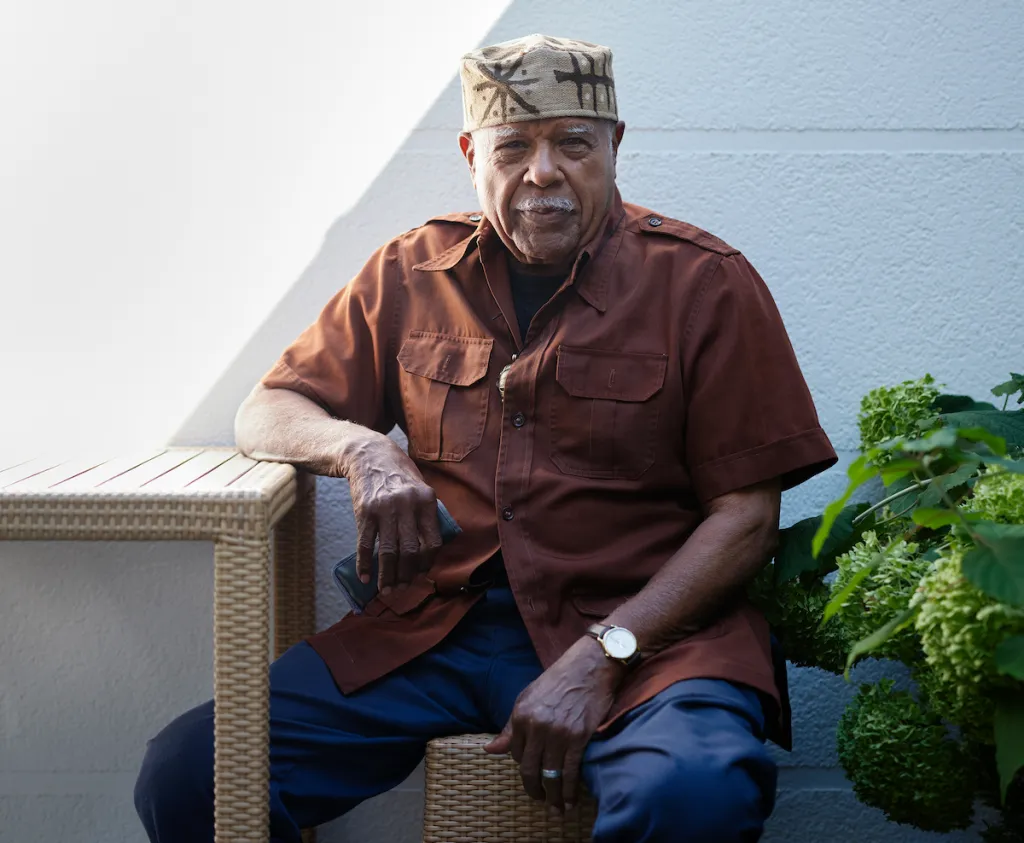
Melvin Edwards, a sculptor whose assemblages of welded steel and barbed wire nodded toward centuries of violence and reframed the visual language of Minimalism, died on Monday in Baltimore. He was 88, according to his gallery, Alexander Gray Associates, which said in its obituary that he died peacefully, in the presence of his wife, Diala Toure.
Edwards remains best known for his “Lynch Fragments,” a body of work he began producing in the 1960s. Working primarily with found steel objects, Edwards created masses of hooks, chains, and beams, some of which were abstracted beyond recognition. His titles—both of the series overall and of the individual works within the series—tended to be forceful, referring to anti-Black violence, Malcolm X, African cultures, and even American-led wars in Vietnam and Iraq.
Many of the “Lynch Fragments” are unsettling. They variously show dismembered limbs, crumpled bodies, and hanging corpses. The weight of their materials conjures a sense of danger, and Edwards’s repeated use of chains calls to mind histories of enslavement and incarceration.
But Edwards was also specific about the fact that the “Lynch Fragments” are not always dark. He once said that his chains were also “symbolically chains of kinship, linkage. The problem is not the chain; it’s how people use it.” And he also said that he intended for the works to contain a certain “human physical intensity,” deliberately hanging his sculptures on museum walls at eye level, “so that it’s about the same place you run into a human head.”
These works and others by Edwards influenced both his colleagues and multiple generations of artists who came after them. Sculptor David Hammons credited Edwards with teaching him about the possibilities of abstraction. Speaking of a work shown in Edwards’s 1970 Whitney Museum show, Hammons said, “That was the first abstract piece of art that I saw that had culture value in it for black people.” That show made Edwards the first Black sculptor ever to have a show at the Whitney.
Melvin Edwards, North and East, 1992.
©2026 Melvin Edwards/Artists Rights Society (ARS), New York/Courtesy Alexander Gray Associates, New York, and Galerie Buchholz, Berlin
In a key essay for ARTnews, painter Frank Bowling lauded that same exhibition for “its wit, in the tradition of Duchamp,” adding, “The elegance and deliberately loose-hanging serial geometry were a sure cover for painful implications. The fact that so many critics missed the point is a lesson in the separation of white from black.”
While Edwards has always been a guiding light for Black artists, with the Studio Museum in Harlem staging his first retrospective in 1978, international fame eluded him for decades. (Mary Schmidt Campbell, the Studio Museum’s director at the time, recalled the show receiving “almost no attention” whatsoever in the press.) He did not have a commercial gallery exhibition until 1990, more than 30 years after the start of his career.
In the past two decades, however, Edwards has ascended to his rightful place in the canon. Following an appearance in art historian Kellie Jones’s 2011 exhibition “Now Dig This! Art and Black Los Angeles 1960–1980” at the Hammer Museum in Los Angeles, he received a survey in 2015 at the Nasher Sculpture Center in Dallas, with Catherine Craft serving as its curator. The Dia Art Foundation staged a presentation of Edwards’s work of the 1970s in 2022, and Naomi Beckwith, a curator at work on the forthcoming edition of Documenta, organized another Edwards survey in 2024 that visited the Fridericianum museum in Kassel, Germany, and the Palais de Tokyo in Paris.

Melvin Edwards, Agricole, 2016.
©2026 Melvin Edwards/Artists Rights Society (ARS), New York/Courtesy Alexander Gray Associates, New York, and Galerie Buchholz, Berlin
Despite this sudden interest in his art, Edwards, who took on teaching jobs throughout his career to make a living, had long been focused on cementing his own legacy. Asked by his friend, the painter William T. Williams, about his role as a role model to young artists, he once said this was his advice: “Just be one. And if possible, be an old one.”
Melvin Edwards was born in 1937 in Houston. One of four children, Edwards was raised in poverty in the city’s Fifth Ward, a historically Black neighborhood. He recalled vivid memories of his mother sewing and his father, a worker for an oil company, fashioning a knife. “To me … it was magical that he made a knife,” Edwards said. “I thought a knife was something magical that you bought.” The city was segregated, but Edwards said he did not realize this—he spent so much of his childhood ensconced in Houston’s Black community that “I didn’t know there was a white community,” as he said in an oral history for Bomb.
Melvin Edwards with his sculpture Column of Memory, 2005.
©2026 Melvin Edwards/Artists Rights Society (ARS), New York/Courtesy Alexander Gray Associates, New York, and Galerie Buchholz, Berlin
In 1944, after his father took an executive position with the Boy Scouts administration, becoming the first Black person ever to do so, Edwards and his family moved to Dayton, Ohio, where he visited his first art museum and lived in a housing project. But his father’s Boy Scouts job ended after what Edwards described as a “falling out,” and the family moved back to Houston in 1949. He attended an all-Black high school, then moved to Los Angeles, where he took a scholarship to study painting and play football at the University of South California.
The year 1960 marked a turning point for Edwards, who in a 12-month span married his first wife—Karen Hamre, also an art student at USC, with whom he had three children prior to their separation in 1969—and learned how to weld steel. That year was also one of consciousness raising for Edwards, who participated in protests over housing and began reading publications such as Liberator and Freedomways, which reported on topics such as lynchings.
Influenced by his high school job as an employee in the meat department of a Houston supermarket and his work at the Los Angeles County Hospital in the early ’60s, Edwards began to conceive his “Lynch Fragments,” which were made from scavenged steel. “Once I started to weld steel,” Edwards said in an interview for his Nasher show’s catalog, “I realized how much of the world I lived in is welded.” Later, in a 2021 New York Times profile, Edwards would go on to say that he was “working in the tradition of blacksmiths and metalworkers.” His great-great-grandfather, after all, was trained as a blacksmith in Africa before he was enslaved and taken to the US.
Melvin Edwards, Some Bright Morning, 1963.
©2026 Melvin Edwards/Artists Rights Society (ARS), New York/Courtesy Alexander Gray Associates, New York, and Galerie Buchholz, Berlin
The first “Lynch Fragment,” a sculpture called Some Bright Morning (Lynch Fragment), was completed in 1963. With a name referencing a quotation from Ralph Ginzburg’s 1962 book 100 Years of Lynching, the piece features a chain that extends across a sharp triangle of steel. It’s a piece that feels imposing, despite the fact that it stands just over a foot tall.
Edwards’s “Lynch Fragments” expanded in size, with Chaino (1964), a hunk of steel suspended by chains inside a rectangular armature, running eight and a half feet long. (The title puns the first name of Chano Pozo, a Cuban percussionist whose music expanded the influence of African sounds and ideas to Latin America.) But for the most part, Edwards’s sculptures resisted the pressures of working on an expanded scale, something that became a staple of Minimalist art around the same time.
Edwards moved to New York in 1967 and engaged with Minimalist art firsthand, helping Robert Grosvenor install one of his monumental pieces at the Jewish Museum. Certainly, Edwards’s barbed wire pieces of the ’70s recall the work of artists like Richard Serra and Robert Morris, who likewise used industrial materials to reorient how viewers experienced the gallery space around them. With these works, Edwards ran strips of wire across corners and walls, creating areas that could not be inhabited by viewers. But Edwards’s pieces were not just formalist experiments, with his wire directly referring to real-world violence. (A version of these works formed part of Dia’s four-year installation of Edwards’s art.)
Melvin Edwards, Felton, 1974.
©2026 Melvin Edwards/Artists Rights Society (ARS), New York/Courtesy Alexander Gray Associates, New York, and Galerie Buchholz, Berlin
During the ’70s, Edwards became increasingly engaged in his politics. In 1971, he pulled out of a Whitney Museum survey of Black American art, signing a blistering Artforum statement written by John Dowell that called the show a “waste of time, energy and life” because it “negates a coherent viewing and analysis of the creative content, context, influence, and general value of the works of African American artists.” And starting in 1970, he began his repeated visits to Africa, something he would continue through the end of his career. At the time of his passing, his CV listed Dakar, Senegal, as a base alongside studios in Plainview, New Jersey, and Accord, New York.
Melvin Edwards, “Look through minds mirror distance and measure time” – Jayne Cortez, 1970.
©2026 Melvin Edwards/Artists Rights Society (ARS), New York/Courtesy Alexander Gray Associates, New York, and Galerie Buchholz, Berlin
Edwards married poet Jayne Cortez in 1975 and remained with her until her death in 2012. Together, in 2000, they purchased the Accord home, which was big enough for Edwards to work on his large-scale sculptures. Edwards subsequently retired from his longtime teaching position at Rutgers University in New Brunswick, New Jersey, and spent much of his time in Accord, producing his art largely without the help of assistants.
Doing so seemed in keeping with his career-long use of art as a form of self-exploration. In a statement that accompanied his 1970 Whitney show, he said, “I am now assuming that there are no limits and even if there are I can give no guarantees that they will contain my spirit and its search for a way to modify the spaces and predicaments in which I find myself.”
