


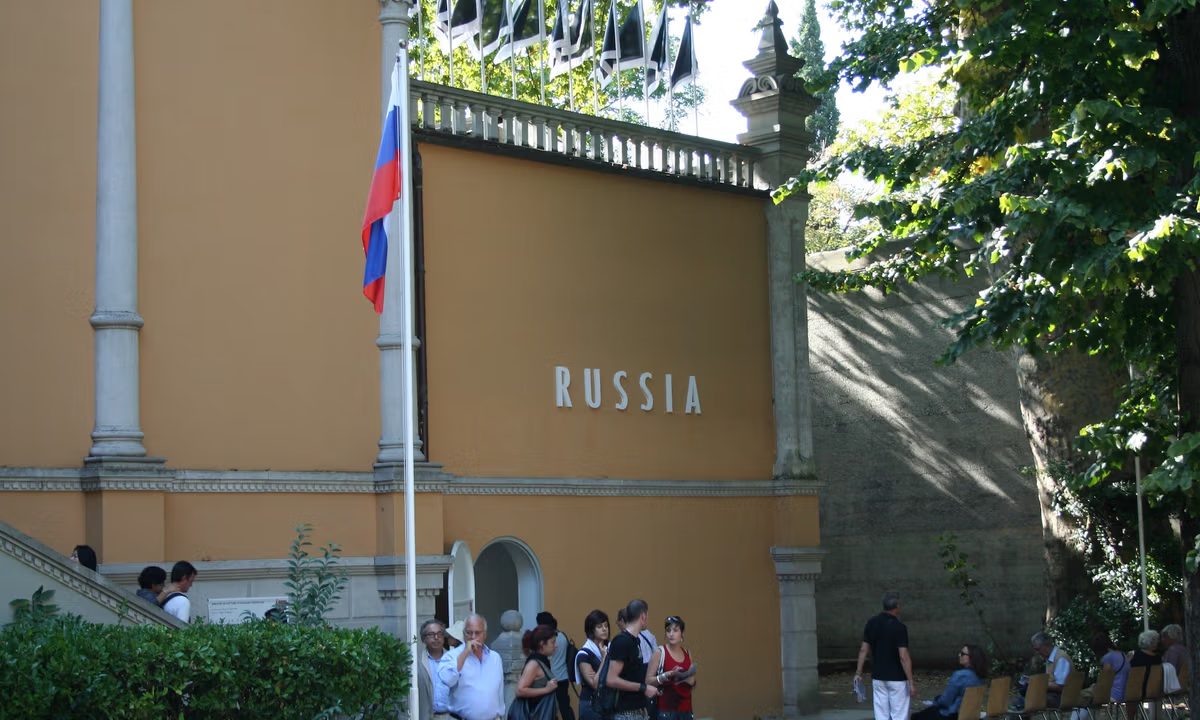
At least 34 members of the European parliament have signed a letter demanding the suspension of “all European Union funding to the Venice Biennale Foundation should Russia’s participation proceed”. The letter, obtained and published on 26 March by Politico, shows 34 signatories, but the publication reported that 37 MEPs have signed it.
Addressed to EU president Ursula von der Leyen, foreign policy chief Kaja Kallas, and the foreign minister of the Republic of Cyprus Constantinos Kombos, it warns that “under no circumstances should Russia, a state subject to extensive European Union sanctions on trade, goods and services, be permitted to participate in an event financed by European taxpayers’ money”. It adds that “the Russian pavilion must likewise not be used for any activities organised by Russia, whether in physical or digital form”.
The parliamentarians conclude their letter with a warning that Russia’s presence in Venice will weaken the EU and betray Ukraine. “Every day that Russia’s pavilion remains on the programme of the Venice Biennale is a day the European Union’s credibility is weakened,” they write. “Every euro of EU funding that flows to an institution hosting that pavilion is a contradiction in terms. The Ukrainian people, who are fighting and dying for the values this union was built upon, deserve better than ambiguity.”
Mikhail Shvydkoy, Vladimir Putin’s international cultural envoy, announced earlier this month that the Russian pavilion will present a programme, heavy on folk and world music. It would be the first time Russia has participated in the Venice Biennale since the country launched its full-scale invasion of Ukraine in 2022.
The announcement set off widespread outrage and opposition, including a letter signed by 22 European culture ministers and a statement by the EU’s commissioners for in charge of technology and culture, Henna Virkkunen and Glenn Micallef, who first threatened suspension of the EU’s grant to the Biennale, which according to the Financial Times amounts to €2m. On 24 March, after Russia targeted the Unesco-protected centre of Lviv in western Ukraine in a massive drone strike, Ukraine’s foreign minister Andrii Sybiha called on the Biennale’s organisers to acknowledge “the ugly face of barbaric Russia”.
Plans for the Russian pavilion, titled The tree is rooted in the sky, have been described as a musical festival to be held outside the landmark structure in the Giardini before the official opening of the Biennale, which will subsequently be shown as a projection inside the pavilion for the duration of the Biennale.
In 2022, when the Venice Biennale opened just two months after Russia’s war on Ukraine began, the Russian pavilion remained closed after the curator and artists cancelled their participation. For the 2024 biennale, Russia loaned its pavilion to Bolivia.
The dissident art collective Pussy Riot has said it will protest the Russian pavilion if it goes ahead this year. One of the group’s founders, Nadya Tolokonnikova, revealed some of its plans in an interview published on Friday in Meduza, a Russian-language news site based in Riga, Latvia. She said that “several major collectors, curators and artists from other pavilions” want “to participate in our action,” which she compared to Pussy Riot’s protests at the 2014 Winter Olympics in Sochi, which is near Putin’s seaside residence.
“It will be a protest action with an artistic component,” Tolokonnikova said. “I’m hoping there will be slightly less of a physical beating involved this time around than there was [in 2014]. After all, we won’t be in Russia, which certainly simplifies our task—though the situation itself remains, in many respects, quite similar. The Venice Biennale is to the art world what the Olympic Games are to the world of sports.”
