


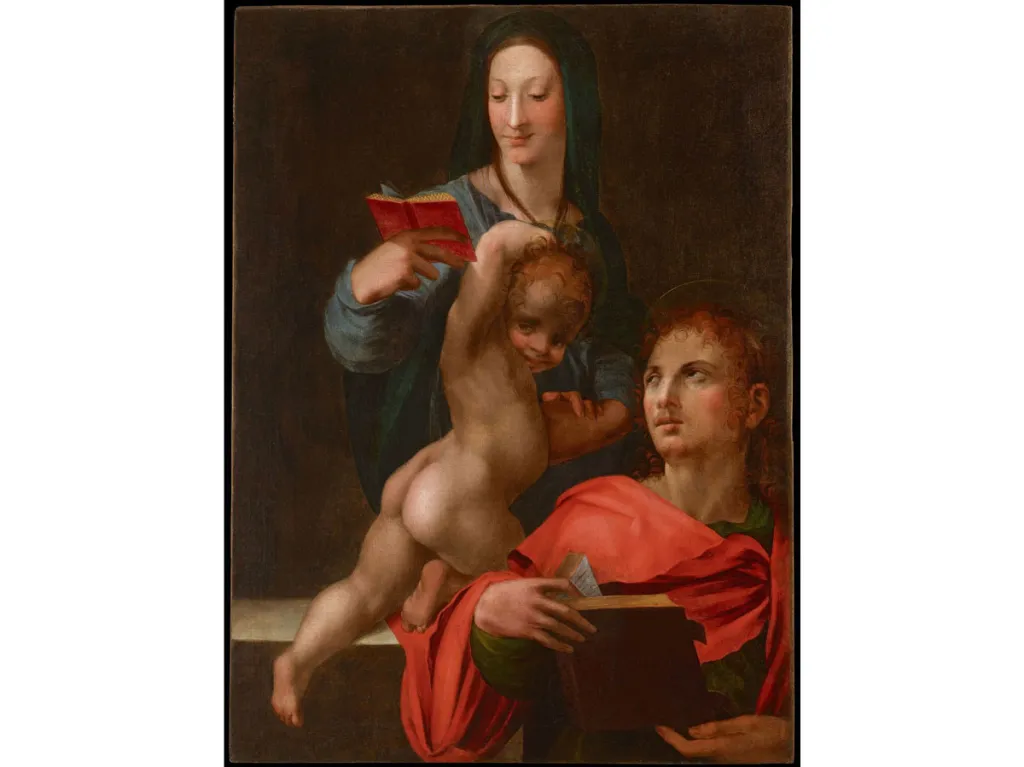
The Metropolitan Museum of Art in New York announced Thursday that it had acquired a recently rediscovered Renaissance painting of significant art historical importance.
Layers of paint were removed during a recent conservation to reveal the figure of Saint John the Evangelist in the canvas’s lower-right portion. With the overpaint now gone, the painting has now been identified as Madonna and Child with Saint John the Evangelist (1512/1513) by 16th-century painter Rosso Fiorentino. The painting’s attribution had previously been questioned, with some scholars assigning it to Rosso and others to a contemporary; it had also been dated to 1520 and titled Madonna and Child.
The Met has already put the work, which was believed to have been lost for centuries, on view in its European painting wing.
In his foundational text Lives of the Most Excellent Painters, Sculptors, and Architects, Giorgio Vasari, often credited as the first art historian, describes Rosso as having secured his first major commission, a fresco of the Assumption of the Virgin (1513) at the Chiostrino dei Voti at Santissima Annunziata in Florence by presenting the work’s patron, Fra Jacopo of the Servite Order, with “a painting of the Madonna and Child with a half-length figure of Saint John the Evangelist.”
“Paintings by Rosso are exceedingly rare, numbering only about two dozen, and many of his most celebrated works remain undocumented or unfinished,” Stephan Wolohojian, curator in charge of Met’s European painting department, said in a statement. “The discussion of this painting in Vasari’s Lives of the Artists, often described as the first book of art history, gives the work the added distinction of having been part of art-historical discourse since the discipline’s inception.”
Vasari called his and Rosso’s approach maniera moderna, or “modern style.” That term would eventually become Mannerism.
In typical Mannerist fashion, Rosso’s renderings of the painting’s subjects have exaggerated features. This is often seen as a response to, and in some cases even a critique of, the sense of harmony and proportion engineered by Leonardo da Vinci and Raphael during the High Renaissance. Though seemingly garish at first, Madonna and Child with Saint John the Evangelist has flourishes that appear intentionally off—for example, the coy smirk on the baby Jesus’s face and his extremely muscular butt.
“With his unusual placement of the figures and daring postures, Rosso transforms a familiar devotional type into a charged encounter that draws the beholder into a complex interplay of seeing, feeling, and believing,” Met director and CEO Max Hollein said of the rediscovered painting.
Giovanni Battista di Jacopo, who would later called Rosso Fiorentino, or “Florentine Redhead” for his red hair, was born in 1494 in Florence and enrolled in the artist guild Arte degli Speziali in 1517 when he was 23 years old. The following year, he would receive his breakthrough commission, the Santa Maria Nuova Altarpiece, from 1518. With that work, he would establish himself as one of the era’s most important Mannerist artists.
Little is known of the artist’s early life, though he spent the first decade of his career before moving to Rome and finally France, where he died in 1540, at 45. In France, he became a court painter to Francis I, establishing, with Francesco Primaticcio, the First School of Fontainebleau.
“This painting is a rare and pivotal early work by one of the most important painters of the 16th century, striking in its experimental ambition and psychological intensity,” Hollein added in his statement. “The rediscovery of this work reshapes our understanding of Rosso’s early oeuvre and the emergence of more expressive and dynamic compositions in 16th-century Florentine painting.”
