


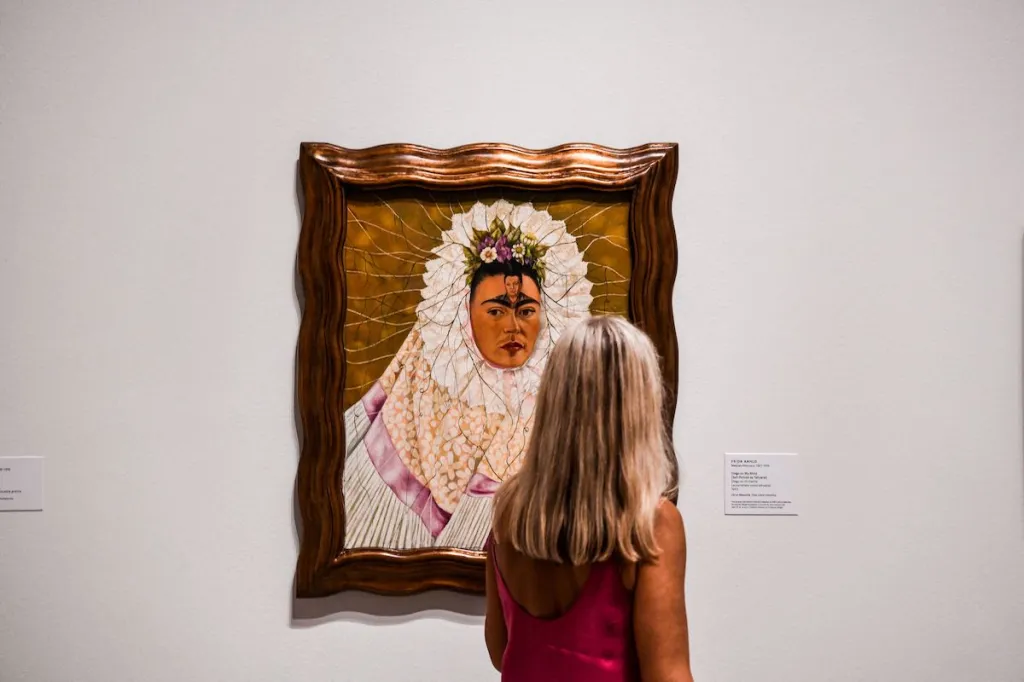
The Mexican government continued to face scrutiny this week over its handling of the Gelman Collection, a trove of artworks that includes an array of historically important paintings by Frida Kahlo and other artists of note.
Amassed by the late collectors Jacques and Natasha Gelman, the 300-work Gelman Collection partially resurfaced in the holdings of Spain’s Banco Santander in January, about a year and a half after the Mexican government claimed not know the whereabouts of the collection. Then the bank traveled the collection to Spain, a move that many in Mexico’s art world claimed was illegal, according to the country’s laws guiding cultural heritage.
After accusations that the Mexican government had been overly opaque about the terms surrounding the collection, Instituto Nacional de Bellas Artes y Literatura (INBAL), the organization that manages arts initiatives in Mexico, responded by saying that “public resources would not necessarily be sufficient for an acquisition of this magnitude.”
Amid controversy, Mexico said that the collection would come home in 2028. But the announcement appears not to have entirely quelled dissent surrounding the Gelman Collection.
Now, Defense of the Gelman Collection—a coalition of artists, critics, historians, and more that has repeatedly denounced Banco Santander and the Mexican state—once again reiterated its calls for a formal inquiry into the facilitation of the collection, saying on Wednesday that it had begun legal proceedings against both the bank and the government in a lengthy release.
In a letter to a Mexico City judge, representatives for Defense of the Gelman Collection called Banco Santander and INBAL’s actions “unconstitutional.” A representative for the group told ARTnews that this was “the first of several planned lawsuits.”
The group did not clarify the nature of those proceedings, instead using the release to reiterate its position that the Gelman Collection’s arrangement represented an uncomfortable mix of private and public interests. According to the group, the ordeal shows that “Mexico’s artistic heritage should be governed by the Constitution and the law rather than by administrative convenience or private financial interests.”
To back up that point, the group noted the importance of the Gelman Collection, which contains works by David Alfaro Siqueiros, Diego Rivera, Rufino Tamayo, and others. Just seven Kahlo works are owned by Mexico; 10 are in the Gelman Collection alone.
“Throughout this controversy an unmistakable contrast has emerged,” the group said. “On one side stand the Government of Mexico and one of the world’s largest financial institutions and powerful private interests. On the other stand historians, lawyers, journalists, artists, collectors and hundreds of ordinary citizens who possess neither political authority nor financial power. They have devoted countless hours to researching legal questions, examining public records, engaging with legislators, museums and cultural institutions, and explaining why this Collection matters. They have done so not because they expected recognition or reward, but because they believed that the rule of law and Mexico’s artistic heritage were worth defending.”
The group called for the creation of a permanent space dedicated to the collection that the public could visit, as is common for the holdings of private collectors who have died.
Representatives for Banco Santander and INBAL did not respond to requests for comment.
