


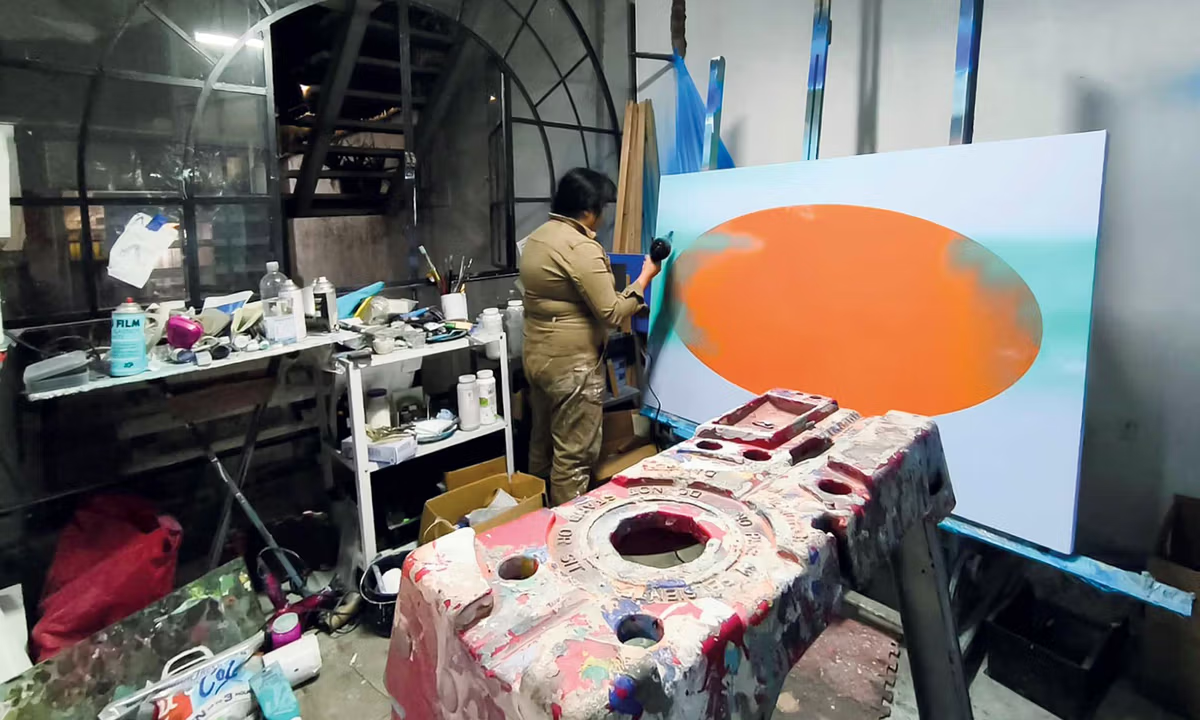
In Mexico City, the go-to neighbourhoods to see contemporary art have long been Condesa, Roma and San Miguel Chapultepec, where many of the city’s galleries are located. However, over the past five years, Santa María la Ribera, west of downtown, has emerged as a place to encounter the Mexican art scene in its most genuine form, free from the formal trappings of traditional galleries. This shift is largely due to the growing number of artists who have established their studios here.
“Santa María la Ribera has become a huge art studio where all of us fit,” says Andrew Roberts, a Tijuana-born artist who exhibited at the 2022 Whitney Biennial and the 2025 Bienal de São Paulo.
Roberts, who works primarily with sculpture and video art, will present his first painting exhibition at Pequod Co gallery during Art Week. He says he moved to Santa María la Ribera with his partner, the painter Mauricio Yael, because many of their artist friends were already living there. He says the neighbourhood’s central location, access to public transportation and affordable rents were key factors, as well as the size of the area’s warehouses and Porfirian-era houses, which are well suited to the needs of visual artists.
“It’s an amazing area to live and work,” says Yael, who is hosting an open studio during Art Week at Sabino 234.
The artist Cosa Rapozo, who is participating in the Salón Acme fair and opened an exhibition in Guadalajara at GDL90210 gallery the weekend before Art Week, believes Santa María’s location is highly convenient and affordable. She also enjoys the neighbourhood’s “small village” atmosphere.
The painter Cecilia Barreto, who recently participated the New York Latin American Art Triennial and is presenting her work on Saenger Galería’s stand at Zona Maco, says the neighbourhood appeals to artists because rents are lower than in gentrified areas like Condesa, Roma and the Centro Histórico. But she warns that costs are increasing here as well. “It’s very problematic. In the studio I’m renting, we were told it will soon be turned into an apartment complex. I’m not sure Santa María will remain an artists’ neighbourhood for long.”
All of the artists interviewed for this article moved to Santa María la Ribera during the pandemic, between 2020 and 2021. Since then, several new art spaces have opened in the area, including Casa Siza (Dr. Atl 103), a house designed by the Pritzker Prize-winning architect Álvaro Siza that hosts exhibitions; Vernacular Institute (Sabino 276), a curatorial space and artist residency founded by the artist Jo Ying Peng; and Lolita Pank (Sor Juana Inés de la Cruz 91), a venue highlighting works by female artists. The large complex Estudios Maravilla (C. Sabino 310), located on the north side of the neighbourhood, is hosting the Material Fair this year.
Long before the influx of artists, Santa María la Ribera already had two famous cultural landmarks: the Kiosco Morisco, a late 19th-century kiosk; and the Museo Universitario del Chopo, an Art Nouveau structure that has functioned as a museum for over 50 years. This building has witnessed the evolution of Santa María, explains Sol Henaro, the museum’s director. “The area has gone through many phases,” Henaro says. “It’s a very dynamic place… and we are still witnessing its transformation.”
