


Located on an unassuming block in Miami’s Little Haiti neighbourhood, the once-derelict Villa Paula houses within it some of Miami’s most fascinating lore. The residence was originally built in the late 19th century for Domingo Milord, the Cuban consul at the time, and his wife Paula, an opera singer. The Milords needed a comfortable residence that contrasted Cuba’s rich design and architectural history compared to Miami’s at-the-time provincial aesthetics.
Built by the Havana-based architect Cayetano Freira using imported Cuban materials, the resulting Neo-Classical structure sits entirely at odds with the neighbouring properties. It features Tuscan columns, towering ceilings, hand-painted ceramic tiles and a sprawling garden. A rich mythology surrounds the Milords, too: though they only lived there for about five years, it is said that Paula was so enamoured with the home her husband lovingly built to her comfort and taste that when she died she was buried in a sarcophagus on the property.
Historical records show that Paula was buried elsewhere, but the legend has been invoked to explain alleged supernatural occurrences on the property, which sat in disrepair for much of its existence. As the neighbourhood surrounding Villa Paula became blighted, the home’s grandeur faded into memory.
More recently, a civic-minded landlord bought the property and has transformed the villa into a site for cultural production. It has hosted numerous pop-up exhibitions and events, and is now home to a semi-permanent tenant, the design gallery the Future Perfect, which also has locations in New York and Los Angeles. The Future Perfect’s interventions have underlined the building’s heritage while creating design vignettes in each of its intimate rooms. During Miami Art Week, artists including Autumn Casey and Faye Toogood have works on view at the villa.
Villa Paula’s layered history is emblematic of Miami’s own evolution. Nina Surel, a Buenos Aires-born, Miami-based artist and founder of Collective 62 (an all-female artist-studio complex in Liberty City), considers Villa Paula to be one of Miami’s most under-rated cultural landmarks.
Lamps by the Miami-based designer and artist Autumn Casey feature in the Future Perfect’s exhibition at Villa Paula, which bridges “the historical and contemporary into a singular vision”, Nina Surel says
Photo: Joe Kramm; courtesy of the Future Perfect
The Art Newspaper: Why are you personally attracted to Villa Paula?
Nina Surel: Villa Paula is one of those places that is misplaced in Miami. It could be anywhere—Cuba, Lisbon, another world—but it’s here, in Little Haiti. That sense of displacement, of history living alongside the new, is what makes it so poetic. When I moved here, I was attracted to those misplaced elements because I felt misplaced too. Miami is the perfect place to tear things down—the termites, the weather, the excuses—and yet this house has survived. I love the mystery, the ghost stories, the gossip around it… I think that so many things can happen in a location like that.
What are some of the stories you have heard over the years about its supposed haunting?
According to lore, Paula died in 1932 from complications of a leg amputation at Jackson Memorial Hospital, and people have reported seeing a one-legged apparition floating in the house. She’s said to have loved playing piano and brewing Cuban coffee, and people claim to smell both coffee and roses (her favourite) when at the home. There have also been numerous incidents involving cats being trapped and crushed by the iron front gate. And one of the past owners claims they have seen two different spirits milling about the house. Villa Paula is definitely considered one of Miami’s most haunted houses.
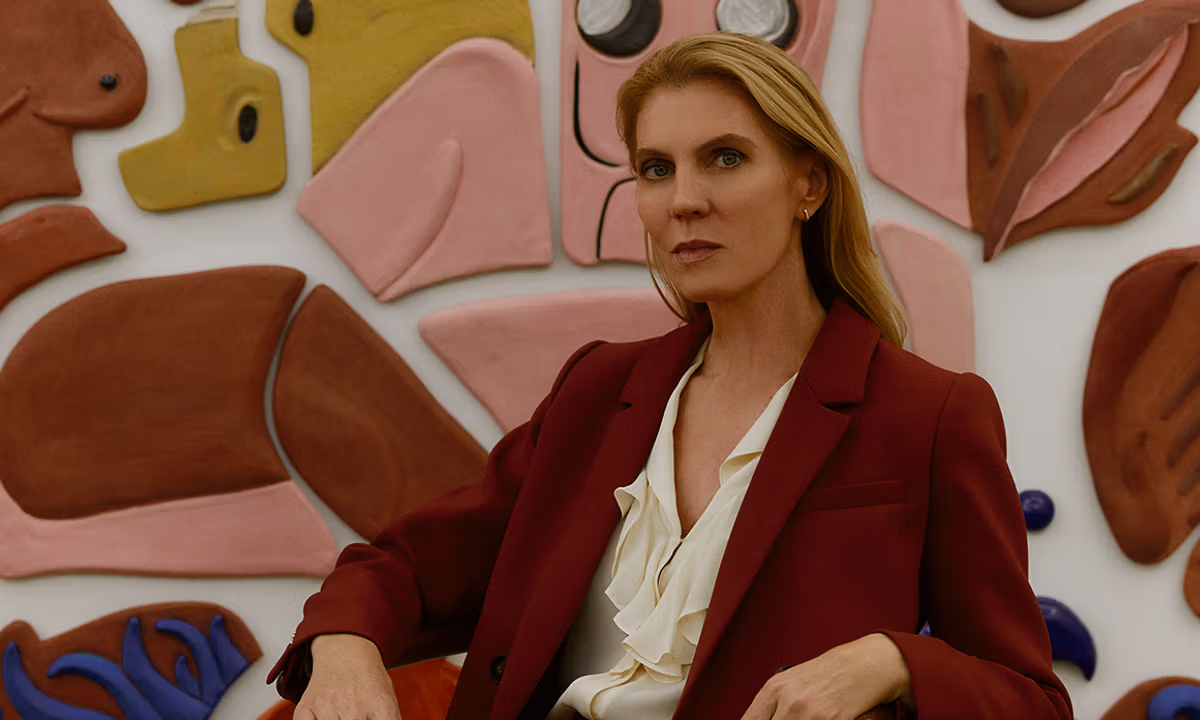
Your current body of work explores different mythologies and feminist histories through ceramics. What can you tell us about Villa Paula’s historic ceramic tiles?
I’ve always been obsessed with tiles, because they tell the story of a people. It’s design and utility and poetry all at once. The tiles in Villa Paula are like a window through culture and pigments. When you walk in, it’s this harmony between contemporary and historic.
What do you think of the Future Perfect moving into Villa Paula?
The Future Perfect’s programme is based on bridging the historical and contemporary into a singular vision. In Miami, landing in Villa Paula is the most amazing fit. The lighting, how the tiles work with the existing bathrooms, the wood, the doors—it’s so unusual for Miami to have that level of architectural conservation, and the Future Perfect has thoughtfully chosen to work with artists whose objects truly uplift the site’s historical elements. When you walk in, you see design and art merging with this architecture to tell a story.
• Villa Paula, 5811 North Miami Avenue, Miami
