


When I learned of an opportunity to interview Michael E. Smith—an artist I’ve long admired—my brain boomeranged: I was excited to hear from an elusive artist who seldom speaks, but also stumped as to what exactly I might ask the man. I intuited that direct questions—of the what does this mean, why did you make that variety—wouldn’t do for an artist whose work is so withholding. His sculptures have this magical yet vernacular quality you’d feel silly overexplaining.
Smith’s work—characterized by playful arrangements of found objects—elides language … or so I thought. So often, what makes an artwork great is also what makes my job as a writer hard.
Yet after making the trek to Mass MoCA in the Berkshires, where Smith has a solo show on view through February 21, I realized that his work elides language in part because it has so much in common with it. Smith takes ordinary objects—often readymades—and renders them unfamiliar, both dumber and more mysterious at the same time, in much the way that poets turn the ordinary medium of English on its head. Like a poet, he relies on rhythms and rhymes, and on scrambling semiotics.
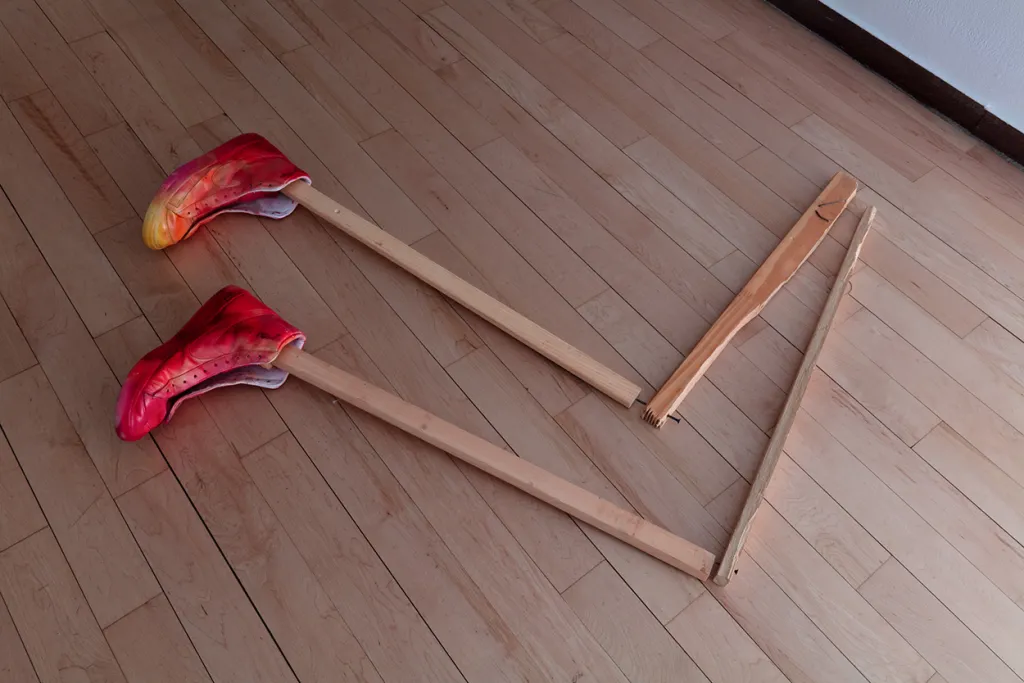
Here’s an example: Two long, rolled tubes of yellow paper sit on the floor, greeting viewers to his Mass MoCA show. Immediately, I read them as legs; just as quickly, I wrote off my impulse toward anthropomorphism. Their sole bend, near the end but against the wall, is anything but anatomical. Then, through the door, I glimpsed a set of sticks lying on the ground. This set, wooden with shoes and knees, was indisputably limblike. Only on my way out did I notice the third pair: Two wires hanging from the ceiling are draped over the top of the door, from which they appear to float above, ghostlike. It is through repetition that these pairs come to feel leggier and leggier.
Smith makes you ask: Where does the material end and the metaphor begin? Where do the profound and pedestrian converge, if they do at all?
Other moves feel like puns: Gallery lighting, mounted to the ceiling, is in this show unplugged, cords dangling and cans unscrewed. Here what we call “light” feels jarringly heavy as it sags. I’m told that visitors keep walking right into the dangling plugs, so used we are to tuning out the fixtures from our field of view.
As with any artist whose work has been subject to the machinations of language, there are the narrative tropes that will haunt him for life—the Detroit-born-artist-working-with-post-industrial-refuse story. He has, however, been living in New England for decades,and such a story does little to convey the experience of encountering his work. Fair enough: It’s hard to write about absence, and he withholds so much. Few works in the show are titled, boxes filled with objects remain closed (one is even tightly wrapped in cellophane), and canvases are stacked one atop the other like pizza boxes—content and images concealed.
After much mulling (and an illicit-feeling peek inside the boxes and at the paintings), I thought of a few questions for Smith. The artist spoke from his studio in Providence, Rhode Island, where he was between opening shows at Waldo in Maine and at Maxwell Graham in New York.
View of Michael E. Smith’s 2026 exhibition at Mass MoCA.
You haven’t publicly spoken about your work much. Why’s that?
For 10 years I avoided doing interviews, but I’m actually weirdly super talkative if you get me going.
I mixed things up for this show, largely becuase I wanted the curator, Emma Poveda, who is a grad student fellow, to have a good experience. I never really collaborate with curators: The process is notoriously dry and empty until install starts, so I just decided it could be interesting if I flipped that inside out and gave Emma complete access. She met my partner and my kids. She spent time here in Providence. She has all our phone numbers. I never let anyone work in my studio for more than two years.
Earlier in my life, I was really disappointed in almost everyone, though there was still 20 percent of the world I absolutely adored and would die for. But it’s flipped now. Weirdly, I feel more connected and in love with humans than I ever have.
I noticed some lists on the stacked canvases at Mass MoCA. What role does list-making play in your work?
I think the origin of the lists is just neurosis. I spend a lot of time on paper, remaking lists of things—even thinking about how to write my materials list in a very truncated way. Rather than saying “stork beak,” it will just say “bird,” and then you have to put together the rest of the bird that’s missing in your head.
The lists are also born from practicalities. I seem to grow into every crevice of what it means to find ways to source meaning … including in the demands that come with making on a professional level, whatever that means. The only shot I have is complete abandon each time. I know that sounds extreme, but at least, if that’s the goal, then how do I negotiate things like shipping and flights and still give myself over all the way? So I just fold everything into the mix. If it’s a part of that day, then it becomes part of the song.

View of Michael E. Smith’s 2026 work untitled, comprising a speaker and a curtain, at Mass MoCA.
How would you describe your relationship to poetry?
For me, poetry is related to songwriting, and I’ve read more poetry than anything else. To me, the best word for talking about the indescribable aspects of what makes something work is often “poetic.” I’ve never studied writing or the theory of it, so maybe this is a common way to think about it, but for me there’s no other art form that separates itself from its use or function quite like poetry. A poem seems to be beyond writing somehow.
I love the idea of a poet being the most lightweight of all—even lighter than the troubadour. All they need to work is a piece of burnt wood, if that; they can also just rely on memory.
This show had these rhyming and rhythm moments that really made me think of the structure of the show as poem-like.
Totally. I live in music, especially pop music. Sometimes, I build shows around certain artists or a suite of songs that somehow holds what I’m feeling or what’s happening. Music gives me a way in.
The last work in the Mass MoCA show, titled More Bounce (2026), is a reference to a Zapp song, “More Bounce to the Ounce.” I think that song is asking us all to be more rubber and keep bouncing to survive. Sound is in the work a lot, and rhythm for sure. Rhythm is the material I’m working with.
How do you go about choosing what objects to work with? When you see something, do you know right away what it will be?
Things choose me. I don’t know if it’s a blessing or a curse, but the schedule I keep feels like the blue-collar response to having two teenagers and trying to keep my promise to my partner: We’ve worked so hard to try not to give any energy to anything we don’t believe in. It seemed like a pipe dream in the beginning, but we did it for a while. A lot of times, the materials were because we didn’t have a ton of money.
I remember when I was in the Venice Biennale [in 2019], and they gave me the Scarpa Garden. I thought: Lord have mercy. I did a site visit. I try to do that as little as possible, but in this case, I had to. It was nothing, nothing, no ideas. The show was getting close, and every morning I’d wake up with panic. Like, how do I live up to this incredible opportunity, in maybe the best spot you could possibly have? I’m not used to that. Usually, people put me in the corner, or I’m weird shit in the stairwell.
I didn’t have funds. In the beginning, I refused advances, because I don’t want to owe people money. But that Christmas, my son got an anvil from my father-in-law, who’s a blacksmith and a glassblower. Boom: The whole idea was there. We ordered anvils from throughout Europe, from different ages. They could be outside. People could sit on them. They’re heavy as shit.
A lot of times it’s like that. That one’s very clean. But so much of what I do feels like being a spiritual detective or something, yet I try to be as pragmatic as possible. Free things, or Craigslist free … if you can find something that motivates you outside of the unbearable lightness of trying to do something worth your time, then just jump. We bleed for it and hopefully people dig it.
View of Michael E. Smith’s 2026 work untitled at Mass MoCA.
That’s also where the work feels like poetry to me. Poets take language—this very pedestrian, perfunctory material—and strip it down while also turning it into something greater than the sum of its parts. The iPhone boxes do that for me; they just felt so unfamiliar and special in a way that I hadn’t thought about before.
That’s what I’m looking for, some kind of nexus where all the different forms of our understanding and consciousness are firing, like many memories and many layers of information all at once. It’s like you can see something in a different way for a minute if you’re in it, and that’s generally durational and maybe even immersive. You have to give over.
That’s part of the reason I build shows the way I do. I was always annoyed with the way attendance works at an exhibition. Anywhere else … you would never listen to six songs simultaneously. It’s just such a stale way to experience something so powerful. We made a fake band when I was in undergrad for that reason, so that people would come and act as though they were at a show—much more relaxed.
Totally. Is that how you landed on the car wash next to Mass MoCA as a kind of motif, and as a site for an artwork and performance?
I was really into the car wash right away. It made me think of Ed Ruscha, and of my grandfather, who worked at Hydramatic, a factory in Detroit. Half of my family worked in the factories, and my grandfather loved washing cars. He worked most of his life to get a Cadillac, and then he never drove it. He would just pull it out, wash it, put it back.
Cars were of almost religious importance in our family. That wasn’t important for the show, but I know from experience that if I connect to a material on a personal level, beneath that will be something universal. It’s just a good fuel for me, and the space’s little weird stalls felt kind of like little galleries or something. I can be impulsive with initial decisions, and then it’s like, “Oh fuck! Now, how do I make this work?” I got a lot of heart, but if I had to figure it out first and then do it, I’d never do anything.
View of Michael E. Smith’s 2026 work arc wash at Mass MoCA.
You also collaborate with your kids a lot.
They’ve always been a part of all of it; it just felt very natural. I did this series of events at Giorno Poetry Systems, and my daughter performed, which was super cool. My son drives through sketchbooks at a ridiculous pace, to the point where I feel like we’re killing some trees. I brought in a huge stack of them, and everybody got to flip through them, which they were into. I explained to my son, they’re still yours, but if I were to frame them as an artwork, it’s a window into your head. To look at a 15-year-old’s sketchbook is a powerful experience for a person who’s in their 30s or 40s. I asked: Are you okay with this? Is there anything you would want to get rid of? He said nah, it’s cool; it’s all good.
And then sometimes I put them to work just like good old-fashioned child labor! [Laughs] They like it though; we hang out. They have different skills. My son is like drunken style, so if I’m stuck on something, he’ll just plow through. My daughter is just incredible with color mixing, patterns, repetition … she’s got more of a painter’s mind and sensitivity to stuff. I also work with a partner, Scott. I don’t call anyone assistants. I usually work with young artists and I pay them whatever I can afford to, and we learn from each other. That’s worked pretty well, surprisingly.
I have this strong, strong pull to at least just walk gracefully, whatever the fuck that means—to be as harmless as possible while all of this happens.
It sounds like the lifestyle and the art are supporting each other.
Yeah. If anything takes the hit, it’s the life part. But we’re fighting for the way we want to live. It can seem almost pointless, though it feels like a perfect time for work like mine, because any attempt at reasoning or objective thought seems laughable in the face of all that spirals around us.
And I mean, what’s the alternative? It’s not like there are a lot of attractive things that I’m missing out on.
A friend once described being an artist as “the best job I’ve ever had”—meaning, the least soul sucking way to spend one‘s time and energy—which I think about a lot.
One of my favorite songs is Son House’s Preachin’ the Blues (1930). My favorite line is, “I’m gonna join the Baptist Church … so I won’t have to work.” I know that to a lot of people, that sounds lazy or whatever. But no, having a job is an oppressive experience for 99.9% of the planet.
I don’t mind working. I don’t want to have a job.
David Graeber’s book Bullshit Jobs makes the argument that capitalism hurts rich people and poor people alike because it forces us to spend our time on pointless and soulless things, pursuing anything but truth and beauty and kindness.
And it sets up enemies immediately, as if everyone is competing to collect acorns. It took me so long to get rid of that basal impulse. I‘ll never forget when I did this New York studio program thing, and this artist named Mike Dopp was listening to me and my homie talk about art. We were talking about it like it was sports. Being from Detroit, we felt like underdogs, like we shouldn’t have even been there. He had the courage to pop around and school us on how art isn’t competitive, and I feel so lucky to have glimpsed maybe a bit of peace in terms of acceptance.
That’s why I keep coming back to that word “harmless.” I think it is about the best I can come up with these days. Art has introduced me to so much complexity. The amount of arrogance it would take at this point for me to profess understanding or any judgment whatsoever … At best, I try not to do any harm, and if I get there, that’s pretty cool.
