


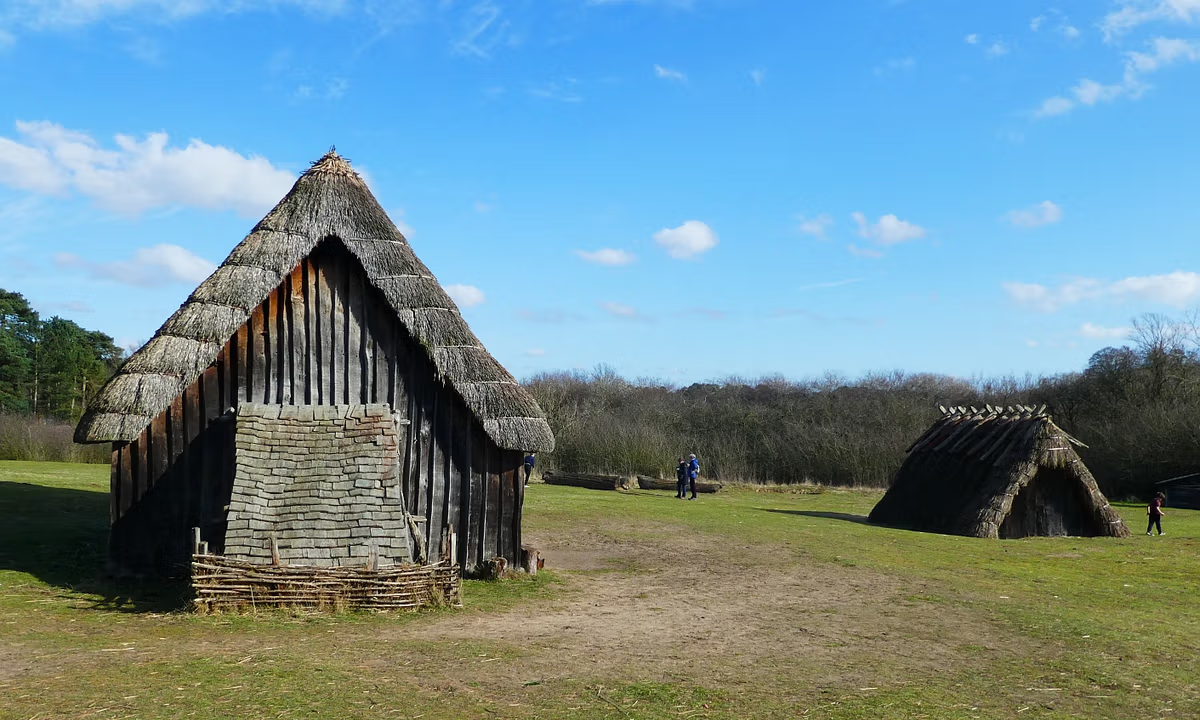
In the sixth century, a monk named Gildas described the arrival of the Saxons in Britain as a mass movement of German and Scandinavian mercenaries, who descended on the island as a punishment. His words, and writings by later authors, influenced our understanding of this era for over 1,000 years, giving rise to the theory of an Anglo-Saxon invasion. But in recent decades, archaeologists have questioned this reconstruction of events: Perhaps the “invasion” was simply the arrival of a small armed elite. Over time, this dominant new group may have influenced Britons, leading them to adopt foreign fashions and objects. If so, in a grave, a local would look no different from a foreigner, masking the true extent of migration.
To shed light on this situation, a team led by Sam Leggett at the University of Edinburgh drew on data from hundreds of skeletons unearthed across England, all from the early medieval era—approximately AD 400 to 1100. By studying chemical signatures trapped in the skeletons’ tooth enamel, it was possible for the team to reconstruct whether these individuals had drunk water and eaten in locations that differed from where they were buried.
Writing in the journal Medieval Archaeology, the team concluded that instead of migration happening in bursts—a possible sign of invasions—it was a continuous feature of early medieval British life. Yes, people did arrive from Germany and Scandinavia, as medieval writers said, but men and women also travelled from elsewhere on the continent, and perhaps even from as far away as the Mediterranean and beyond. People of diverse origins mixed over generations.
It seems, then, that the ancient sources were a little right and a lot wrong. Rather than a victim of invasion, early medieval Britain was a cultural melting pot.
Our understanding of past population movements have long relied on what could be pieced together from archaeological evidence, which is interpretable in multiple ways, or the accounts of writers, which can be biased or inaccurate. Now though, scientific methods are providing new avenues to reconstruct our ancestors’ travels. Not only do they show where people lived at different stages in their lives, but they are pushing back a number of “firsts” in human history.
Our ancestors travelled earlier than thought
Take, for example, the question of when humans first reached East Asia. For decades, experts proposed vastly differing dates with no clear consensus. Now, writing in the Journal of Archaeological Science: Reports, Wei Wang of Shandong University and Chuan-Chou Shen of National Taiwan University, and their colleagues, have dated speleothems—mineral deposits formed by water over thousands of years—in Fuyan Cave in Southern China. Because archaeologists discovered fossilised human remains between some of these dated layers, and by comparing their data to other sites, the team concluded that Homo sapiens must have first travelled to East Asia at least 130,000 years ago. Even more significantly, these findings support arguments that our ancestors may have left Africa tens of thousands of years earlier than previously thought.
Another big question is when Homo sapiens first sailed to Sahul, a landmass that combined New Guinea, Australia and Tasmania until rising sea levels separated them 9,000 years ago. Expert opinion has fallen into two camps: that the migration happened 60,000 years ago or 45,000 to 50,000 years ago, with the latter option increasingly popular. Adding to this debate, a team, led by Helen Farr of the University of Southampton and Martin Richards of the University of Huddersfield, recently studied 2,500 mitochondrial DNA genomes from Aboriginal Australians, New Guineans and others from the region. By analysing changes in this DNA across the centuries—a method called “molecular clock” dating—they revealed lineages stretching back 60,000 years, they write in the journal Science Advances. As in East Asia, the earlier date appears to be the most probable.
Clearly, our ancestors travelled more widely and earlier than previously believed. In the past, it was normal for people to migrate when conditions became inhospitable. But today, with increasingly restrictive immigration rules, our countries are becoming fortresses, locking others out and, people often forget, us inside. In a volatile world of climate change, wars and natural disasters—problems that impact us all—movement will be key to survival, as our ancestors knew.
