


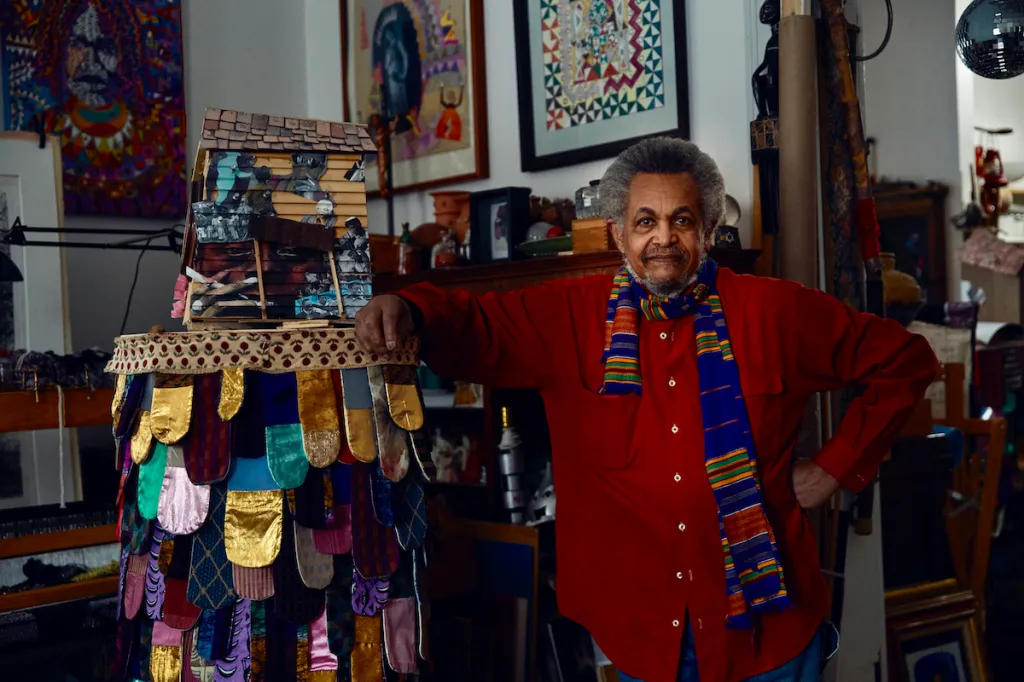
Napoleon Jones-Henderson, a member of the AfriCOBRA collective who made art for the age of Black Power, died in Boston on December 6 at 82. Wonderland, a Boston-based art publication, reported that Jones-Henderson had been battling cancer.
Jones-Henderson was one of the key artists associated with AfriCOBRA, a Chicago-based group whose members synthesized African styles with emergent Black forms of expression in the US. Founded by Jeff Donaldson, Wadsworth Jarrell, Jae Jarrell, Barbara Jones-Hogu, Nelson Stevens, and Gerald Williams in 1968, the group’s output defined an era, though the art produced under the AfriCOBRA name was not seen in major museums until very recently.
Jones-Henderson, too, has only been given his due attention in the past decade. After other AfriCOBRA artists showed in “Soul of a Nation: Art in the Age of Black Power,” a traveling exhibition first held at Tate Modern in 2017, Jones-Henderson appeared in an AfriCOBRA show in Venice during the 2019 Biennale that was staged by the Museum of Contemporary Art North Miami. The year afterward, he showed at the Biennale of Sydney. Two years after that, in 2022, Jones-Henderson received a survey at the Institute of Contemporary Art Boston.
Yet the artist never cared much about how his work was received because he was less concerned with critics than his work’s viewers. “We were revolutionary in the sense that we were speaking about and affirming ourselves,” he said in a 2010 oral history for the Smithsonian’s Archives of American Art. “We were reactionary because we were about affirming our own image. Our own selfhood.”
AfriCOBRA was an acronym for the African Commune of Bad Relevant Artists, though this was not the group’s first name: it was originally titled COBRA, or the Coalition of Black Revolutionary Artists, upon its founding, then rebranded in 1969. Jones-Henderson recalled becoming aware of the group through Barbara Jones-Hogu and Jae Jerrell, who invited him to attend one of the collective’s meetings while he was still an undergraduate student at the Art Institute of Chicago. He thrilled by the collaborative atmosphere he found there, which he later said was derived from a specifically African sensibility.
“Africa is the place from which we stem, to the place from where we are, to the place where we are
going,” he said in the Smithsonian oral history. “Because, commune is a community. And that’s different than the word community, in the sense that commune means that we all have a shared place that we wish to move to. And so, in doing that, we have linked the past with the present. And that present was the formulation of a set of principles and a philosophy, move us forward to the future.”
Music was also key to the group’s output. “The art of AfriCOBRA operates in a world where the connection between music and color becomes vividly manifested,” Jones-Henderson wrote in a text that accompanied his work at the Biennale of Sydney. “These artists attempt to stretch and extend their use of colors across the full range of the spectrum, much like Coltrane attempting to squeeze a multiplicity of tonal patterns and textures out of every note played on the saxophone. In both contexts (image-making and sound-making), colors and notes are essentially units of energy. The aesthetic ground for this approach to making art seems to be rooted in the rhythmic values of African aesthetics.”
Installation view of the ICA Boston’s 2022 show for Napoleon Jones-Henderson.
Photo Mel Taing
Born in 1943 in Chicago, Jones-Henderson had already studied art in Paris by the time he joined AfriCOBRA. In France, he read James Baldwin’s 1962 novel Another Country, which he credited with influencing his own thinking about the relationship between oneself and one’s setting.
After graduating from the Art Institute in 1971, he moved to Boston in 1974 and remained there for much of his career. There, he continued making textiles that continued what he called the “African ethos” of his AfriCOBRA work.
One tapestry made prior to his arrival in Boston, TCB (1970), features a vibrantly hued person surrounded by the words “TO BE FREE,” which are rendered in such a way that the letters appear like stained glass. “We must protect our communitee,” more text surrounding this person reads. “Come here to get, to learn, to find us.”
Other woven works were more explicitly meant as protests. Stop Genocide (1975) situates text bearing its title atop patterning that recalls kente cloth, while SO-WE-TOO Black Men Rise (1974–75) features a Black man’s head and a title that refers to Soweto, a South African township where Black students were forced to use Afrikaans and English in their schools.
Jones-Henderson became directly involved in African causes. In protest of apartheid, Jones-Henderson exhibited at a print biennale in South Africa, where he showed Bebop Kuba, a set of screenprints that drew on subjects as diverse as the singer Nina Simone and the art of the Kuba Kingdom in Central Africa. He also attended the FESTAC ’77 festival, a month-long event in Lagos, Nigeria, that celebrated African art in all its many forms. The photographer Marilyn Nance, who shot pictures of that festival, once recalled in an interview that Jones-Henderson was among “the important artists and cultural leaders of the time.”

The ICA Boston’s 2022 show for Napoleon Jones-Henderson.
Photo Mel Taing
He also got involved locally in Boston, becoming executive director of the Institute of African and African Diaspora Arts during the mid-’70s. His emphasis on the Boston community remained up until the very end of his career. In 2025, he was appointed to the city’s art commission.
While Jones-Henderson’s art remains under-recognized, there are signs that it is now on the rise. He died while he was a fellow at New York’s Center for Artist and Research Alliances, and his words are featured extensively in the catalog for a current retrospective for the Boston artist John Wilson that is on view at the Metropolitan Museum of Art and was co-organized with the Museum of Fine Arts Boston.
But he was always less focused on his present than in ensuring that he and his people could launch themselves forward. In his 2010 oral history, he said, “I draw upon my past. And I project toward my future.”
