


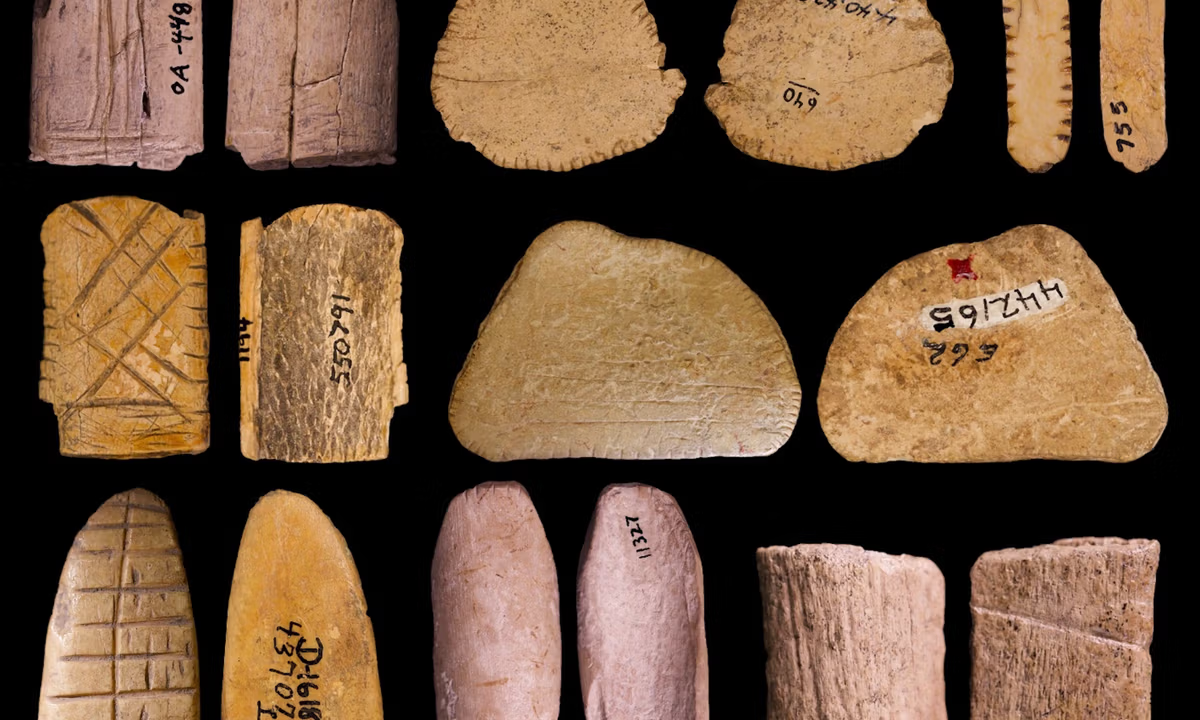
A new Colorado State University study reveals that the earliest known dice in human history were made and used by Native American hunter-gatherers on the western Great Plains more than 12,000 years ago. This was at the end of the last Ice Age and long before the earliest known dice from Bronze Age societies in the Old World.
According to research published by Colorado State University archaeologist and PhD student Robert J. Madden in American Antiquity, dice, games of chance and gambling have been a persistent feature of Native American culture for at least the last 12,000 years. Artefacts found at Late Pleistocene Folsom-period archaeological sites in Wyoming, Colorado and New Mexico predate the earliest known Old-World dice by more than 6,000 years.
“Historians have traditionally treated dice and probability as Old-World innovations,” Madden said in a statement. “What the archaeological record shows is that ancient Native American groups were deliberately making objects designed to produce random outcomes and using those outcomes in structured games thousands of years earlier than previously recognised.” By employing more recent historical analysis and developing a checklist of physical features previously identified as dice, he reclassified older artefacts that had been misidentified or overlooked.
Madden tells The Art Newspaper that, according to his research, Native Americans have been making dice (two-sided versions, called “binary lots” with dual outcomes) and using them in games of chance and for gambling “from the end of the last Ice Age, through colonialism, and continuing to the present day”.This places Native Americans, he says, at the “forefront of the invention of these objects and practices, predating the first dice and games of chance in Europe by more than 6,000 years”.
Examples of early Native American dice discovered at more than 50 archaeological sites in the United States Robert Madden
More importantly, Madden says, because historians of science and mathematics view the invention of dice as some of the earliest evidence of human engagement with concepts of chance and randomness, “these findings indicate that ancient Native Americans were early movers in humanity’s exploration and understanding of probability and the probabilistic nature of the universe”.
His research also indicates, Madden says, that Native American groups used dice, games of chance and gambling over thousands of years “as a means of social integration allowing disparate groups, who may not have known each other well or even spoken the same language, to come together, interact and exchange on the basis of a shared understanding of the games and gambling”.
Madden’s findings show that Native Americans have been “grappling with and making use of highly complex, non-intuitive ideas—chance, randomness and probability—that are foundational to our modern society since the end of the last Ice Age, and that they harnessed these forces and used them to power a social technology of integration”. This suggests, he says, a level of complexity and intellectual depth “that is surprising for any prehistoric society”.
Madden adds that the dice in his study are, generally speaking, the only decorated “artistic” objects found at the late-Pleistocene, 12,000-year-old sites where he conducted his research. The study identifies 15 dice associated with so-called “Folsom” groups at the Lindenmeier site in northeastern Colorado. While thousands of artifacts have been recovered there, none of them—other than the 15 dice he identified—appears to have any form of artistic marking or decoration.
He adds: “Dice, and their ability to channel and display the natural force of randomness, appear to have triggered some desire in these early groups to mark these objects in a way that identifies them as transcending the purely utilitarian.”
