


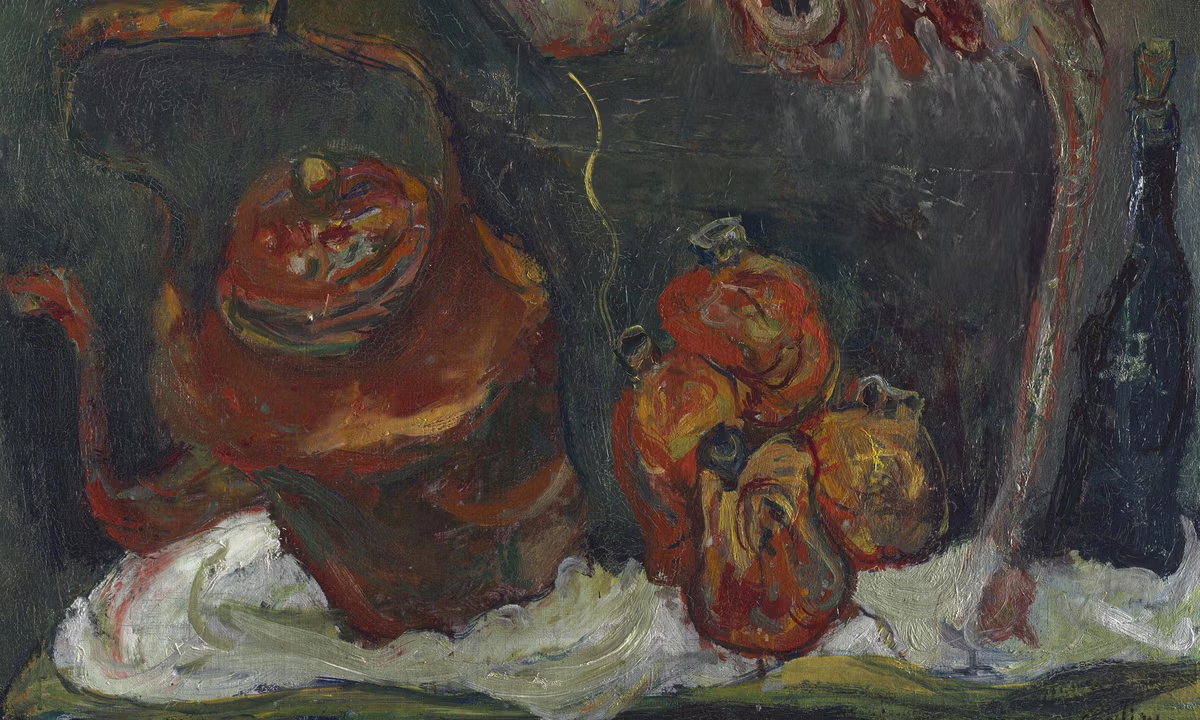
The legacy of Chaïm Soutine (1893-1943) is a conundrum. Often his reputation spreads beyond him or his art. One goal of this new biography is for his paintings to win out.
Soutine arrived in Paris in 1913—poor and unwashed—from the shtetl of Smilovichi in Belarus, via Minsk and Vilna. He fell in where he could, in art studios where members of the new “School of Paris” gathered—a frequently misunderstood term that loosely designated those foreigners and non-Parisians living in and around Montparnasse, often in squalor.
Soutine was called an Expressionist then and now—the best since Vincent van Gogh, said some who saw the term as positive. Celeste Marcus, the managing editor of Liberties: A Journal of Culture and Politics, argues that those who find a mood or, even worse, a moral in Soutine’s work are missing the point. Soutine, she argues, was more about paint and energy than about feelings: sometimes energy here feels like another term for je ne sais quoi. The US poet and art critic John Ashbery described his response to Soutine (quoted by Marcus) more vividly: “The fact that the sky could come crashing joyously into the grass, that trees could dance upside down … was something I hadn’t realised before, and I began pushing my own poems around and standing words on end.”
Marcus finds a through-line from early landscapes painted in the town of Céret in French Catalonia to the remains of slaughtered animals inspired by Old Masters: “He practiced a sort of pictorial translation,” she observes, “except that a translator’s job is to maintain the spirit of the original, and Soutine set himself the task of resuscitating Rembrandt and Chardin and Courbet with their forms but his soul.” None of these pictures, Marcus argues, were intended to be easy to look at, but neither did the artist set out to explore the pain from his childhood or the suffering of the Jewish people.
Soutine barely wrote anything that might give us a hint. He made no drawings. He also destroyed finished works that he came to scorn, so we do not know how much he produced. This dedicated painter was disciplined but idiosyncratic. He shared a bed with Amedeo Modigliani—by turns not as lovers. It is said that when the US collector Albert Barnes decided to buy 60 works by Soutine in 1923, he found the artist, who by then rarely changed his clothes, sprawled on the floor of his studio. The purchase of just one painting would have enriched Soutine.
Biography as group portrait
Soutine was an odd fit in the beau monde. He rejected earlier supporters like the art historian Élie Faure over minor slights. He abandoned a devoted female companion who had kept him alive. He turned down an offer from rich Americans to flee to the US, where, he said, there would not be trees to paint. Ailing from stomach ulcers and living on milk at the end, Soutine hid outside Paris during the Nazi occupation, venturing to his doctor there without wearing the yellow star, somehow avoiding capture. Ultimately, the ulcers, rather than Nazis and their French helpers, did for him.
Marcus’s study of an unconventional artist has its own eccentricities. With so little testimony from Soutine himself, she relies on the people around him. Digressions are so extended that the book can feel like a group portrait. (To be fair, so do many books about that era’s personalities.) In an addendum, we read of Soutine’s contemporaries among other Jewish artists from Eastern Europe. Many were murdered by the Nazis, chilling reminders of how Soutine’s destiny was shaped by luck.
The author quotes Elie Wiesel, who called his paintings “survivors”, situating Soutine in the suffering of Jews under Russian rule and in the horrors of the Holocaust. Yet for Marcus, “viewers—particularly Jews who wish to claim Soutine as a spokesman for their people’s experience—indulge in unfounded stereotypes about Soutine’s origins, his Jewishness, his pain, and his psychology”. She continues: “Imputing to Soutine a fixation on blood and death and fury with God is as reasonable as characterizing artists as nymphomaniacs for painting naked women.”
Marcus also takes on Clement Greenberg, the de facto “pope” among critics in the 1950s, and far beyond, who found Soutine’s 1950 show at New York’s Museum of Modern Art ultimately uninspiring. “Greenberg concedes, however obliquely, that Soutine’s drive, his project, is beyond Greenberg’s comprehension,” she writes. “If that had been an admission rather than an indictment, it would have been wise.”
Greenberg no longer dominates among scholars, so denouncing him can feel like a spirited but needless exorcism. Yet Marcus’s views are not so different from those of Esti Dunow, co-author of the Chaïm Soutine catalogue raisonné, whom the author cites as a crucial influence. Or from those expressed by Hilton Kramer in Artforum in 1968: “In a sense, Soutine had no biography outside his art; one might even say that his art was a substitute for a biography.”
Celeste Marcus, Chaïm Soutine: Genius, Obsession, and a Dramatic Life in Art, Public Affairs, 304pp, $34/£25 (hb), published 28 Oct (US) & 20 Nov (UK) 2025
• David D’Arcy is a regular contributor to The Art Newspaper
