


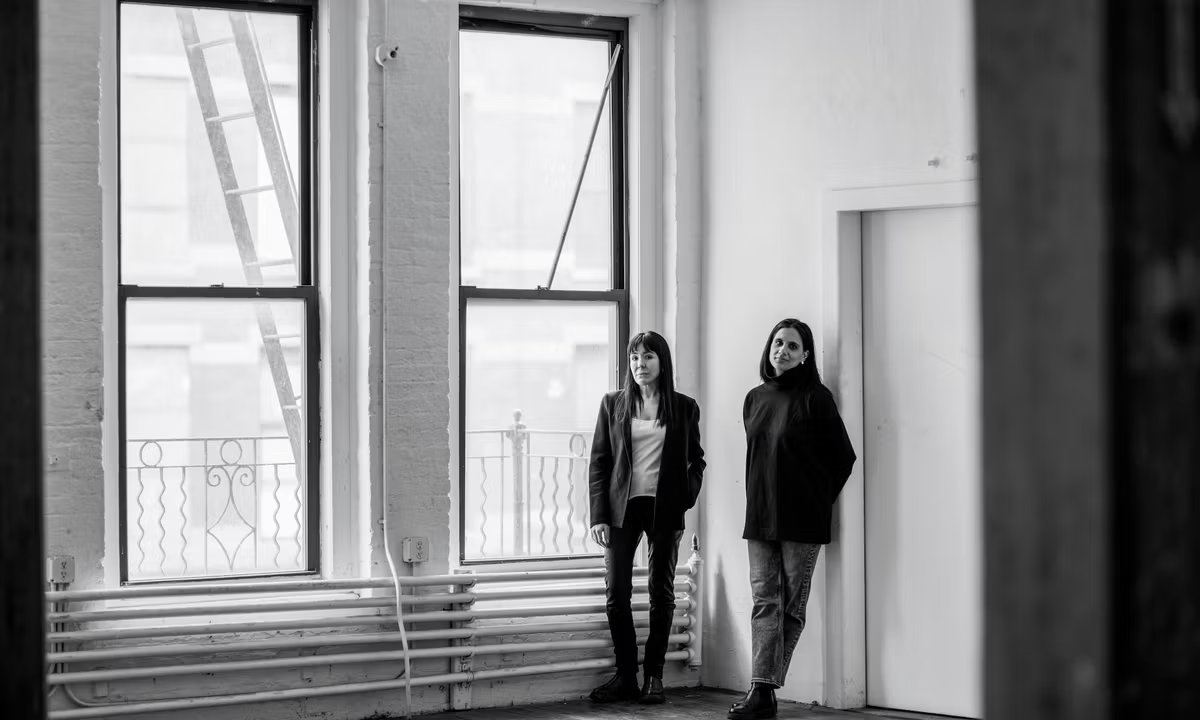
It is not often that an economics student abandons the field to become a curator. But this was the case for Summer Guthery, who has established four non-profit experimental art spaces across the US, including Joan in Los Angeles and the soon-to-shutter Canal Projects in New York. Guthery is now preparing to launch her fifth space with fellow curator Francesca Sonara.
“My economics degree made me more attuned to the global picture, and more sceptical of capitalism’s default setting: perpetual growth at any cost. It’s hard to unsee,” Guthery tells The Art Newspaper. “Art starts to look less like a space for risk and more like an industry of supply and demand, speculation and status, with ‘affordable’ risks quietly deciding what gets made.”
On the contrary, Guthery and Sonara were inspired by the economist E. F. Schumacher’s rather Buddhist theory in his compendium Small Is Beautiful: A Study of Economics as if People Mattered (1973). The curators say that they are committed to the flexibility, responsiveness and “efficiencies of being small” as they embark on their new venture, Times. The project rejects a legacy-style institutional model in favour of a nimble operation with a planned three-year obsolescence that rises to meet artists’ needs in the present.
After they decided to join forces last summer, the duo found a 3,000-sq.-ft space in Manhattan’s Chinatown (151 Lafayette Street, fourth floor) that would allow them to hold as many as three exhibitions at once in its two galleries and screening room. The Latvian performance artist Jana Jacuka will inaugurate the space with an event on 12 February. This will be followed by a robust programme of solo presentations, beginning with the Danish artist Nina Beier (21 February-9 May).
In its first year, Times will work with a cohort of artists who are “thinking through absurdity, economic uncertainty, contemporary and historical forms of therapy and alternative models for presenting art”, Guthery says. (These will include the duo Calla Henkel and Max Pitegoff, Nadia Belerique, Asad Raza, Liv Schulman and Gernot Wieland.) Times’ conceptual theme emerged as Guthery and Sonara found themselves “coming back to earlier moments of sociopolitical rupture, especially the Dadaists and Surrealists in the interwar years, as touchstones for how artists respond to trauma”, Guthery says.
Beier’s inaugural exhibition will have a dark, absurdist humour to it—an installation of hundreds of frozen ice-cream cones arranged on the floor that never fully melt due to a preservative that enables them to hold their shape. Like the ice cream, Guthery observes, we are living today in “a moment that’s indigestible”.
Times’ mission is to provide artists like Beier with a platform to exhibit work that is not conventionally commercial and, instead, embraces “time as both a material and a method”, Guthery says, while responding to present-day social, political, economic and ecological crises.
The Times co-founders hope their approach will offer an alternative to commercialised art spaces and, as Sonara says, “speak to the complex systems around us that are rapidly dematerialising and breaking down. Surrealists and Dadaists weren’t portending a disaster; they were living through it. They were sharing pamphlets, gathering, finding community as they grappled with the degenerating context. We want to indicate that art history isn’t just about work that is canonised; it’s also a record of how people dealt with the calamity of what was happening in the present.”
“We’re not trying to be around forever,” Guthery says. “Times is built to show up fully for artists who need support right now, especially experimental and conceptual practices that don’t align neatly with the commercial system. Curatorially, that means making real room for artistic freedom: giving work time, context and the conditions to take risks without having to translate itself into market logic. We might shift in three years; we’ll see what that moment needs.”
