


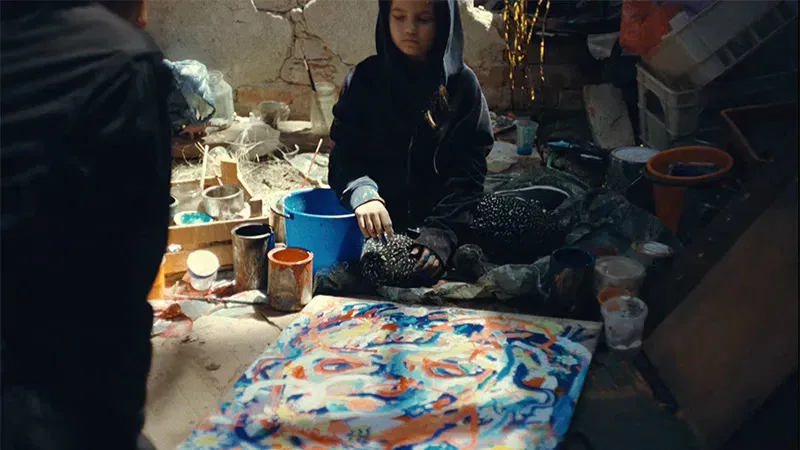
A Canadian curator and sad dad is working for a Quebecois collector in Nina Roza, a film that premiered this week at Berlinale. His rich boss is doomscrolling and stops on a viral video that shows a child prodigy finger painting in a Bulgarian barn. Her abstractions, she explains to the camera, depict the cosmos; anyone who sees them as mere paint, she says, is “dumb.”
The wealthy collector shares the video with his personal curator, giddy with glee and declaring that he wants to buy one of her paintings. Our depressed curator is instantly dismissive, quipping that you simply cannot trust Bulgarians. They are so poor, he says, that they have no choice but to scam. He strongly advises getting her paintings authenticated before paying a dime; the video proves nothing.
What does this Canadian curator have against Bulgarians? The film tells a story of man versus self. It turns out that the curator is a self-hating Bulgarian immigrant who hasn’t been back home in 28 years. Born Mihail but known in Canada as Michel, he refuses to let his grandson learn the language: it’s useless, he protests when his daughter suggests the idea. None of them even have Bulgarian friends.
But our collector is hellbent on obtaining those mediocre finger paintings—or, more accurately, the perceived purity of the child villager. He insists that, if all Bulgarians really are scammers, then he can’t trust anyone on the ground to authenticate them. So Michel/Mihail must be the one to go and lay eyes on the 8-year-old to determine if she really paints all by herself. Any interference from adults, after all, would ruin the rawness of the work.
Sounds like a funny film, doesn’t it? I regret to inform you that Nina Roza is deadly serious. Judging from the forlorn facial expressions, I don’t think the jokes simply got lost in translation. Its self-seriousness rivals that of The Brutalist, another film seemingly warning against the pretentiousness of the creative class that is itself cloyingly dramatic.
Nina Roza revolves around a trauma plot in which the curator character must face his past, specifically the country he left the minute his wife died. When he departed, he cut all familial ties with the excuse of giving his daughter Roza a better life. Fair enough, but he could have called, as his angry sister points out when he shows up at her door unannounced and nearly three decades too late. When a gallerist tries to provide the same path for the finger painter named Nina—to invest in her future by whisking her away to Italy—Mihail helps the budding artist get out of it, lending her a lighter to burn all her work. Apparently, he no longer buys the idea that the grass is greener in the Western art world. After all, here he is, doing as a rich man’s bidding against his will as a full-grown grandpa.
Still from Nina Roza, 2026.
The film tells a story that needs telling: the art world might have a savior complex, but it will not save you—and making it always has a catch. If only the movie’s characters were were more dynamic. We learn that Michel/Mihail has softened toward his homeland when he gets drunk on rakija and starts singing along with villagers to the national anthem. I wished this prodigal son had shown his repentance with a bit more personal touch. Junebug (2005), after all, tells a similar story: newlywed artsy types return to North Carolina—the home of the husband, George—in search of a self-taught artist, only to discover something about themselves vis-à-vis their family. Reckoning with where he came from, George is both reminded of and softens on all he tried to escape, the black-and-white giving way to shades of gray. But Junebug blends drama with comedy, and its characters are unforgettable: the film, after all, was Amy Adams’s breakout role. Instead, Nina Roza gives us a spunky Yoda-like phenom, cute but wise and speaking in age-inappropriate aphorisms. She is not uninteresting, just unconvincing.
Nina Roza’s most complicated character might be the art world itself, but even that portrayal leaves something to be desired. The director, Geneviève Dulude-De Celles, warns by way of an 8-year-old that one can love art but hate the art world, that all the machinations and marketing a creative career demands can ultimately defeat the entire point. An Italian gallerist promises a new life for Nina, but Mihail silently senses her less altruistic motivation: profit. And anyway, Nina wants to stay with her family and friends. Bizarrely, no one ever questions Nina’s my-kid-could-literally-do-that abstraction, nor makes a case as to why her finger paintings are any good. A rich man simply sees that they are popular on the internet, and that is all it takes. I like to think it works that way only sometimes.
What is the good life, and how do you get it? Nina and Roza took opposite paths, but we don’t know who is happier (how could you compare?) or even were Nina ends up later in life. All we know is that what the establishing shots show us: the grass is literally greener in Bulgaria than it is in Montreal.
