







Leonora in the Morning Light, a new film about the British Mexican Surrealist painter Leonora Carrington (1917-2011), is based on a novelisation of her life by Elena Poniatowska simply titled Leonora (2011). But the film takes its title from a different fictional account of Carrington’s life, written by Michaela Carter and published in 2021. This is an early indicator of the somewhat confused nature of the movie’s blending of fact and fiction.
Poniatowska, the 94-year-old French-born Mexican journalist, knew Carrington personally. In fact, the artist illustrated many of her books. Both women were feminists who had fled Europe in the early years of the Second World War, and both came from aristocratic backgrounds they rebelled against. Poniatowska knew that the best way to capture Carrington’s tumultuous, artful life was to turn it into a fable—like in the Surrealist parlour game Exquisite Corpse, where participants take turns writing or drawing on paper, fold it to hide their entry and pass it to the next person to add theirs. Leonora in the Morning Light follows in a similar spirit of storytelling.
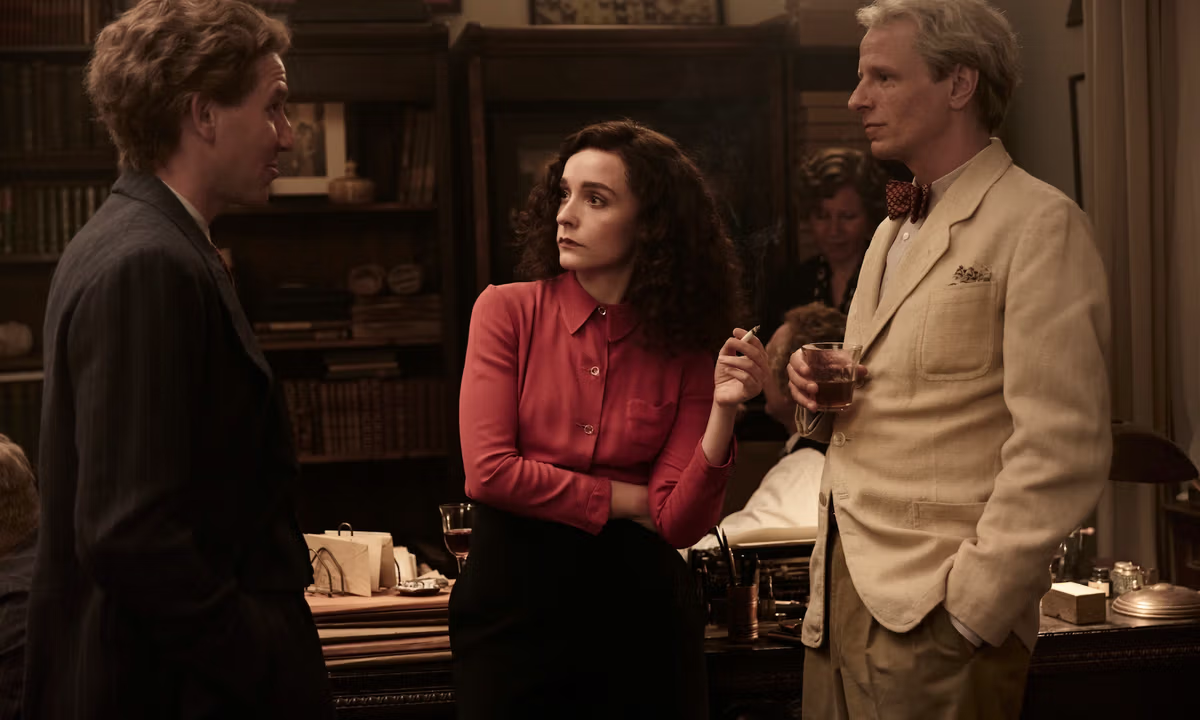
Directed by Thor Klein and Lena Vurma, the non-linear film begins in Mexico in 1951 with Carrington (Olivia Vinall) visiting Edward James (Ryan Gage), an eccentric English patron who also collects works by Salvador Dalí and René Magritte. James lived part-time in Mexico and created Las Pozas, a surrealistic sculpture garden in the Sierra Gorda rainforest with a platformed tower that Carrington climbs during her stay. The film then jumps back to 1930s Paris, where Carrington joins her new lover, the German artist Max Ernst (Alexander Scheer). While they work, she declares: “I hide many images away deep inside me, so they won’t discover me. I still don’t know what I am.”
Carrington’s feminism is on full display at a gathering where the French writer André Breton (Denis Eyriey) opines about Surrealism’s idealisation of women. “The Surrealist revolution is only conceivable through the muse,” he says, “and especially the woman-child who, thanks to her ingenuity, is in direct contact with the unconscious.”
These words echo those of Dalí (Cat Jugravu), who says of Carrington: “Look at her. Isn’t she the essential woman-child? Leonora, Max’s amour fou. You are closer to purity than a man can ever get.” To this, Carrington responds: “I’m no such thing… Do you also call your wife a muse? This definition of women is absurd. The Surrealists call their women muses, but the women still end up changing the sheets. And doing the cooking.” Breton’s reply: “Leonora, I adore you.”
Film still of Leonora at Las Pozas © Mirjam Kluka, Dragonfly Films, Alamode Films
Carrington and Ernst retreat to Saint-Martin-d’Ardèche in the south of France, making bas-relief sculptures in their garden and swimming nude. But in 1939, at the outbreak of the Second World War, Ernst is arrested by the French government because of his German heritage. Carrington suffers a breakdown but manages to escape to Spain, where she is institutionalised after being found roaming the streets of Madrid. Her father pays for her treatment in Santander, including electroshock therapy and injections of a drug that causes seizures.
This is an instance where the story diverges from fact. While Carrington did suffer emotionally and was hospitalised, the film attributes this to Ernst’s incarceration. In fact, he was released quickly as a result of the intervention of high-profile friends, although he was arrested again by the Nazis during the occupation. In Madrid, Carrington was gang raped by Francoist soldiers, which is never mentioned in the film.
Back to the story. Carrington is released and suddenly appears in Mexico. There, she flashes back to her aristocratic childhood in England, where she identifies strongly with animals and claims she is a horse. The connection between madness and artistic genius persists when Carrington erupts at her own exhibition opening in Mexico City, causing a scene at the gallery.
Carrington’s art and life later find harmony in Mexico City. She is now married and has two sons with the Hungarian photographer Chiki Weisz (István Téglás)—the darkroom manager for Robert Capa during the Spanish Civil War—who also escaped to Mexico during the Second World War.
In Mexico, Carrington makes strong connections with local Indigenous women and local art. A woman named Ximena tells Carrington of the ancient city of Tamtoc—run by priestesses who made sacrifices for trees to grow and the sun to shine, and who knew the cycles of the moon and its effect on the tides. Carrington’s art incorporates all of these tales and more, and it is here that she discovers who she truly is.
Watch the trailer for Leonora in the Morning Light:

- Leonora in the Morning Light is currently screening in Dublin and throughout England and Scotland


