








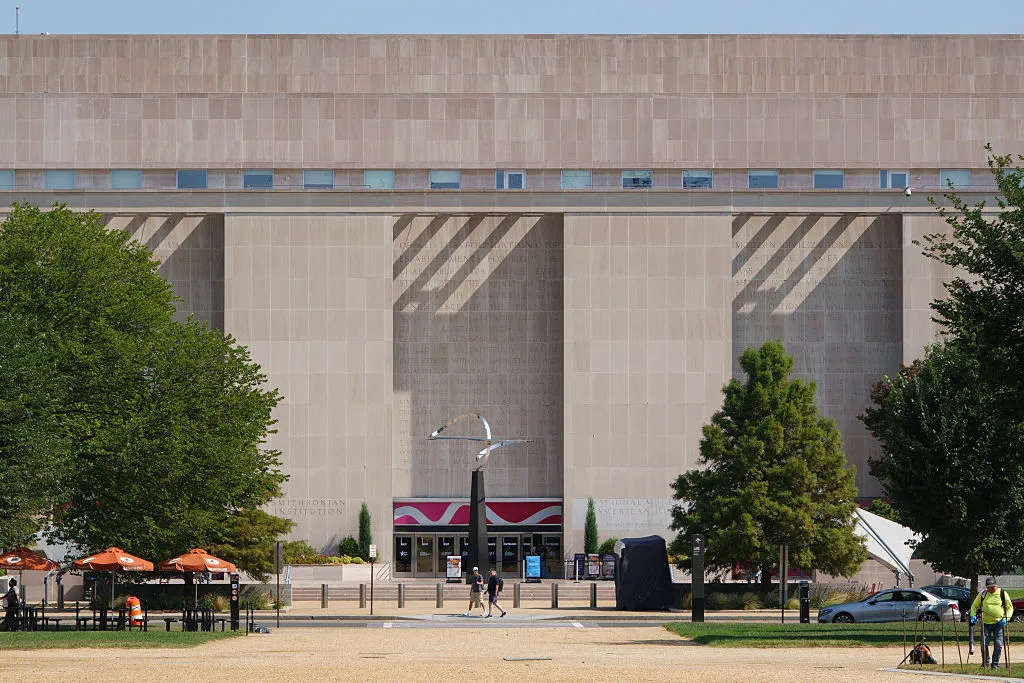
The Trump administration has proposed the Smithsonian Institution’s leanest budget in nearly a decade, along with staff reductions, as its campaign against the museum over its ideological direction takes an expected turn.
For fiscal year 2027, the White House has proposed giving the Smithsonian $961.3 million in federal funding, roughly an 11 precent cut from the $1.08 billion Congress provided to it fiscal year 2026 and the institution’s lowest proposed funding level since at least 2020.
The reductions would fall most heavily on facilities spending, which would drop by about 21 percent from $152 million in fiscal 2026 to $120 million under the new proposal, reducing it from roughly one-seventh to about one-eighth of the Smithsonian’s overall budget. The proposal would provide $841.3 million for salaries and operating expenses and $120 million for facilities and capital projects.
The proposal would reduce the Smithsonian’s federally funded staffing by about 6 percent, cutting the equivalent of full-time positions from 4,047 in fiscal 2026 to 3,804 under the fiscal 2027 request. It would also cut the salaries and expenses account by $87.2 million, bringing it from $928.5 million in the current fiscal year to $841.3 million.
“Our national fundraising campaign, only the second such Institution-wide effort in the history of the Smithsonian, is helping us advance these goals. Yet donors are naturally drawn to the excitement of new museum openings and exhibitions, rather than the ongoing budget needs of staffing, maintenance, and operations, which rely heavily on federal support. In short, federal funding allows us to preserve our heritage, serve the public, and plan responsibly for the future.
ARTnews has contacted the Smithsonian Institution for comment.
President Trump has kept the Smithsonian in the headlines for months as a target of his second administration’s push against what it calls “anti-American” interpretations of history. In July, Smithsonian National Museum of American History Director Anthea M. Hartig faced two contentious congressional hearings over a White House report that accused the museum’s programs and exhibitions of “extreme political activism.” Republican lawmakers questioned Hartig in particular about exhibitions focused on transgender and feminist American history, while some challenging her patriotism. Hartig defended the museum’s scholarship as “fact-based” and said it was committed to telling a complex story of America through “competing perspectives.”
Days after the hearing, the White House released a directive ordering the installation of signs outside the National Museum of American History to flag what it called “inaccurate information” in exhibitions that “should be renovated” in accordance with the report. The signs would also direct visitors to locations, not yet identified, where the administration says American history is presented more accurately.
The directive also ordered several high-ranking government officials, including the Interior Secretary and the director of the Office of Management and Budget, to “restore trust in the Smithsonian Institution” and ensure the museum complies with the White House’s findings.
President Trump’s second term has already brought major proposed cuts to the National Endowment for the Arts, the National Endowment for the Humanities, and the National Park Service, including rescinding grants awarded to organizations the administration has characterized as “woke.” Meanwhile, the administration’s fiscal 2027 budget would boost defense spending to $1.5 trillion—a proposed 44 percent increase—underscoring the growing gulf between federal investment in national security and the resources available for cultural institutions.


