
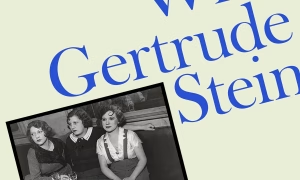





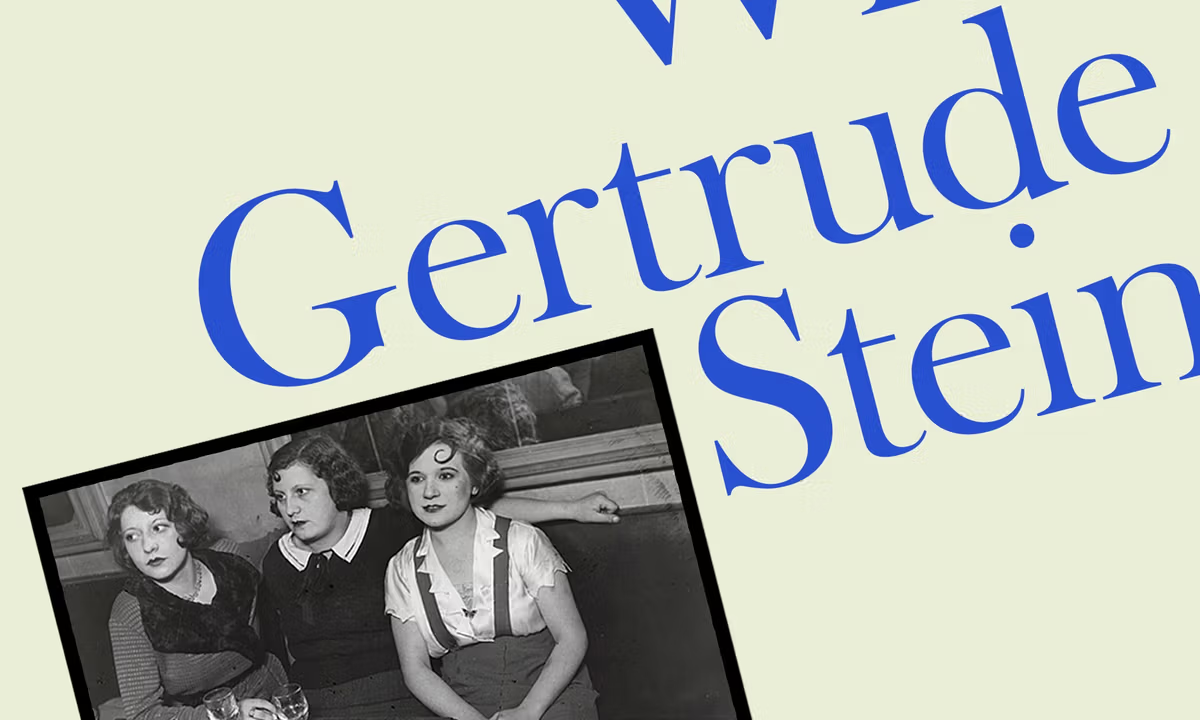
I came to Deborah Levy’s latest book as a keen admirer of the titular figure, Gertrude Stein (1874-1946), the American writer and art collector, whose Parisian flat, which she shared first with her brother Leo and later with her de facto wife Alice, became the nucleus of the artistic and literary avant-garde before the outbreak of the Second World War.
Stein looms large in the contemporary imagination, despite not coming to prominence in her own lifetime until her last decade or so. Her salon and its influence on the most important artists and writers of the day was immortalised in Ernest Hemingway’s posthumous memoir A Moveable Feast (1964); portrayed on screen in Woody Allen’s 2011 film Midnight in Paris, with Kathy Bates as Stein; and, of course, depicted in Stein’s own memoir, the curiously titled Autobiography of Alice B. Toklas (1933), told from her partner’s perspective. In London, Stein is reflected in the concept of trendy restaurant and bakery Toklas, opened in 2021 by the founders of Frieze. And now, thanks to Levy, she can be found on the new fiction table of seemingly every bricks-and-mortar bookshop.
The fascination with Stein and “why she matters” is the driving force for Levy’s narrator, an unnamed British writer who has come to Paris to write an essay on the artist, as the reader is often reminded. It is not clear why the essay is being written, nor for whom or even for when, as the narrator thinks deeply about Stein’s biography from medical student to Modernist maven, and laboriously types out long quotes from her various poetry and prose. (Why?, one wonders, given so much of Stein’s oeuvre can be found online and easily copied and pasted.) The narrator does not appear to take advantage of the Parisian setting to research Stein and her pioneering collection of Modern art, once housed at 27 rue de Fleurus, although she does make a couple of forays to Père Lachaise cemetery to find Stein’s grave. Rather, the narrator spends most of her time in the French capital hearing of the romantic exploits of her financier friend Fanny and searching for the lost cat of another friend, a starry-eyed illustrator called Eva. The cat’s name, Eva insists, is “It”, an appropriately Modernist designation that allows Levy to play with Steinesque diction in phrases reminiscent of the latter’s oft-quoted maxim: “Rose is a rose is a rose is a rose.”
Ironically, Levy’s story becomes most compelling when focusing on these well-wrought fictional women or when delving into asides on some of Stein’s contemporaries and Modernism’s lesser-known women, such as Alice James, sister to writer Henry and psychologist William, and Hortense Fiquet, the wife of Paul Cézanne, who complained she “only cares for Switzerland and lemonade”. Levy also uses the narration, which fluctuates between the Parisian present and Stein’s past, to draw apt comparisons between these alarmingly complementary time periods. “Gertrude Stein wanted to kill the nineteenth century,” she writes. “The twenty-first century seems to be killing itself.”
Enigmatic influence
Stein was a heavyset, lesbian, Jewish woman living in Europe in the lead up to the Holocaust, with a “look like a Roman emperor”, as Picasso depicted her in his portrait now housed at the Metropolitan Museum of Art, New York. And yet as a Parisian expat (nay, immigrant—she lived in France for over four decades), she found the literary success and artistic respect that she so craved.
So, how did a woman whom everything was against become a
tastemaker in a male-dominated avant-garde scene, to the point that these
men, many of whom were notoriously misogynistic, craved her opinion and approval? Aside from the self-proclaimed “genius” and family wealth that permitted Stein her art collecting—albeit when artists such as Cézanne and Henri Matisse were relatively cheap—as well as, crucially, the freedom to live independently and spend her time writing and hosting salons, the narrator never quite gets to the bottom of Stein’s enigmatic influence despite the odds. It seems that even a year with Gertrude Stein, or a few days with Levy’s slim novel, is not time enough to find out.
- Deborah Levy, My Year in Paris with Gertrude Stein: A Fiction, Hamish Hamilton, 240pp, £18.99 (hb), published 16 April
- Rachel Kubrick is an American art journalist and editor based in London


