
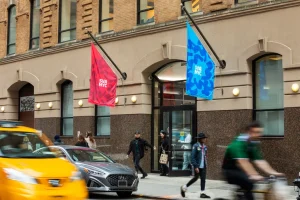






Amid a broad crisis in higher education in the US resulting from demographic trends and a combative Trump administration, enrollment at New York’s School of Visual Arts (SVA) is down some 34 percent since 2019, and the school faces a $22 million structural budget deficit, “the largest in its nearly 80-year history,” according to a previously unreported July 1 email to faculty and staff from interim president Christopher J. Cyphers.
The school’s annual operating budget is around $200 million. SVA is largely dependent on tuition; full-time tuition is $55,270 annually for the coming school year.
The drop in enrollment is partly due to the so-called demographic cliff, a plunge in enrollment resulting from a drop in birth rates in the US at the advent of the Great Recession, starting around the end of 2007. The email also puts the crisis partly down to “the ongoing dismantling of education and the arts by the federal government, and an onslaught of threats to immigration policies that directly affect our international students.”
Cyphers, who had been provost since 2017, was named interim president on June 1, taking over from David Rhodes, of the school’s founding family, who had been president since 1978. Enrollment in 2019 was the highest the school had ever experienced, he explained in a phone interview.
The school has seen major changes in recent years. The faculty opted to unionize last year, with 77 percent voting in May in favor of joining the United Auto Workers. Most of the school’s teaching corps is made up of adjunct faculty, who unionized in response to what they called stagnant wages and heavier course loads, among other conditions. Then, in September, the Rhodes family, which owned the for-profit school for nearly 80 years, transferred ownership to the nonprofit SVA Alumni Society. That was followed in February by the news that the school would shut down its curatorial practice MFA program, established by Steven Henry Madoff in 2013, in 2027; in an email to faculty announcing the news, Madoff cited the school’s “financial challenges.” Cyphers pointed out that the school has also shut down two other programs: a Master of Professional Studies in digital photography and a low-residency MFA in art practice.
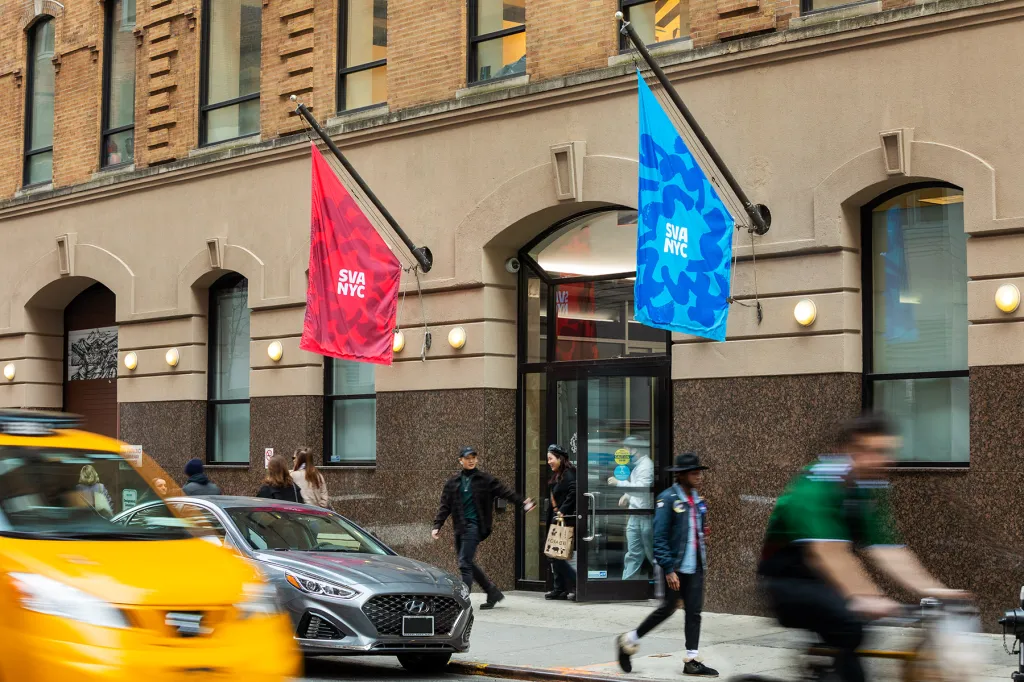
School of Visual Arts.
School of Visual Arts
SVA counts numerous widely known and respected artists among its faculty, including Tom Burr, Andrea Fraser, Brian Donnelly aka KAWS, Joseph Kosuth, Sol LeWitt, Elizabeth Peyton, Collier Schorr, Lorna Simpson, and Sarah Sze.
SVA’s situation is far from unique, pointed out Deborah Obalil, president and executive director of the Association of Independent Colleges of Art and Design (AICAD), in a phone interview. AICAD represents nearly 40 art schools throughout the US and Canada. “About two-thirds of our membership have seen declining enrollment,” she said. “Very few schools are back to 2019 enrollment numbers. Many independent colleges of art and design have gone through some round of restructuring or layoffs, some of them multiple.”
Some art schools have not survived. San Francisco’s California College of the Arts will close in 2027. Philadelphia’s University of the Arts closed abruptly in 2024. The failing San Francisco Art Institute was acquired by the University of San Franciso in 2022.
New York’s New School, home of Parsons School of Design, laid off nearly 90 employees in June, including some tenured faculty, and eliminated some programs in response to a $50 million annual deficit and a $160 million accumulated deficit. Provost Richard Kessler, speaking to ARTnews, also cited changing Trump administration policies.
As ARTnews reported in 2025, American art schools are heavily dependent on international students; stringent new restrictions on immigration in the Trump administration have spelled major trouble. At the time of that report, international students made up some 50 percent of the student body at SVA.
Also driving down enrollment, Cyphers said, was a widely publicized 2024 fiasco with the portal through which students submitted the Free Application for Federal Student Aid (FAFSA), which the Department of Education revamped under President Joe Biden and was released three months late, in the last days of 2023, in what NPR called “a slow-motion explosion of mistakes and miscommunication.” As a result, Cypher said, about 600,000 first-time full-time freshmen did not matriculate that year.
Furthermore, Cyphers pointed out, Congress last year removed a safety net program associated with the Parent PLUS loan; the federal government eliminated the Federal Direct Graduate PLUS (Grad PLUS) Loan program; and Congress voted to cap student loans for most graduate students at $20,500 per year.
“It’s just really become a perfect storm,” he concluded.


