


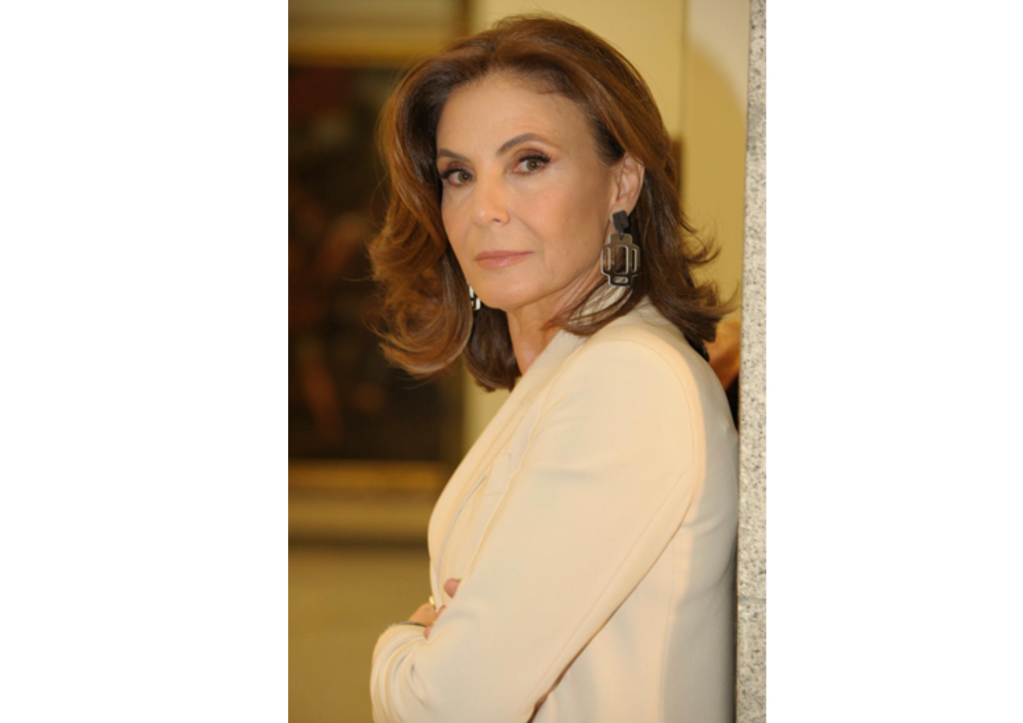
Carmen Reviriego talks less like the head of cultural foundation than someone building an engine. On a warm evening in Madrid, at the Royal Academy of Fine Arts of San Fernando, she moved through the International Patronage Awards with calm efficiency, greeting patrons (like ARTnews Top 200 collector Batia Ofer, this year’s winner of the foundation’s International Patronage Award), warmly hugging artists, and shaking hands with public officials as if she were assembling a coalition in real time.
She is the founder and president of the Callia Foundation, the organization behind the awards, now in their 11th edition. The project began with her book La Suerte de Dar (The Luck of Giving) and has since become one of Spain’s most visible platforms dedicated to private support for the arts. Beyond the ceremony itself, the foundation funds restorations in Spain’s public collections and convenes the International Council of the Royal Collections in collaboration with Patrimonio Nacional.
An art historian by training, Reviriego also studied marketing and business, and began her career in finance. “My brain is that of an executive,” she told me over lunch near Madrid’s Plaza de Independencia. “All my effort and intelligence are focused on achieving the greatest possible impact.” The mix of scholarship, strategy, and passion defines her approach, as does her insistence on measuring cultural change, not just celebrating it.
Callia’s guiding argument is direct: without patrons, many great artworks would never have existed. ARTnews spoke with Reviriego about the shifting balance of public and private support in Spain, generational tensions in philanthropy, and what she hopes the foundation will make possible in the years ahead.
The Callia Foundation’s annual patronage awards celebrate private support for the arts. What role do you believe patronage plays in Spain’s cultural ecosystem today?
In Spain, things have changed in a very positive way and continue to evolve toward a mixed model—one that, for example, helped prevent layoffs in the cultural sector during the pandemic crisis. We can identify three models: the British and American model, where private patronage carries enormous weight; the European model, where the public sector generally still plays a predominant role; and the Canadian model, which is more balanced. Spain is moving toward that balance.
Across the EU, I would speak of cultural changes, legislative changes, and financial changes, all occurring at different speeds, but all connected. Financial growth is the result of the first two. In Spain, although we do not yet have the scale of major patrons seen in France, those who do exist resonate more visibly. That is where we work: providing visibility that influences cultural change, which in turn influences legislative change. Together, they create the conditions for a more balanced system.
Spain has traditionally relied strongly on public funding for culture. Do you see private patronage evolving here, and if so, how? What about globally?
What interests me most is not only the figures, but the substance: a love of art and the conviction that the more art we have, the more cohesive and harmonious our societies become.
Spain’s fundamental patronage legislation dates from 2022. Even then, it acknowledged that private support had grown more rapidly than expected. Legislation often lags reality. I am confident further positive changes will come. France offers a useful example. After the Aillagon Law of 2003 introduced major tax incentives, individual donors increased from 1.3 million in 2005 to 5.4 million in 2022. Corporate patrons grew from 12,000 to more than 105,000. Hundreds of new cultural foundations and endowment funds were created. Today, culture is one of the most supported areas of corporate philanthropy in France.
In Spain, we lack equally comprehensive official data, so it’s difficult to make direct comparisons. But private support has steadily increased. During the 2008 financial crisis, as public sponsorship declined, the relative weight of private funding grew.
I apologize for the dryness of data—it is like speaking about the balance sheets of the Medici Bank instead of Botticelli’s Primavera. But it is essential to understand what we seek to do with the Awards: foster a shift in mentality and encourage the creation of new patrons.
When you founded the Callia Foundation, what gap were you hoping to address within the Spanish arts landscape? Does the U.S. have the need for a similar foundation?
After publishing La Suerte de Dar, I was struck by a shared idea among major patrons: not how much they had given, but how much they had received. Giving transformed them. I wanted to contribute to that transformation in others. I conceived the Callia Foundation as an incubator of patrons—bringing together figures from Spain, Latin America, and internationally. The heart of Callia is not one individual. It is the community of patrons who believe in art as a shared responsibility.
How do you define the difference between a collector and a patron?
That is an amazing question. Let me be disruptive: is there really a difference? I believe such a distinction is often overstated. What greater act of patronage exists than using one’s own money to buy works from living artists and support the very possibility of art coming into being?
The production of art is wrongly reduced to an artist-artwork binomial. Great works endure because someone supported the artist and preserved the work. The Sistine Chapel makes no sense without Julius II. The Royal Collections would not exist without the patronage of Philip II and Philip IV. What began as public-private initiative is now national heritage belonging to the citizens.
In selecting honorees for the annual awards, what qualities or commitments matter most to you?
Values. Capacity for dialogue. Passion for art as an instrument for improving societies and individuals. Diversity without renouncing identity. Long-term vision. A sense of legacy. I believe in custodianship rather than ownership—holding a work in trust for future generations, with openness to local and global audiences. And above all, human substance.
Have you observed a generational shift in how younger philanthropists approach cultural support?
Yes, both positively and negatively. Patronage is an intergenerational dialogue. One generation contributes its values, and the next builds upon them with its own. I am less interested in patrons who see art sponsorship merely as possession or as a place to deploy surplus capital. We live in a time of paradigm shift. For me, the history of art is a continuity between generations. Where each person believes everything begins with them—what we call “adanism”—I do not connect.
Looking ahead, what would success for the Callia Foundation look like in five or ten years?
Our structure is particular. We reward patronage, but that obliges us to practice patronage ourselves. We are not observers. We will continue consolidating the Awards and strengthening collaboration with institutions. The International Council of the Royal Collections has only just begun. Our goal is to make it an exemplary model of public-private partnership.
In the coming years, we will support restorations such as El Greco’s The Martyrdom of Saint Maurice. One cannot understand Picasso or modern art without El Greco—and all that work must be seen as it was meant to be seen.
