


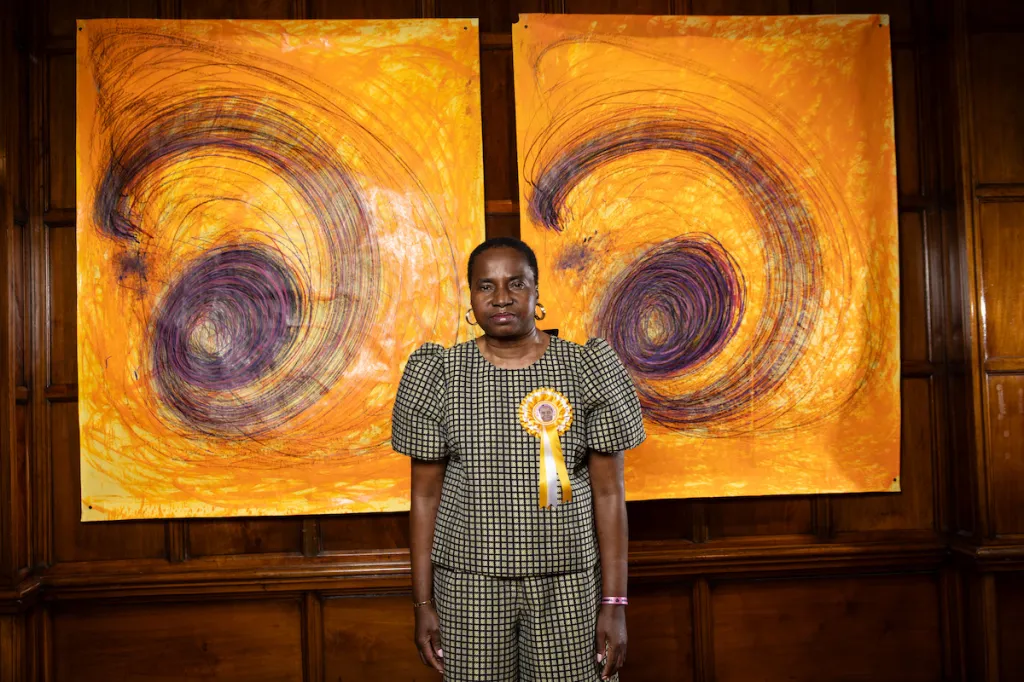
The Turner Prize, England’s most high-profile art award, has named Nnena Kalu as its 2025 winner. She will take home £25,000 (about $33,300), while the three other shortlisted artists will receive £10,000 ($13,000).
Kalu is officially the first-ever learning-disabled artist to win the award, which has in past years gone to artists such as Anish Kapoor, Wolfgang Tillmans, and Lubaina Himid. She is also one of the few Black artists ever to have received the prize.
She is known for sculptures resembling cocoon-like forms that she strews with videotape, cellophane, and other unconventional materials. Since 1999, Kalu, who is autistic and is largely unable to speak words, has worked with the London-based nonprofit ActionSpace to create her art. Only recently, however, has her work begun to appear in commercial settings, with the London gallery Arcadia Missa taking her on last year.
Kalu also makes drawings with dense, spiraling forms that record her repetitive motions as she works.
“When Nnena first began working with action space in 1999, the art world was not interested,” said Charlotte Hollinshead, the head of artist development at ActionSpace, said at a ceremony in Bradford on Tuesday night. “Nnena has faced an incredible amount of discrimination that continues to this day, so hopefully this award smashes that prejudice away. Nnena Kalu, you have made history!”
A statement from Tate, the museum network that runs the Turner Prize, said, “The jury commended Kalu’s bold and compelling work, praising her lively translation of expressive gesture into captivating abstract sculpture and drawing. Noting her distinct practice and finesse of scale, composition and colour, they admired the powerful presence these works have.”
That jury was led by Tate Britain director Alex Farquharson and also included Andrew Bonacina, an independent curator; Sam Lackey, director of the Liverpool Biennial; Priyesh Mistry, associate curator of modern and contemporary projects at the National Gallery; and Habda Rashid, senior curator of modern and contemporary art at the Fitzwilliam Museum.
This year’s Turner Prize shortlist was notable for its diversity. Rene Matić, a photographer known for diaristic shots of friends and loved ones, was the second-youngest person ever to be nominated for the Turner Prize. Painter Mohammed Sami and sculptor Zadie Xa, meanwhile, were born outside the UK, in Iraq and Canada, respectively.
All four artists are currently exhibiting their work at the Cartwright Hall Art Gallery. Early reviews of that show suggested that Sami had emerged as the clear winner.
Founded in 1984, the Turner Prize once stoked controversy for awarding provocative art, though it tends to be divisive for other reasons today. In 2019, for example, the prize polarized critics when its four nominees decided to jointly share the award.
