


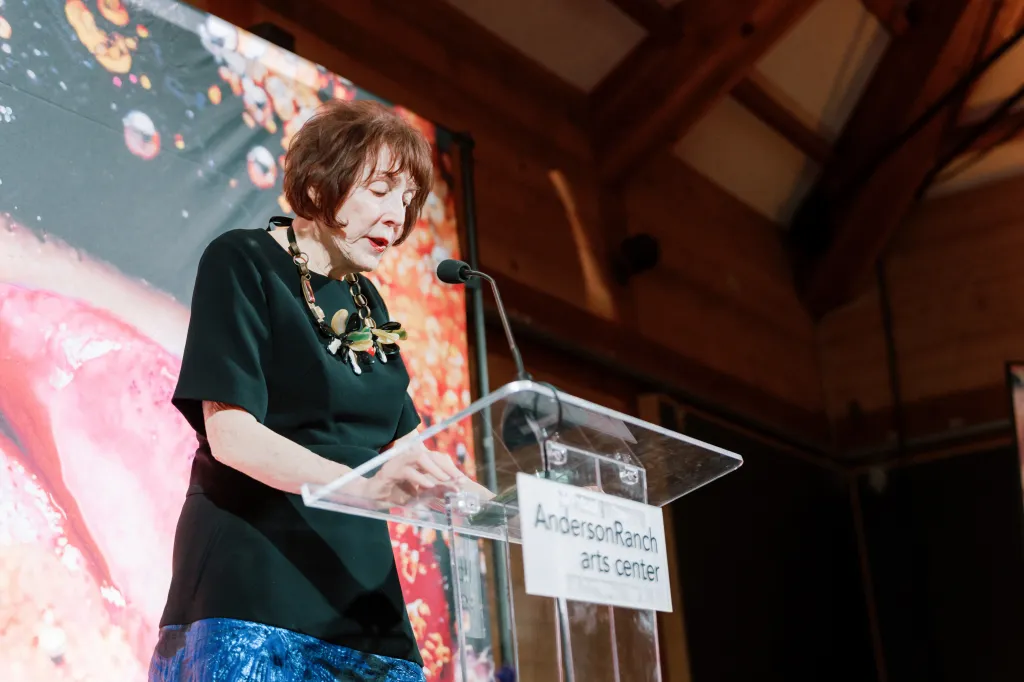
The Anderson Ranch Arts Center, a five-acre complex of studios and artist housing in Snowmass, Colorado, that offers workshops and residencies, is often called a maker’s paradise. You understand that moniker upon arrival: Once you get over the 8,000-foot elevation, you feel energized, breathe in the crisp air, behold your bucolic surroundings—mountains dotted with the watching eyes of aspens—and want to revel in making something, even something as banal as your morning coffee.
When I was at the Ranch in mid-July for its 60th-anniversary celebrations, for which ARTnews was a media sponsor, that crisp air had a threatening edge, that crisp air had a threatening edge: It was so dry it seemed like you could start a fire simply by thinking about one. Dry enough that the arrow on the daily fire danger rating board outside the Snowmass Wildcat fire station had swung all the way into red (“extreme”). Dry enough that the Ranch’s artists needed special permission to fire up the kiln. Dry enough that the first five letters of the dress code for the annual gala—“Sparkle”—formed a word that sounded almost transgressive.
The Ranch is situated nine miles away from Aspen in a kind of holy trinity with the local fire station and the local chapel, each side of the triangle about the length of a football field. “It’s mind, body, spirit,” Ranch president Peter Waanders told me. The studios and workshops are arranged such that artists are encouraged to move among them—a painter to the ceramics studio, a ceramics artist to photography. The more I learned about the Ranch, the more I thought of it as synonymous with artistic fluidity, a kind of freedom. Its founder, Paul Soldner, was one of the ceramics practitioners in the 1960s who, like Peter Voulkos, his teacher, freed the clay arts from their strict association with traditional pots and other vessels; he pioneered a new form of Japanese raku that came to be known as American raku.
The importance of making to the human spirit is baked into the Ranch’s origin story. Soldner would never have created the Ranch if he hadn’t become an artist, and he might never have become an artist had a prisoner of Austria’s Mauthausen concentration camp not made charcoal drawings on the walls of his cell. As a young medic in the US, Soldner saw those drawings when his division liberated the camp. Although he’d started taking photographs during his service, he’d planned on becoming a doctor upon his return to America but, his daughter said in a recent lecture, those drawings pushed him in the direction of art. He pursued ceramics; in 1966, he created Anderson Ranch.
Back then, the Ranch was, as veterans of the place have recalled, little more than a kiln in a field. Over the years, a hot tub Soldner jerry-rigged on the grounds has become a metaphor for what the place was like in the early days. “There was a lot going on in the hot tub other than hot tubbing,” artist Lee Lyon said in an interview in 2012. Waanders told me that about an artist who visited recently recalled driving out to the Ranch in those old days, when there wasn’t a single tree on the property, sleeping in his car, and showering with the garden hose outside the shed. Even after it started to professionalize in the 1970s and ’80s—women were told they had to wear bras and the infamous hot tub was dismantled—the Ranch still saw plenty of colorful characters. Caleb Bach, an early director, “was once a CIA agent in Argentina, and his cover was being an artist,” an artist related in a book devoted to the Ranch’s history. “He painted for years, waiting for a Russian director that never arrived.”
Since then, the Ranch has grown—and grown some more. Its operating budget, according to the most recent filings, is $7.6 million; Waanders told me the current endowment is around $17 million. In the ’80s, there were around 175 students per summer. Now, the Ranch operates year-round, and there are over 1,200 students. This summer, Waanders said, has seen the highest enrollment of students in the history of the Ranch. As for facilities, there’s a high-tech digital fabrication lab, state-of-the-art printers (3D and otherwise), a scholarship program, and a robust visiting artist program.
Aspen and the area around it have also changed. The average home price in Aspen and its environs is $14 million. I was told that there is a saying: If you live in Aspen you either have three homes (the other two in, say, New York and Palm Beach) or three jobs. A few years ago, Richard Carter, an Aspen-based artist who was around during the early Ranch days, told a local newspaper, “It’s not like it used to be. I don’t have studio assistants anymore; they had to move. I had an incredibly talented carpenter I’ve worked with for years who had to leave because he couldn’t afford it here anymore.”
Anderson Ranch is in an interesting position today: Even as it seeks to be in dialogue with the contemporary art world, what the people in the contemporary art world value about it is its separateness from the rest of that world they inhabit. Curator Helen Molesworth has said that she loved the lack of the kind of politics she’d experienced in museums and “the Utopian summer-camp vibe of ‘we’re all just here making stuff together.’” One of the Ranch’s strengths, she said, is its heterogeneity: “You have everyone from Simone Leigh to a Sunday painter. If you put art-making at the center… all of those divisions fall away, and we can have different kinds of conversations.” Waanders told me he loves the fact that the Ranch is somewhere you can see a billionaire sitting next to a scholarship student, both of them learning how to paint with watercolors.
Waanders came to Anderson Ranch in 2019 from the Aspen Institute, where he was the director for the Society of Fellows and expanded its reach to year-round events in cities around the US. Unlike most of his predecessors, he is not an artist, but he’s been involved in the arts and ideas world in Aspen for 25 years, long enough to know some of the early Ranch artists. When he was first hired he was to work alongside a rotating curator in residence, but after bringing in Molesworth for a couple years and then Douglas Fogle, he has since dropped that role, having determined that his core staff has gotten as much as they could have from such guidance.
Six years into his tenure, Waanders has already outlasted all but two of the Ranch’s 13 previous directors. He told me he sees his mandate as building a new foundation for the Ranch to stand on while preserving its history and “the relationships that got us to where we are”—essentially, how to professionalize while keeping the spirit of the place.
“We’ve grown, which was one of my goals when I came,” Waanders told me in his office, fancy for the Ranch but still rustic. Over the past five years, the endowment has gone up by about $7 million. “About half of that is that the market keeps going up,” he said. “But some has been really generous gifts.” Earlier this year, the Ranch launched the Marie Figge Wise Master Printer-in-Residence fund and position, which will help maintain its Printmaking and Editions program with a gift from the William and Marie Wise Family Foundation. He told me that the Ranch just got invited to be a member of the IFPDA, the International Fine Prints & Drawings Association. Ranch president of artistic affairs Andrea Jenkins Wallace, who has been on staff for 18 years, told me that despite being larger more professionalized than ever, the place is still flexible. “We’re still very nimble…It’s not so big that we can’t just say, okay, let’s just do” this or that program.
Waanders said he’s looking at the next 10 to 20 years in both material and immaterial terms, with a focus on ongoing renovation and updating of its facilities and continuing efforts in thought leadership. “One mantra in the back of my head is I don’t want to lose what’s really special about this place,” he said. Pointing to a photograph of Dennis Hopper using then-new Photoshop software at the Ranch in 1995, Waanders said part of that includes investing in technology. “Among our peers, we were really early [in digital fabrication] and ours is integrated across all of our studios. That investment in technology is a constant drive, and technology has become more and more expensive.” The Ranch’s advanced CNC machines cost up to a quarter-million dollars. “I want to make sure we continue to be on that edge that is melding craft and fine art.”
He is also dealing with aging infrastructure. “Our campus was mostly built in the ’80s and ’90s, so all of my boilers are 40 years old,” he said. “It’s time for us to look at the campus and what it is going to be.” There also needs to be a big investment in the photography and new media facilities, which will probably involve replacing the existing building.
As for thought leadership, Waanders wants to continue having seminars on such subjects as the role of public art and issues related to race, class, and gender in the arts. “We’re going to invest a lot in building a seminar space and really lean into what’s going on in the art world and how collectors understand art as an artist’s intention versus art as a commodity,” he said.
The annual summertime gala week is an important time for the Ranch in terms of fundraising. The gala typically brings in a little less than a third of the money, Waanders told me, with the rest coming from “national council and major giving.”
Galas can be jarring at every art institution, where spaces typically populated by parents with strollers and senior citizens shuffling around are taken over by monied donors in all their finery. The contrast is even starker at the Ranch. Waanders, in our interview, drew a distinction between the Ranch and institutions in nearby Aspen, where “there’s a lot of diamonds and champagne glasses.” Here, he said, “you walk around in flats in the gravel and drink beer out of a bottle.” Still, there was much pomp and circumstance at the gala in July, and many thousands of dollars’ worth of clothing and jewelry plus plenty of vertiginous heels negotiating with the gravel. At a live auction, more than $1.6 million was raised for scholarships and programming, with the year’s artist honoree, Marilyn Minter, generously agreeing to donate not one but two portrait sessions to winning bidders. At one point I looked toward the back of the room and saw one of the artists I’d been with at an hours-long crit I’d sat in on earlier in the day, dressed very much at odds with the “sparkle” theme, hovering at the margins looking a bit bemused. The portion of the menu that made the most sense was the dessert: lowly doughnuts cut in half and fashioned into rainbows that captured the can-do spirit of the Ranch, the transforming of humble materials into something really special.
