


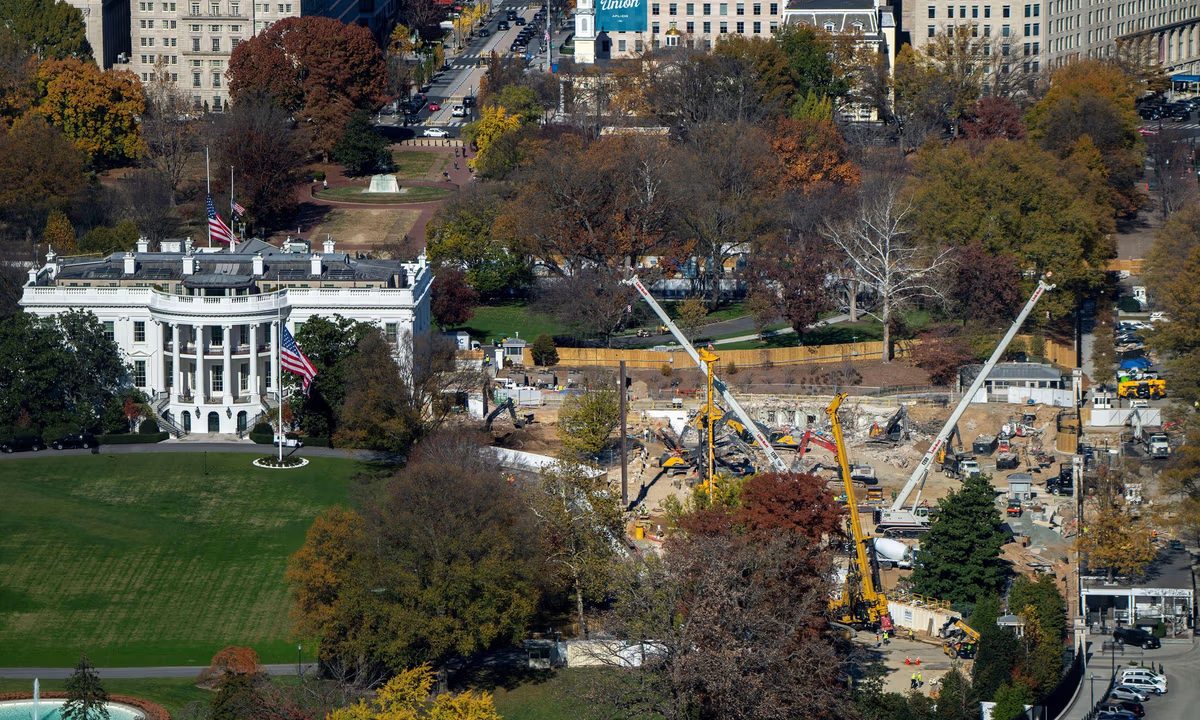
President Donald Trump’s efforts to reshape the US in his image are nowhere more apparent than in his personal involvement in the architecture of Washington, DC. In the past few months, the real-estate developer turned politician has torn down the East Wing of the White House in order to build a flashy $400m ballroom, added his name to the façade of the John F. Kennedy Center for the Performing Arts (which he announced would close for two years for major renovations starting this summer), suggested painting the exterior of the Eisenhower Executive Office Building (EEOB) all white to “beautify” it, and pushed plans to build an enormous triumphal arch near the capital’s historic centre. On top of that, 45 federal buildings overseen by the General Services Administration (GSA) have been targeted for “accelerated” disposal, raising alarms among preservationists and architectural heritage experts that these structures and the site-specific art they contain could be bulldozed overnight.
“For the first time of which I am aware, a president is personally involved in facilitating end-runs around the agency’s obligations to the buildings that are our national heritage,” Mydelle Wright, a former GSA senior official who oversaw the EEOB for nearly 20 years, testified in a lawsuit brought by Cultural Heritage Partners in November to block Trump’s whitewashing plans. “And who in the agency is going to tell him no?” The law firm withdrew its motion for a temporary restraining order after receiving assurances from the government that no work would be done on the building before 1 March.
But such assurances ring hollow to preservationists who witnessed Trump bulldoze the East Wing of the White House in October without warning, approval from federal agencies or public input on his plans for a ballroom on the site. That led to another lawsuit, filed in December by the National Trust for Historic Preservation against Trump, the National Park Service and several government officials; it seeks to halt any further construction until the ballroom plans undergo agency and environmental reviews and gain congressional approval. In a recent filing in response to government officials’ heel-dragging and obfuscation in the case, the National Trust’s lawyers warned: “They have, repeatedly, broken the rules first and asked for permission later.”
And despite promises from the government’s lawyers that construction on the ballroom would follow the necessary procedures, Trump started off the new year shopping for marble and onyx from a stone importer near his Mar-a-Lago estate in Florida, according to CNN.
The first public review of Trump’s ballroom took place on 8 January, when a broad overview was presented to the National Capital Planning Commission (NCPC)—led by Trump’s personal lawyer and White House staff secretary, Will Scharf, who enthusiastically supports the project. However, another member of the commission, Phil Mendelson (the chair of the District of Columbia’s city council), questioned the scale of the nearly 90,000-sq.-ft expansion—almost twice the size of the rest of the White House, and large enough to hold 1,000 people.
“I’m concerned about this addition overwhelming the original historic building,” Mendelson said, adding that the overall effect was “just so imbalanced”. (This issue was earlier alluded to by the project’s architect, Shalom Baranes, who suggested that balance could be achieved by adding a second storey to the colonnade leading to the West Wing.) Mendelson added that he was disturbed by the piecemeal way the project was being presented to the commission, with changes apparently planned not just for the East Wing site but also the West Wing and nearby Lafayette Square.
An unambiguous message
In addition to transforming the White House, Trump is personally invested in erecting a grand triumphal arch in the middle of Memorial Circle, a traffic circle on the Potomac River near Arlington National Cemetery, the main military burial grounds. He has said he wants the arch built in time for the US’s 250th-anniversary celebrations in July, and claimed construction would begin before March.
But while Trump has repeatedly shown off a small 3D scale model of the arch to reporters and White House visitors, there has been a lack of concrete plans. The 1986 Commemorative Works Act sets out a meticulous process for any new memorials in the capital—including requiring congressional authorisation, which often takes years. (A proposed memorial to women’s contributions during the Second World War, for example, was approved by congress in 2022 but its site on the National Mall is still waiting for a vote in the senate.) No budget has been given for the arch’s construction either, although Trump has suggested that any leftover funds raised for the White House ballroom would go to the project.
Equally concerning is the fate of the dozens of federally owned buildings the GSA has recently flagged for “accelerated disposition”, which could result in them being either sold or demolished. Many of these are listed landmarks and contain specially commissioned works of art dating from the New Deal era. Among them are four buildings in Washington, DC, that preservationists fear will be demolished: the Marcel Breuer-designed Robert C. Weaver Federal Building, which is the former headquarters of the Department of Housing and Urban Development and listed on the National Register of Historic Places in 2008; the Wilbur J. Cohen Federal Building, housing what has been called the “Sistine Chapel of the New Deal”; the GSA Regional Office Building, with its 22-panel series of paintings by Harold Weston; and the Liberty Loan Building, one of the last surviving examples of the “tempo” structures built to house federal workers between the world wars.
“I think that all four of the federal buildings in question are in real danger of being demolished without any notice, just like the East Wing of the White House this past October, and just like the Bonwit Teller building in Manhattan in 1980,” a former longtime GSA staff member tells The Art Newspaper, referring to a Fifth Avenue department store that Trump tore down to make way for Trump Tower. After promising to donate the building’s signature Art Deco limestone relief panels by the artist Rene Paul Chambellan to the Metropolitan Museum of Art—which was happy to accept a piece of architectural history for its collection—Trump changed his mind and jackhammered the sculptures to avoid further costs and delays.
“The demolition of the East Wing sends an unambiguous message: ‘We can do whatever we want, and nobody will stop us,’” says the former GSA staffer, who asked to remain anonymous for fear of reprisal. “I believe the demolition of the Cohen Building would send the same message. And there’s an additional symbolic benefit for this administration, because the Cohen Building was constructed under Franklin Roosevelt to house the Social Security Administration, and later housed offices for both Voice of America and the former Department of Health, Education and Welfare. All of these agencies and programmes are current political targets.” (An online petition to save the building has garnered thousands of signatures.)
The destruction of the Cohen Building would include the loss of a number of key works by artists including Philip Guston, Seymour Fogel, Ben Shahn, Emma Lou Davis, Henry Kreis and the twin sisters Ethel and Jenne Magafan.
“These artworks represent the ongoing and—especially today—vital work of making America a place where everyone can live with moral, social and economic dignity,” the former staffer says. While some of the works, like an auditorium screen painted by Guston and oil-on-canvas mural by the Magafan sisters, could be somewhat easily removed from the building with sufficient notice, other murals and reliefs were painted directly on or carved into the walls, making it very difficult and in some cases impossible to remove them.
“Historical art is like time travel: we can see the artists’ individual brush strokes and signatures as if they were painted yesterday,” the former staffer says. “We see the now-archaic clothing styles worn and machinery used by the figures in the paintings, which were previously contemporary. Once artworks like these are destroyed, those physical connections to our past that the artworks provided are gone forever.”
