


Controversy has once again reached the Venice Biennale, this time at the Kazakhstan pavilion, where artist Äsel Kadyrhanova’s presentation was reportedly dismantled prior to the exhibition’s opening. The fallout has left fractures within the Kazakhstani art community and among the pavilion’s organizers in Venice, with conflicting accounts emerging over who ordered the work’s removal and why.
The news emerged in a May 21 open letter signed by prominent members of the Kazakhstani art community and published on e-flux. The letter alleges that Äsel Kadyrhanova’s multimedia installation Machine (2013)—a meditation on Stalin-era repression in Kazakhstan—was dismantled on May 5 on the orders of the nation’s Ministry of Culture, or by individuals acting on behalf of the pavilion’s organizers, after negotiations between Kadyrhanova and the pavilion’s curator, Syrlybek Bekbota, failed.
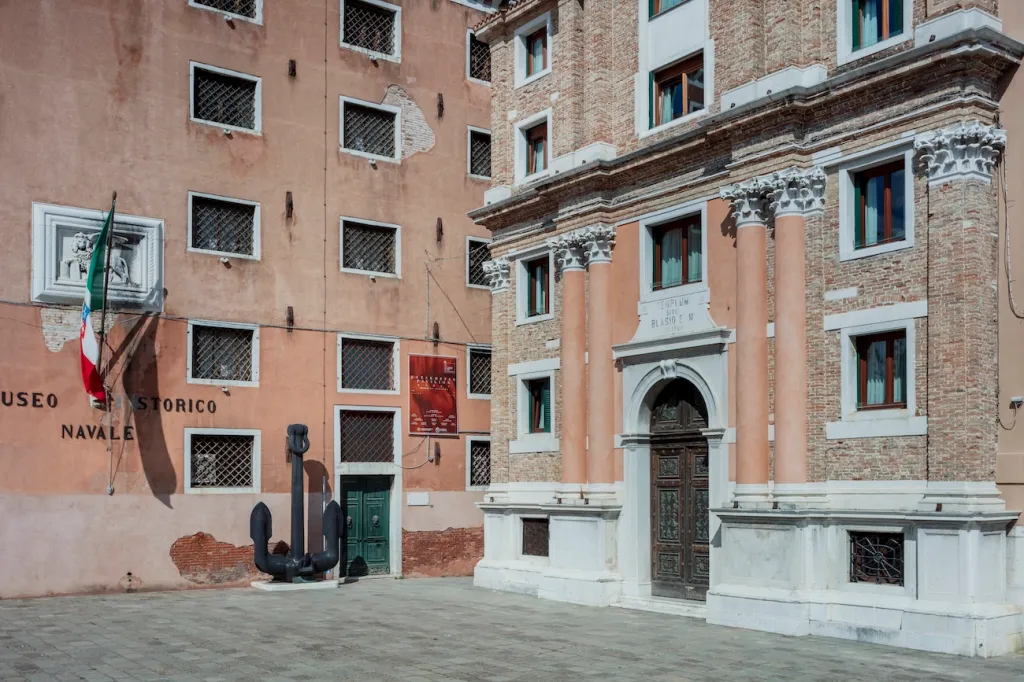
In a May 11 article published by the Kazakh media outlet Vlast, titled “Kazakhstan’s Ministry Removes Kadyrkhanova’s Work from the Venice Biennale,” representatives of the Museo Storico Navale di Venezia, the Italian Navy–affiliated museum hosting the exhibition, denied any role in the work’s removal. D’Uva, the company that manages the museum, told Vlast that it “did not impose any specific restriction concerning [Machine]…nor did it ever request its removal or non-exhibition.” D’Uva said that it had not received any instructions or requests regarding the display of Kadyrhanova’s work from either Difesa Servizi S.p.A., which oversees properties belonging to the Italian Ministry of Defense, or from the Italian Navy.
A copy of the contract signed on February 2 by D’Uva and a representative of the Kazakhstan pavilion team was reviewed by ARTnews. It includes a stipulation prohibiting the exhibition of artworks deemed “political, ideological,” or “propagandistic” in nature, while also reserving D’Uva’s right to require the “amendment, removal or non-exhibition of any content” considered incompatible with the “relevant contractual framework.”
According to the curator, Bekbota, the pavilion team explored several alternatives with Kadyrhanova that would have preserved the work’s conceit while allowing it to remain on view. One proposal involved displaying documents referencing Stalin upside down, which Bekbota argued could have given the installation “a new level of meaning.” He contends, however, that Kadyrhanova later restored the work to its original presentation—with all text fully legible—despite acknowledging the financial, legal, and organizational risks the pavilion could face if found in breach of contract.
In a statement posted to Facebook, Bekbota said that, in light of these constraints, he ultimately made the decision to dismantle Machine in its original form. “As a curator, I was obliged to consider not only the fate of a single work, but also the functioning of the entire pavilion, the participation of all the artists, and my responsibility to the institutions that supported the project,” Bekbota wrote. “Therefore, I personally made the decision to dismantle the ‘Machine’ installation in its original form. And I take full responsibility for this decision.”
He also stated that concerns over the museum’s “sensitivity” to political content had been raised in meetings with D’Uva representatives, including a request not to mention Stalin directly.
The project’s co-commissioner, Danagul Tolepbay, meanwhile, described D’Uva’s statement to Vlast as “entirely inaccurate,” telling ARTnews that in two separate Zoom calls a representative of the company explicitly requested the removal of any mention of Stalin after reviewing the exhibition’s contents. She also denounced accusations of censorship directed at Kazakhstan’s Ministry of Culture as “shameful,” noting that the ministry had commissioned the work, and previously exhibited it at the Kasteyev Museum and in London. Tolepbay expressed fears that the pavilion itself was vulnerable to shuttering between now and the end of the Biennale in November.
Following the Vlast report, D’Uva has sought to distance itself from the controversy, telling the press that any directives to remove Machine were issued by a specialist who was not authorized to make such decisions. ARTnews has contacted company head Ilaria D’Uva for comment.
Kadyrhanova was one of nine Kazakh artists featured in the exhibition “Qoñyr: The Archive of Silence”, which “centers the twentieth-century evolution of music in Kazakhstan from predominantly major to minor tonalities, a transformation that closely reflects the country’s turbulent modern history,” according to a press release. The third official national presentation by Kazakhstan at the Venice Biennale, it also marks the first time a Central Asian nation selected its pavilion project through an open call.
Kadyrhanova’s contribution confronted the Soviet occupation of Kazakhstan, which, having ended just over 30 years ago, continues to shape the country’s sociopolitical memory. During that period, more than one million Kazakhs died in famine, while roughly two million people were imprisoned or deported to gulags on politically motivated charges. Machine comprised three elements: a 1930s typewriter, copies of Soviet-era arrest warrants sourced from archival records, and a red thread connecting the typewriter’s keys to the documents.
The signatories of the e-flux letter characterized the removal as censorship, arguing that, in the absence of a clear legal basis, it was incompatible with constitutional guarantees of freedom of expression and creativity. They have demanded an apology from the Ministry of Culture and Information of the Republic of Kazakhstan by May 31, the memorial day for victims of political repression and famine in Kazakhstan; the reinstatement of the work, with any associated costs covered; and full documented transparency regarding the decision, including testimony identifying from whom the orders originated.
In a statement to ARTnews, Kadyrhanova reiterated the letter’s claim that the work had been removed at the direction of Kazakhstan’s Ministry of Culture. “Kazakhstan pavilion’s explanations are quite vague, and I believe they are going to still insist the reason was some undisclosed restrictions imposed by Museo Storico Navale despite that the museum has already denied any involvement in the removal,” she said.
In the Facebook statement, Bekbota described the pavilion as having faced complications from the early planning stages. Initially intended for the Palazzo Pisani Conservatory, the exhibition was relocated to the Museo Storico Navale due to concerns about the installation’s sound elements.
Bekbota described Kazakhstan’s participation in the Biennale as a “formative stage” and emphasized the need for a “professional dialogue” between artists, curators, and arts institutions. He concluded by expressing regret that, in a view shared by Tolepbay, the controversy had overshadowed the achievement of the Kazakhstani artists in reaching contemporary art’s most vaunted venue.
