


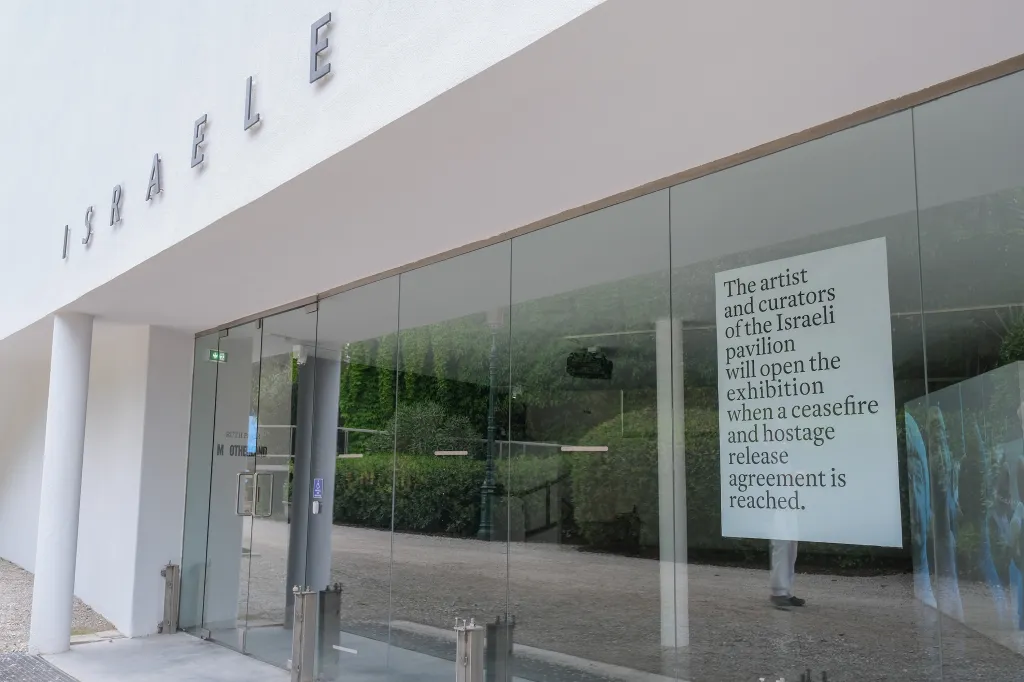
The activist group Art Not Genocide Alliance released an open letter this week demanding that the Venice Biennale prevent Israel from participating in this year’s exhibition. The letter has been signed by nearly 200 artists, curators, and arts workers associated with this year’s edition of the Biennale.
Among the signatories to the letter are curators Gabe Beckhurst Feijoo and Rasha Salti, two members of the team tasked with realizing the vision of the late curator Koyo Kouoh. Kouoh died last May just months after being announced as the curator of the 2026 Venice Biennale. There are also dozens of artists included in the main exhibition, “In Minor Keys,” who signed the letter, as well as artists or curators associated with the pavilions of Belgium, Brazil, Bulgaria, France, Peru, Poland, Spain, Switzerland, and other countries. Twelve artists and curators from other pavilions have signed the letter anonymously, fearing “possible physical, political, or legal harms from signing publicly,” the letter explains.
“We, the undersigned, stand together as artists, curators, and art workers in a collective refusal to allow you to platform the Israeli state as it commits genocide,” the letter reads. “We do this in support of our fellow artists and cultural workers in Palestine, in solidarity with Palestine, and in profound hope of an end to Zionist genocide and ongoing apartheid, and the rebirth of a free Palestine.”
The letter continues, “In 2024, the outrage against the inclusion of a genocidal state in the art Biennale was so strong that the Israel pavilion was forced to close. As we reach an appalling anniversary—two and a half years of open genocide against Palestine—and 77 years after the Nakba, the Israeli state once again seeks the legitimation of the Biennale to masquerade as a creator instead of a destroyer of life and culture.”
ANGA released a similar letter in 2024 ahead of that year’s Biennale, which eventually gained over 20,000 signatories. In April of that year, artist Ruth Patir, who was chosen to represent Israel, announced that she would open her exhibtion for Israel’s pavilion until “a cease-fire and hostage release agreement” was reached between Israel and Hamas. That did not happen before the closure of the exhibition that November, and Israel’s pavilion never opened. There were still protests outside of the pavilion during the Biennale’s professional preview days and public opening in April 2024.
Israel’s contribution to this year’s Biennale will not take place in its pavilion in the Giardini—which it said is under renovation—but in the Arsenale, the Biennale’s other main venue. Speaking by phone with ARTnews, Haifa-based artist Belu-Simion Fainaru, who is set to represent Israel, said that he actually sees the new venue as a positive shift, adding that he’s glad to be showing alongside countries like the United Arab Emirates, Turkey, and Saudi Arabia, which all have their pavilions in the Arsenale.
The participation of Israel has not been the only controversy facing the Biennale. Earlier this month, Russia announced that it was planning to reopen the Russia Pavilion for the first time since the country’s invasion of Ukraine in 2022.
The move has drawn widespread outrage, with over 8,500 people signing another open letter calling on the Biennale’s top brass to “address the implications” of Russia’s participation.
The Biennale has so far rallied against those protesting the participation of Russia and Israel, saying publicly that it rejects “any form of exclusion or censorship of culture and art.” The organization added that the exhibition should remain “a place of dialogue, openness, and artistic freedom,” even as geopolitical tensions persist.
When asked earlier about Russia’s participation, a Biennale representative told ARTnews, “As a general premise, La Biennale di Venezia does not decide on national participation; countries themselves choose whether to take part.”
That answer has done little to quell the controversy. Last week, 22 culture ministers signed a letter asking Biennale president Pietrangelo Buttafuoco to rethink Russia’s involvement, warning that giving it such a visible cultural stage could make things seem “normal” while the war in Ukraine is still ongoing.
EU officials have also weighed in. In a joint statement, tech commissioner Henna Virkkunen and culture commissioner Glenn Micallef said the move could put around €2 million in funding from the EU at risk, calling it out of step with the bloc’s broader response to Russia’s invasion of Ukraine.
The participation of Russia, Israel, and Iran—not to mention the US—amid ongoing wars has raised serious questions about the Biennale’s stated aim of being “neutral.” As ARTnews senior editor Alex Greenberger wrote in an opinion column last week, no art exhibition can truly be “neutral,” and it is high time the Biennale develop ethics standards to facilitate such disputes, as other international events, like the Olympics, have long had.
