


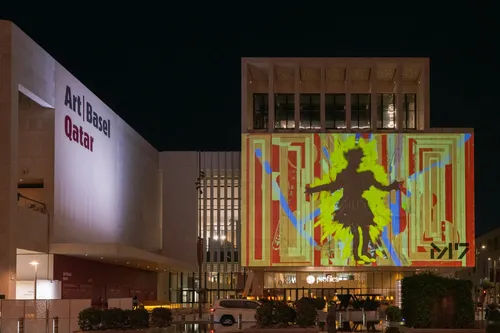
The inaugural edition of Art Basel Qatar wrapped up on Saturday, February 7th. The fair, which hosted some 87 galleries, is Art Basel’s first in the Middle East. More than 17,000 attendees visited the fair during its run, with more than half hailing from the region.
This was a different kind of Art Basel fair. Unlike the sprawling, group-artist booths of the company’s other fairs in Basel, Miami, Paris, and Hong Kong, the Qatar edition was limited to solo “Special Projects.” Exhibitors showed works in an open-plan design across the M7 and Doha Design District venues. Under the artistic direction of Egyptian artist Wael Shawky, the fair replaced standard gallery stalls with a museum-like flow where gallery presentations centered on the theme “Becoming.”
While many blue-chip international artists familiar to visitors of Art Basel, such as Jean-Michel Basquiat, Georg Baselitz, and Pablo Picasso, were present, more than half of the featured artists were from the Middle East, North Africa, and South Asia (MENASA). Several regional galleries, such as Dubai gallery The Third Line and Saudi space Hafez Gallery, also made their Art Basel debuts.
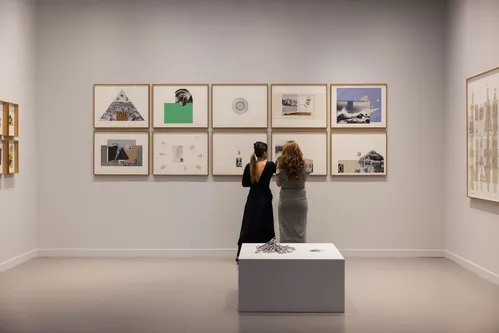
While many blue-chip international artists familiar to visitors of Art Basel, such as Jean-Michel Basquiat, Georg Baselitz, and Pablo Picasso, were present, more than half of the featured artists were from the Middle East, North Africa, and South Asia (MENASA). Several regional galleries, such as Dubai gallery The Third Line and Saudi space Hafez Gallery, also made their Art Basel debuts.
This was a big moment for Qatar’s cultural strategy, run by the Gulf state’s ruling family. The family has personally driven the state’s massive investment in museums like the Museum of Islamic Art and the National Museum of Qatar. The Emir of Qatar, Sheikh Tamim bin Hamad Al Thani, and his sister Sheikha Al Mayassa bint Hamad bin Khalifa Al Thani, chairperson of Qatar Museums, conducted a private walkthrough of the fair before it opened. The fair reportedly granted the royal family and state institutions the right of first refusal on works.
Sales announced by galleries did not follow the hectic pace of other Art Basel fairs, where a flurry of transactions are reported on the first day. Many outlets reported that some works had been placed on reserve in advance by the Qatari royal family during the private walkthrough, and many galleries noted a more considerate pace to transactions overall. Reported sales from galleries at the fair were trickling in as the fair closed (check back for Artsy’s report soon).
Here, we share three takeaways from Art Basel Qatar 2026.
1. The Middle East art scene can no longer be ignored
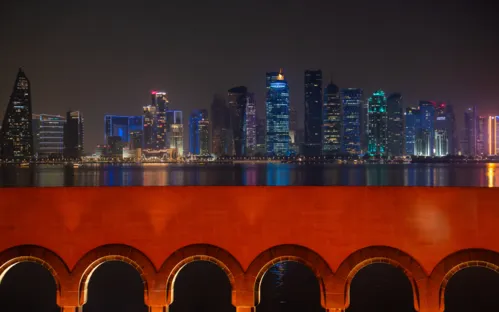
Art Basel Qatar is less a sudden arrival and more like the next step in the Middle East’s rise as a global artistic powerhouse. While the fair has drawn increased international eyes to Doha, it represents the continuation—not the culmination—of a decades-long, state-led investment in world-class infrastructure.
“This growth was not immediate but rather a decades-long process,” Mohammed Hafiz, co-founder of Saudi gallery ATHR and member of the fair’s selection committee, told Artsy. He views the event as one that “solidifies the region’s maturing and developing cultural ecosystem.” This maturity was visible on the ground; many VIPs arrived in Doha directly from Saudi Arabia’s third Diriyah Biennale, signaling a cohesive regional circuit rather than isolated projects.
As Diane Abela from noted art advisory firm Gurr Johns told Artsy, the fair “signals not only recognition, but a confident statement that the region is not just participating in the global art conversation, but helping shape it.”
“The region has long been building strong foundations through artists, galleries, collectors, ambitious cultural policy, and the development of leading museums and institutions, and has reached a solid level of maturity, sophistication, and global relevance,” she added.
For those pushing the Middle East’s art scene forward, the moment is transformative. “I have been immensely proud, and at times even emotional, these past two weeks,” Alia Al-Senussi, Art Basel’s MENASA representative and patron, told Artsy. “[The region has] opened the third edition of the Diriyah Contemporary Art Biennale and the inaugural Art Basel Qatar—it felt like the culmination of my 20 years of work to have my worlds all coming together.”
2. This was a new fair model for Art Basel
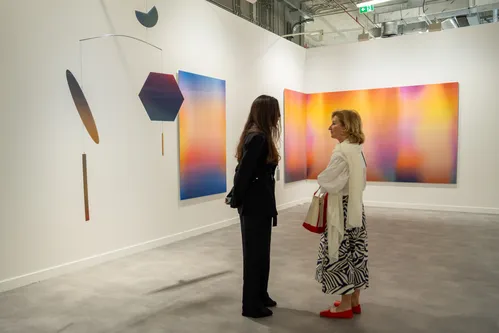
In the art world, the term alternative art fair usually refers to curated events that operate outside the traditional booth-led model of major commercial art fairs. These events often prioritize artists, take place in unconventional venues, and platform experimental works to provide a more accessible and community-focused entry point into the art market.
Even though it’s operated by the largest commercial art fair company in the world, Art Basel Qatar was also experimenting with breaking the traditional art fair rules. It celebrated curatorial and regional narratives over pure commercialism, recalling the experimental spirit of an alternative fair.
This was, in part, enabled by Qatari government support. By significantly subsidizing booth costs and shipping, the fair created an environment designed to nurture a new generation of collectors and support regional galleries with less commercial pressure.
“The economics are super different [from traditional art fairs],” art market economist Magnus Resch told Artsy on the fair’s VIP day. “It’s a no-risk experience for exhibitors…selected by an independent curatorial team and highly funded by the government.”
This state-backed security allowed for a shift in the mood on the ground, fostering what White Cube founder Jay Jopling called a “measured refinement” and a “more engaged viewing experience.” A dealer from Thaddaeus Ropac agreed, telling Artsy that the solo format helped create a “deeper understanding” of the work.
Yasmine Berrada Souni, co-founder of Casablanca- and Marrakech–based Loft Art Gallery, said that the organizers were deeply involved in the creative process. “We frequently exchanged with the fair organizers to fine-tune the curation of the booth,” she told Artsy.
The vision is a fair that bridges commercialism and education. “Art Basel Qatar should be seen as a platform of intellectual as well as commercial exchange; yes, of course, it is ultimately about our galleries selling art, and in turn supporting their artists,” Al-Senussi told Artsy. “But it is also about educating the wider international art world on the Arab world and its cultural producers.”
3. Regional collectors are ready to engage
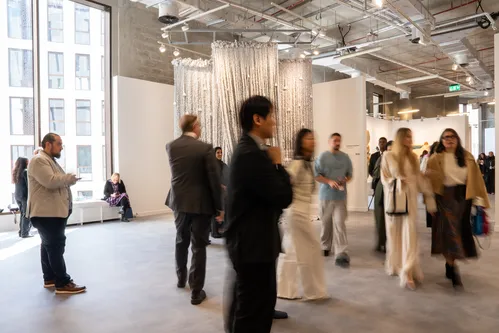
In the lead-up to the opening, the industry wasn’t just asking who would attend, but whether the fair could capture and cultivate a private collector base around Qatar. Would it be robust enough to sustain a market beyond the immediate patronage of the royal family?
“Everything needs three years to bed in,” Philip Hoffman, CEO of advisory firm The Fine Art Group, told Artsy. He drew parallels to the early, quieter years of Frieze London or Art Basel Miami Beach, which have now evolved into staple international events in the art market calendar.
And yet, even in this first edition, collectors were ready. “Clients were active. They were looking to buy,” Hoffman reported. The inaugural energy was distinctly regional. “There was the dominance of Emiratis, Saudis, Qataris, a bit of Kuwaiti[s],” he said, noting a marked absence of “American accents.” Berrada Souni reported sales to both an international clientele and a “larger local customer base that we were meeting and discovering for the first time.”
Advisor Nicolas Nahab of NG Partners observed the presence of “European clients…looking to expand their collection beyond the Western canon.”
Success in Doha, however, required a higher commitment to the artists on view. Abela, the art advisor, noted that the fair’s smaller, solo-presentation format was a deliberate play to match the “long-term vision” of buyers who prefer depth over rapid transactions. This curatorial restraint paid off: Nahab noted that the format offered a “more coherent understanding” of the work, making it easier for collectors to make “decisions on the spot.”
Ultimately, the fair’s trajectory depends on whether this setup can bring in new regional buyers and interested international audiences. To move beyond a royal-led project and thrive in a crowded international art fair circuit, Art Basel Qatar must, as Abela puts it, “preserve what makes it unique…a space for cultural exchange and dialogue.”
If it can successfully bridge the gap between state-led cultural dialogue and private market participation, it will have answered its most pressing question.
