


This week, Basel is coming alive with contemporary art. Anchored by Art Basel—one of the biggest moments of the international art world calendar—this week in the Swiss city promises a dense concentration of art on view. Most of these are even within walking distance of each other (read our guide to Art Basel Week to get up to speed).
While Art Basel doesn’t open to the public until Thursday, June 18th, several fairs are already up and running. Here, we share some choice artwork selections from Liste and Basel Social Club.
Liste Art Fair Basel
Through June 21st
Messe Basel, Hall 1.1, Maulbeerstrasse / Riehenring 113, CH–4058
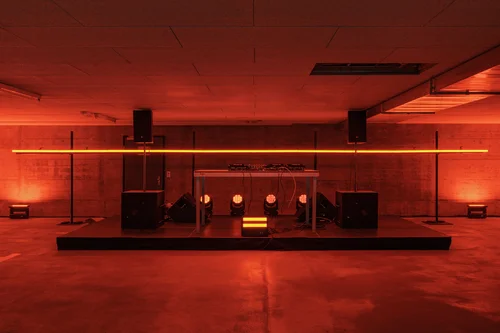
Art Basel’s steady satellite fair, Liste, is celebrating its 30th anniversary this year. Known for its focus on cutting-edge emerging artists and galleries (early participants have included future powerhouse dealers like David Zwirner), the fair returns to its regular spot in Messe Hall 1.1, a stone’s throw from Art Basel.
Fiker solomon
Becoming What we Wear, 2026
Presented by: Afriart Gallery
Price: $6,000
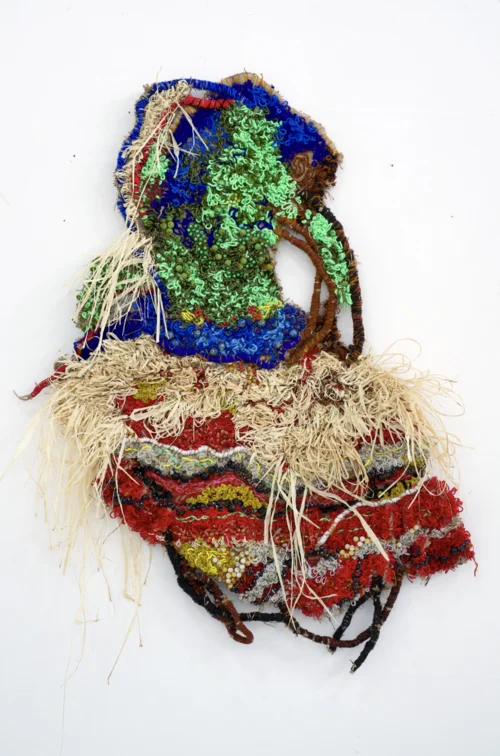
At Afriart Gallery’s arresting solo booth of works by fiker solomon, Becoming What We Wear (2026) is one of several densely layered tapestries that practically vibrate off the wall. The Addis Ababa–born, Kampala-based artist builds her surfaces from yarn, sisal, raffia, and beadwork, combining materials chosen as much for their symbolic weight as for their texture, evoking labor, nature, and the beauty of the everyday. Here, cascading fringes of natural fiber give way to vivid fields of blue and green, part-abstract composition and part-ghostly garment.
Perhaps surprisingly, solomon’s recent practice begins with taking photos. She moves, observes how her clothing responds, and photographs the result. The shapes her fabric makes by folding, stretching, and shifting become the foundation for artworks that explore how clothing relates to identity. Indeed, Becoming What we Wear itself is shaped like a garment waiting to be worn.
Ju Young Kim
The Light Was Still On Behind the Curtain, 2026
Presented by: max goelitz
Price: €5,400 ($6,268)
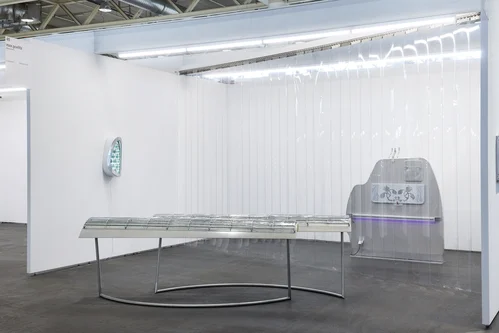
On VIP day, max goelitz’s booth was making visitors pause before they entered: a floor-to-ceiling translucent strip curtain, the kind found in airport service corridors or cold storage warehouses, bisects the space, dividing it into a public and a private half.
Titled “Holding Lounge,” the presentation by Korean artist Ju Young Kim transforms the booth into a transit zone, complete with what appears to be a baggage conveyor running through the center. It’s an environment designed to evoke the in-between: the anonymous, semi-public spaces of air travel where strangers briefly share a destination before dispersing.
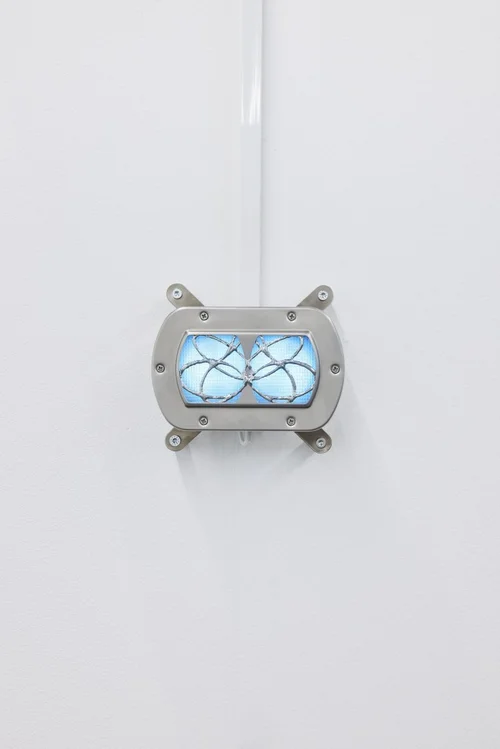
The Light Was Still On Behind the Curtain (2026), a wall-based sculpture, is mounted in the corner. The work, a bolted metal casing, is similar to a “bulkhead light” used on planes, and emits light through a wire grille. Art Nouveau–style florals decorate the lamp’s glass blue glow. A light built for routine service operations becomes something intimate, even tender, an object carrying, as Kim herself put it, “an atmosphere of care, routine, and hidden operation.”
Mackerel Safranski
The Narration of Night, 2024
Presented by: A-Lounge Contemporary
Price: CHF2,500 ($3,151)
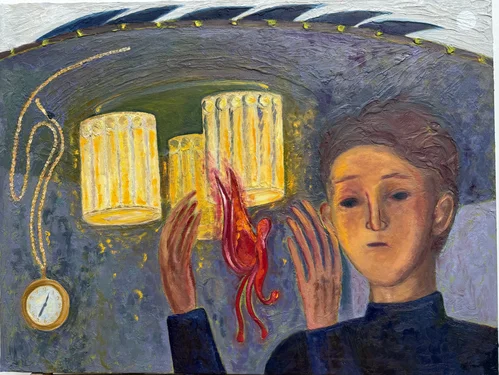
The Narration of Night, 2024
Mackerel Safranski
A-Lounge Contemporary
In sculptures and paintings at the booth of Seoul gallery A-Lounge Contemporary, Korean artist Mackerel Safranski explores themes of death and the body. The Narration of Night (2024) is typical of the artist’s ongoing “Room Tone” series, which depicts moments of presence and disappearance with careful tension.
Here, a solitary figure in dark blue holds something red, raw, and ambiguous up toward her face, while three glass lanterns glow behind her and a pocket watch hangs in the shadows. The mood is somewhere between folklore and horror; the figure’s empty eyes stare blankly at the winged shape between her hands.
Safranski, who draws on a personal history of living with an eating disorder, constructs her paintings from literary sources, news, and everyday observation. The works on view here masterfully hold dread and tenderness in the same frame.
Basel Social Club
Through June 20th
Erdbeergraben 1, 4051
Launched in 2022 as an “alternative” art fair, Basel Social Club has staged editions in open fields, a former mayonnaise factory, and now, an abandoned office. This highly curated, artist-first fair swaps traditional booths for a mazy, four-story experience where art fills unexpected crevices, alongside an onsite gym, indoor golf, and a book fair, among other surprises.
Max Keene
Combo, 2026
Presented by: Pangée
Price: $1,500
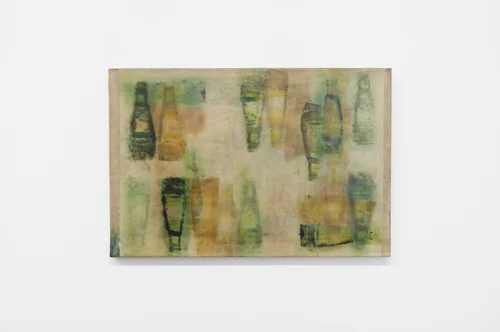
Around an unsuspecting corner in a fair venue full of surprises, a selection of paintings by Canadian painter Max Keene—presented by Montreal gallery Pangée—offers a moment of unexpected stillness. Combo (2026), a watercolor-and-wax work on paper over panel, depicts a loose arrangement of bottles on a pale, dusty ground, rendered in muted greens and hazels. Layers of wax blur the forms, giving them the quality of something glimpsed through smeared glass, or scanned too slowly.
That last reference is intentional. Keene’s source material is images made with office equipment, such as scanners and copiers, and the aesthetic created by that process carries into the painting. The bottles are rendered with a flattened, slightly drifting quality of a scanned image and the wax layers add a further blur, as if a document has been copied one too many times.
It’s a fitting contribution to the fair’s “Office” theme, which invites artists to explore the meaning of labor, rest, and time in an era of digitalization and remote work.
Laurian Popa
Broken chair, 2026
Presented by: Jecza Gallery
Price: €7,000 ($8,104)
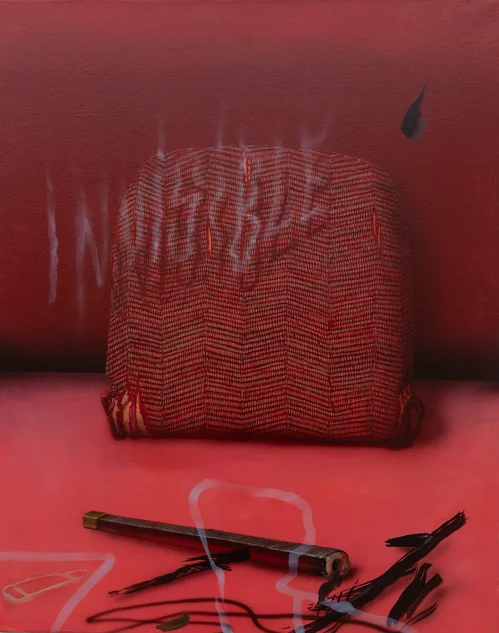
Broken chair, 2026
Laurian Popa
Jecza Gallery
Laurian Popa’s painting Broken chair (2026) is hard to walk past. Presented by Romanian gallery Jecza in a darkened first-floor room, a painting with a deep crimson ground reveals a chair seat leaning against a wall with its scattered, splintered legs and loose fragments lying strewn across the floor below. The word “INVISIBLE” is faintly inscribed across its surface, hinting at a tension of an object present in its parts, but its purpose already gone.
Popa, who works as both a painter and theater set designer, brings a scene-maker’s instinct to his canvases. Everyday objects are isolated, recomposed, and stripped of their original function until they become what gallery director Andrej Jecza calls “enigmatic presences”—objects “broken from the usual context,” stripped of function and placed somewhere between observation and imagination.
