


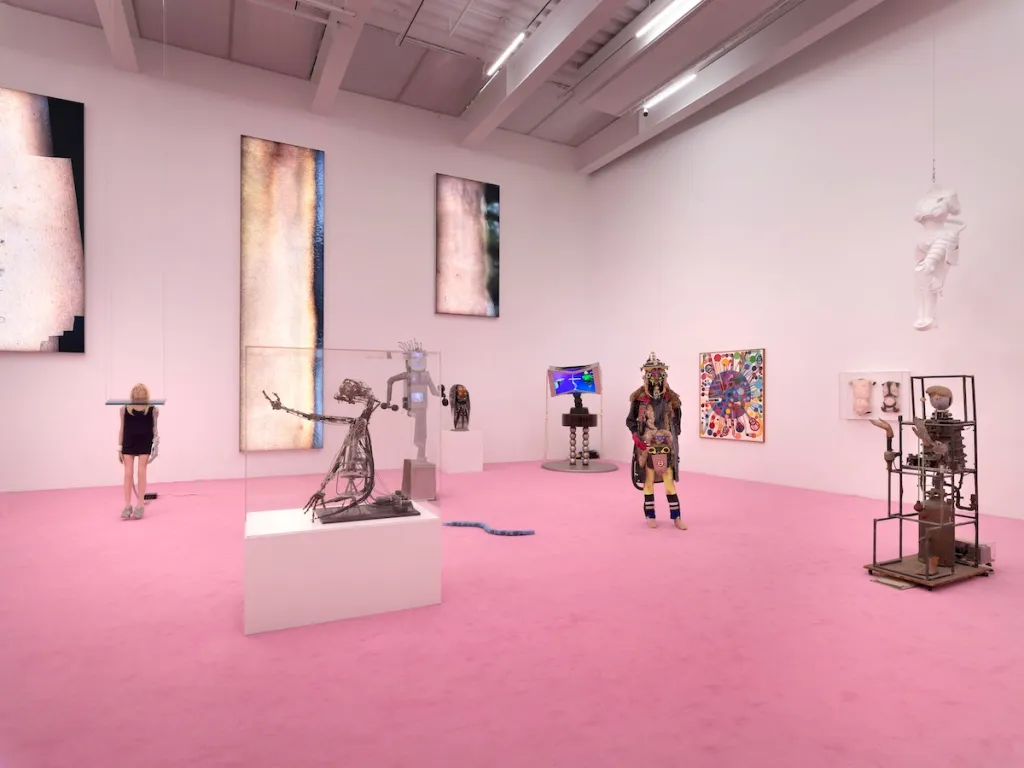
Almost two years ago to the day, the New Museum in New York closed its doors to the public, leaving behind a void—this is one of the country’s few major museums that is focused solely on contemporary art, after all. Now, following an expansion overseen by OMA, the museum is finally back and ready to welcome visitors once more.
Ahead of the public opening on Saturday, the museum hosted a press preview on Wednesday to show off its refreshed digs, which are occupied almost entirely by the group show “New Humans: Memories of the Future.” Organized by the New Museum’s curatorial team under the leadership of artistic director Massimiliano Gioni, the show spans more than a century’s worth of art and features more than 200 artists.
Spread across the museum’s three main floors, and even spilling into the elevators and lobby, “New Humans” is a monumental endeavor—so monumental, in fact, that one perspective is unlikely to do the show justice. To that end, ARTnews senior editors Maximilíano Durón and Alex Greenberger opened a Google Doc to discuss their initial impressions of the new New Museum and “New Humans.”
Maximilíano Durón: To start off bluntly, I have loathed visiting the New Museum ever since my first trip there about 15 years ago. That has everything to do with its building as opposed to its programming—I’ve often said to you that the New Museum is the worst place in New York to see art, since its SANAA-designed building is quite literally form over function. The overall feel of the building is a little cold, some of the ceilings feel too low, and the publicly accessible freight elevator cuts up the architecture. A back staircase connecting the fourth and third floors is perilous at best and I’ve rarely liked how curators stuck art in there. An editor once slipped in a phrase into a piece of mine that suggested the New Museum was a “gleaming, futuristic confection”—and that’s about the only praise you’d have heard from me prior to the museum’s two-year closure. Need I go on?
The New Museum has doubled in size, thanks to its new, OMA-designed building, at right.
Photo Jason O'Rear/Courtesy New Museum
Alex Greenberger: I’m no fan of the old New Museum either—I always found it awkward, claustrophobic, and a pain in the ass to navigate, both for the museum’s curators and its visitors. The good news is that the just-opened expansion improves the New Museum greatly. Designed by OMA, the sleek expansion adds 60,000 square feet of space. It’s seamlessly integrated, with the new portion of the building centered around a spiral staircase with a handsome Klára Hosnedlová sculpture dangling through its middle. The New Museum’s Bowery building has always lacked a staircase like this one, and with it, the museum finally feels complete.
Bigger is not always better, of course: one of the pleasures of the New Museum’s previous iteration was that one needed only an hour to visit it. Accounting for all the space added through the new expansion, I’d advise visitors to now set aside the better portion of an afternoon. I actually think it’s a good thing that it now takes so long to visit the New Museum. At long last, the New Museum has a building that matches its ambitions.

A Klára Hosnedlová sculpture runs through the new stairwell of the New Museum.
Photo Jason O'Rear/Courtesy New Museum
Durón: I think the expansion and renovation was necessary: the New Museum needed more space for exhibitions and its New Inc. incubator, and it needed to fix some of those flaws in its original design. The spiral staircase is a stroke of genius in terms of museum architecture. It’s easy to navigate at a leisurely place, and via the windows, you get some great SoHo sightlines. The reconfigured lobby is airy, and the line to reach the coat check no longer blocks the entrance. Though I will miss the cafe and the ground-floor project space gallery, which is now a gift shop.
I agree the integration of the two structures is well done. The New Museum now has room to breathe—and most importantly, the art looks so much better in its galleries than it ever did. I took one of the older building’s interior stairwells up to the fourth floor and was pleasantly surprised at what I saw. Extending past its former edge was a new gallery where a Tau Lewis sculpture is beautifully installed. That work, from 2024, feels perfectly scaled for the new building. A floor up, two helium-filled, jellyfish-like sculptures by Anicka Yi are able to float above visitors’ heads, emphasizing the airiness of the new space.
Greenberger: Those are just two pieces on the checklist for the 700-work group show “New Humans: Memories of the Future,” which fills nearly every cranny of the museum’s refurbished exhibition spaces. Put in the broadest terms, the show is about humanity as it has been molded and remolded since the dawn of the 20th century. It’s a big show, and a busy one: the galleries are a cacophony of disparate sculptures, clanging videos, and brilliantly hued paintings. But the chaos of the exhibition is also the point, since the show is also a means of processing anxieties surrounding machinery, emergent technologies, social unrest, and AI. I found the exhibition to be pretty persuasive, all the more so because ambitious, sprawling group shows like this one are an endangered species in New York.
A sculpture by Tau Lewis (at left) emphasizes the scale of the New Museum’s new galleries.
Photo Dario Lasagni/Courtesy New Museum
Durón: I was actually surprised when you mentioned “New Humans” had 700-plus works. It’s definitely a dense show with a lot of art, but it never feels overhung. When there are dense clusters of work, they make sense together. The exhibition design is superb. Of course, in true New Museum fashion, the wall labels for every single work are about twice as long as they need to be, but if you take the time reading them through, you’ll definitely leave the exhibition with your head filled with new information, and you’ll likely want to return, given by how much there is on view.
To my mind, the exhibition, despite its size, works because it’s organized thematically, with niftily titled sections like “Auto Women,” “Prosthetic Gods,” and “Dream Machines.” My favorite, though, has to be “Mechanical Ballets,” which mixes avant-garde choreography, via documentation of restagings of ballets by the likes of Oskar Schlemmer and Kurt Schmidt, with paintings by Jacqueline Humphries, drawings by El Lissitzky, and a 1923 sculpture by Lavinia Schulz and Walter Holdt. This also allows for the inclusion of some deep cuts, like lithographs by Sargent Claude Johnson that show a whole new side of this artist, who was associated with the Harlem Renaissance, even though he was based on the West Coast. There are also sculptures by Ovartaci, who made these works when she was forcibly committed to a psychiatric hospital in Denmark. They’re sure to be a revelation to anyone who missed the 2022 Venice Biennale.
I didn’t expect that so much historical work would be on view, given that we’re talking about an institution whose original name was the New Museum for Contemporary Art, but I think those pieces help bolster the exhibition’s argument that artists have been engaged with technology-induced anxiety for just as long as it’s been a part of the human condition. Some of the works on view that were made a century ago could have easily been made in the past few days, and that’s part of the joy of seeing the exhibition. I didn’t think I’d like the exhibition as much as I did; it left my head churning.
A gallery of “New Humans” focuses on how painters and sculptors reimagined the human body following wars and social uprisings.
Photo Dario Lasagni/Courtesy New Museum
Greenberger: This approach of comparing modern art to recent work is an approach seen widely in international biennials right now, and indeed, “New Humans” has such a knotty premise that it could have sustained an entire Venice Biennale or Documenta. Plus, “New Humans” even feels like it’s responding to those shows—most notably the 2022 Venice Biennale, which smartly tethered the present-day turn toward spiritual worlds and absurdism to Surrealist art by women of the 20th century. Not for nothing, “New Humans” and the 2022 Biennale—which was curated by Cecilia Alemani, whose husband is New Museum artistic director Massimiliano Gioni—share more than 40 artists. Alemani said that her Biennale was “rooted in posthuman thought.” “New Humans” clearly is, too.
Where I think “New Humans” differs, though, is in its inclusion of artworks alongside creations from the past that weren’t necessarily meant as art. For example, there’s a 1976 model of a nude man with enormous hands and a big bottom lip by the American neurosurgeon Wilder Graves Penfield; it’s exhibited alongside a 2019 drawing of a nervous system by Hong Konger artist Angela Su. This inspired juxtaposition traverses not just time and space, but multiple disciplines as well. It suggests that the artistic drive to envision the body under duress is in many ways rooted in science.
“New Humans” pairs modern art with contemporary work. Seen here are new works by Wangechi Mutu (at back), with a Constantin Brancusi sculpture set before them.
Photo Dario Lasagni/Courtesy New Museum
Durón: I found this aestheticization of science fascinating because it didn’t fetishize the images being shown. Lennart Nilsson’s photographs of embryos, made between 1965 and 2003, felt at home here. I was also mesmerized by Jean Painlevé’s 1927 film L’OEuf d’Épinoche (The Stickleback’s Egg), showing the reproduction of stickleback fish through intense magnification. As the wall text points out, the avant-garde of Painlevé’s time, from Man Ray to Sergei Eisenstein, was enthralled by science. A more contemporary take on this is artist Yuri Ancarani’s Da Vinci (2012), which shows surgeons at work using a surgical tool called Da Vinci intercut with head-on shots of the robot moving its limbs as if in a choreographed routine. Though the robot’s “dancing” is clearly meant to tap into the long-held fear of “robots taking over,” the work is perhaps of the least scary one on view.
“New Humans” is explicitly engaged with science fiction and horror. At left is a sculpture by H. R. Giger, who designed the extraterrestrials for the “Alien” franchise.
Photo Dario Lasagni/Courtesy New Museum
Greenberger: There are plenty of works that are more unsettling than that film in “New Humans,” which frequently draws on science fiction and horror, at times even directly: one of the offerings is H. R. Giger’s 1990–2005 sculpture Necronom 2005 (Alien-III-Model), which envisions a kneeling creature with a fang for a tail. It’s a being that looks quite a lot like the extraterrestrials Giger cooked up for the “Alien” franchise, and it can be found here just a stone’s throw from a wonderful Ivana Bašić sculpture featuring a gender-ambiguous being that appears to be melting into liquid soup. Elsewhere, there’s body horror on offer: one memorable Jana Euler painting turns a pair of feet into uncircumcised penises; a Hans Bellmer sculpture features a little girl’s leg attached to a many-breasted torso; and a remarkable Maina-Miriam Munsky painting envisions childbirth as a mass of flesh broken up by a square armature.
This is a similar kind of horror to what’s on display at the current Whitney Biennial, and I have a feeling that both shows are indirect responses to the uncertainty of the present. But “New Humans” intriguingly shows that none of this horror is entirely new—the past was scary, too. One of the show’s most disturbing works is from 1979: documentation of a Lenora de Barros performance called Poema, for which she ran her mouth around a typewriter. In one picture, de Barros’s tongue seems to have gotten trapped between the typewriter’s gears. I find this shot sort of abject and strangely beautiful, just like “New Humans” itself.
Durón: I actually think the horror is even more embodied—pun only somewhat intended—in “New Humans” than in the Whitney Biennial. But to my mind, there’s more than just regular body horror that we often see in movie theaters or contemporary art exhibitions today. What I think the curators are drawing out is the body horror of war. To go chronologically, I’m thinking of the series of photographs commissioned by the French government that document military inventions made for World War I; Anna Coleman Ladd’s Painted metal facial prosthesis (1917–20), one example of the devices she crafted for soldiers whose faces had been disfigured too much for plastic surgery after World War I; Natsuyuki Nakanishi’s 1959 painting Ningen no Chizu (Map of Human), which looks like the disfigured skin of the Hibakusha, or a survivor of either the Hiroshima or Nagasaki atomic bombings; and Zoran Mušič’s bone-chilling 1974 painting Non siamo gli ultimi (We are not the last), which reflects on the artist’s own experience of being in a concentration camp three decades earlier and which he connected to the US’s deadly interventions in Vietnam and Latin America of the ’70s.
These works find a moving counterpart in a Paul Thek sculpture from his “Technological Reliquaries” series in which a gray-painted limb rests in a Plexiglas case, partially covered by a piece of fabric and a wig. Thek drew inspiration from Catholic reliquaries, which frequently preserved a saint’s body part, and applied that to the carnage he saw taking place in the Vietnam War. The Thek work is included in the exhibition’s “Hall of Robots,” the most dynamically installed of these sections. If you take that perilous staircase up, you’ll leave Ancarani’s Da Vinci video, check out a stellar contribution by Precious Okoyomon on the way up, and emerge into this gallery, where it really does feel like the robots have taken over. Be sure not to step on Pamela Rosenkranz’s robotic snake as it slithers across the room’s pink carpeting.
Works by Hans Bellmer (at front) and Cao Fei (at back) in “New Humans.”
Photo Dario Lasagni/Courtesy New Museum
Greenberger: Perhaps all this horror is the reason that some artists in the show turn away from reality: Portia Zvavahera, for example, paints her dreams at a grand scale, and Toyin Ojih Odutola draws semi-human entities that hail from faraway places in loving detail. The tendency may also explain the coda of “New Humans,” a section called “Future Cities” that is focused less on bodies and more on the spaces they inhabit, with artists like Cui Jie and Constant taking urban architecture and twisting it until it appears alien. Populated mainly by greyish, humorless art, “Future Cities” struck me as the exhibition’s one off-key note—a bland non sequitur in an otherwise thrilling show.
Durón: The “Future Cities” section was definitely the weakest and, to my mind, the one that is most out of place. I understand the impulse behind it: the mid-20th century was a time in which imagined utopias were a common coping response to the destruction witnessed in the decades beforehand. But the promise of a utopia has long been discredited, and this felt like the least useful point in this show.
Greenberger: I’d rather have seen a section dedicated more specifically to digital art. It’s not as though this is entirely absent from the show: other areas feature early computer art by the likes of Lillian Schwartz and Charlotte Johannesson, and there’s also a digital self-portrait by Donald Rodney that viewers can interact with. But by and large, the show almost entirely omits net art altogether. It also leaves out artists such as Josh Kline, Ed Atkins, Ryan Trecartin, and DIS, all of whom thought about how the internet had remade people during the 2010s. These lacunae are all the more striking in light of the fact that the New Museum helped write the history around these artists and net art.
Charlotte Johannesson, Design, 1984.
Courtesy the artist and Hollybush Gardens, London
Durón: It’s also glaring because the New Museum houses Rhizome, an organization dedicated to historicizing net art and post-internet art. Net art fascinates me because the artists who made it were able to live their whole lives online. Many of them were based in Eastern Europe—they were making this work after the fall of the Berlin Wall and the dissolution of the Soviet Union. This all feels as just as tied to the responses to the two World Wars we see in “New Humans” as anything else here.
It would also have been interesting to see an argument about how artists merged humanity and technology by melding their offline and online lives. The “Dream Machines” section, in that back hallway space behind the old elevator bank, kind of gets at this, but so much of the work on view involves using typewriters or dot matrix printers, as Alison Knowles did with The House of Dust Edition (1967). Other than the Rodney work, there are basically no computers—or smartphones, even—in this section to illustrate how people have willingly uploaded versions of themselves into the ether between the 1990s and the 2010s. To my mind, that’s a big gap.
Hito Steyerl’s Mechanical Turks (2025) is one of many works in “New Humans” that takes up anxieties around AI.
Courtesy the artist and Andrew Kreps Gallery, New York
Greenberger: The show does, at least, include Hito Steyerl, whose contributions to digitally inflected art of the 2010s cannot be understated, even if the work she has produced since isn’t quite so notable. For me, her new video, Mechanical Kurds (2025), was both the standout work of “New Humans” and a return to form for one of our great artists. Her subjects are refugees from Iraq who performed a kind of labor for Amazon known as turking, wherein people manually identify objects to help train AI algorithms. Steyerl interviews these refugees, then intersperses their Zoom conversations with AI-generated images, including one featuring a group of dancers that tumble across—and into—one another, suggesting a total dissolution of the body politic at the hands of technological overlords.
In its own funky way, I think “New Humans” is secretly an exhibition about dispossession. Take Liliana Maresca’s 1983 series of pictures in which she appears nude with tossed-off objects. In one, she stands with a tall metal spiral that is placed in front of her leg, so that it appears as though she was fitted with a makeshift limb replacement. While this photograph does rhyme with Kiki Kogelnik’s paintings of cyborgian women on view nearby, it’s worth remembering that Maresca’s picture has a different context: it was taken at the tail end of a brutal military dictatorship in the artist’s native Argentina. These pictures are about a people robbed of rights and then made anew as a result.
Paintings by Jana Euler emblematize all the body horror on display in “New Humans.”
Photo Dario Lasagni/Courtesy New Museum
Durón: I see a parallel between Maresca’s images and Henrik Olesen’s “A.T.” (2012), which is dedicated to Alan Turing, the mathematician whose code breaking helped change the tide of World War II in favor of the Allies and who was then convicted of homosexuality in 1952 and subjected to castration and hormone therapy. One of Olesen’s collages has the phrase “MACHINES AT WORK” scrawled atop it, along with a 1952 quote from Turing in which he discusses the treatment he received and how “one is supposed to return to normal when it is over.” He adds, “I hope they are right.” Turing’s death in 1954 was ruled a suicide, but the reality is a bit more complex than that. Turing’s story always gets me.
Greenberger: I don’t think “New Humans” is entirely such a dour show, though. If anything, I found it occasionally hopeful. I’m thinking here of Frieda Toranzo Jaeger’s contribution, an altarpiece-like folding painting called To Imagine Is to Absent Oneself (2025). The painting displays a toolbox with certain wrenches embroidered by hand. Last year, Toranzo Jaeger told the Observer that technology will “disempower us slowly,” and that her toolbox paintings are about “surrendering to the machine, becoming one with the apparatus.” But to my mind, these are also works about using that machinery against itself. Toranzo Jaeger is showing us the tools of the revolution. It’s up to us to figure out what we’ll build with them.
