


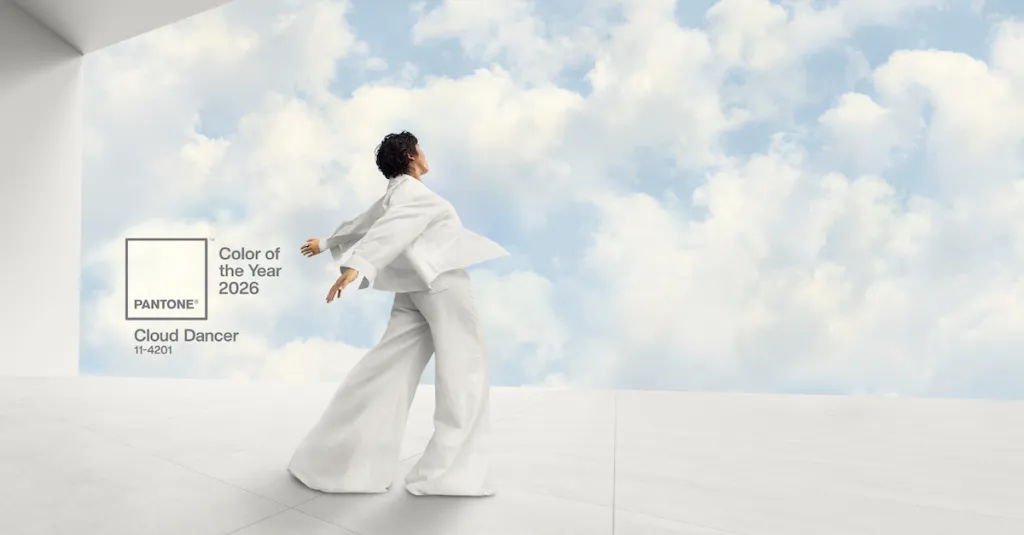
At a time when the political significance of whiteness has been at the center of debates across United States and Europe, Pantone has named “Cloud Dancer,” a shade of white, as its 2026 Color the Year.
According to Pantone’s gushy press release about the hue, Cloud Dancer is “a billowy white imbued with a feeling of serenity” and “a symbol of calming influence in a frenetic society rediscovering the value of measured consideration and quiet reflection”—heavy stuff, indeed.
So heavy, in fact, that you might forget that white is not technically a color. “In a technical sense, black and white are not colors, they’re shades,” Adobe says on its website. And it isn’t just Adobe: the Merriam-Webster Dictionary defines white as “free from color.” But enough from the world’s most widely consulted English-language dictionary.
Here is Leatrice Eiseman, executive director of the Pantone Color Institute, explaining why Cloud Dancer is the 2026 Pantone Color of the Year in a statement issued by Pantone: “At this time of transformation, when we are reimagining our future and our place in the world, PANTONE 11-4201 Cloud Dancer is a discrete white hue offering a promise of clarity. The cacophony that surrounds us has become overwhelming, making it harder to hear the voices of our inner selves. A conscious statement of simplification, Cloud Dancer enhances our focus, providing release from the distraction of external influences.”
Might those external influences include the conservative turn in the US and parts of Europe; the wars in Sudan, Ukraine, and Gaza; and the widespread fears of censorship? Pantone, a taste-making company whose pronouncements about color influence artists, graphic designers, and more, does not say in its release, which essentially implies that Cloud Dancer reigns supreme above all the other hues. I don’t think the company means for its Color of the Year to become another flashpoint in the ongoing discussion around white supremacy with its 2026 Color of the Year, of course, though the evasiveness seems to be part of the point here.
Certainly, Pantone has gone a less political route. In its article about Cloud Dancer today, Vogue wrote that white “does not disturb, does not rock the boat.” Eiseman pointed out to Vogue that Cloud Dancer is “not a stark white, it’s specifically a natural shade of white,” supposedly in proof that this tone is not so aggressive. Laurie Pressman, vice president of the Pantone Color Institute, moreover said the choice was about “encouraging you to use your imagination and bring this [color] in a way that suits who you are and how you want others to see you and how you want to feel.”
This suggests whiteness as a baseline—the color, if it is indeed a color, to which everyone must compare themselves. And it is certainly a choice at a time when the US has a President who, in 2020, reposted a tweet from a conservative publication that read, “Sorry liberals! How to be Anti-White 101 is permanently cancelled!” In his second term, he’s made good on that promise, calling for an end to government-funded DEI programs and denouncing a Smithsonian museum whose wall texts included a mention of “White culture.”
Perhaps it is too much to beg Pantone to take things a little more seriously. In 2025, Pantone went with Mocha Mousse, a brown shade that tickles “our desire for comfort” because of its associations with chocolate and coffee. Two years earlier, during a time of Barbiecore, Pantone picked a shade of pinkish shade (technically, a magenta) because it was “brave and fearless.” But in an era of high stakes and higher tension, one wishes Pantone went in a more sensitive direction.
Already, some have taken notice. Vanessa Friedman, the New York Times’s fashion correspondent, said the choice made “less salubrious associations also leap to my mind.” Those associations were shaken off by Pressman, who told the Washington Post, “Skin tones did not factor into this at all.” That’s a remark that may itself be telling, given that it implies a kind of racial colorblindness that is odd, coming from an entity that bills itself as the “leading source of color expertise.”
Pantone’s announcement brought back memories of an art exhibition I saw in 2018 at the Kitchen in New York: “On Whiteness,” curated in collaboration with the Claudia Rankine–founded Racial Imaginary Institute. That show took as its jumping-off point a 2007 Sara Ahmed essay in which she asked: “If whiteness gains currency by being unnoticed, then what does it mean to notice whiteness?” Among the artists in the exhibition was Charlotte Lagarde, whose 2018 project Colonial White, in which the artist provided participants with a paint chip for a tone labeled Colonial White and asked them to send back a picture comparing the chip to sights seen in the wild. Images of napkins, coffee shops, and the US Capitol came back to her, continuing what the artist has called a “conversation about structural racism.”
What might happen if one repeated Lagarde’s project with Cloud Dancer? I encourage someone to try, and to keep her conversation going.
