


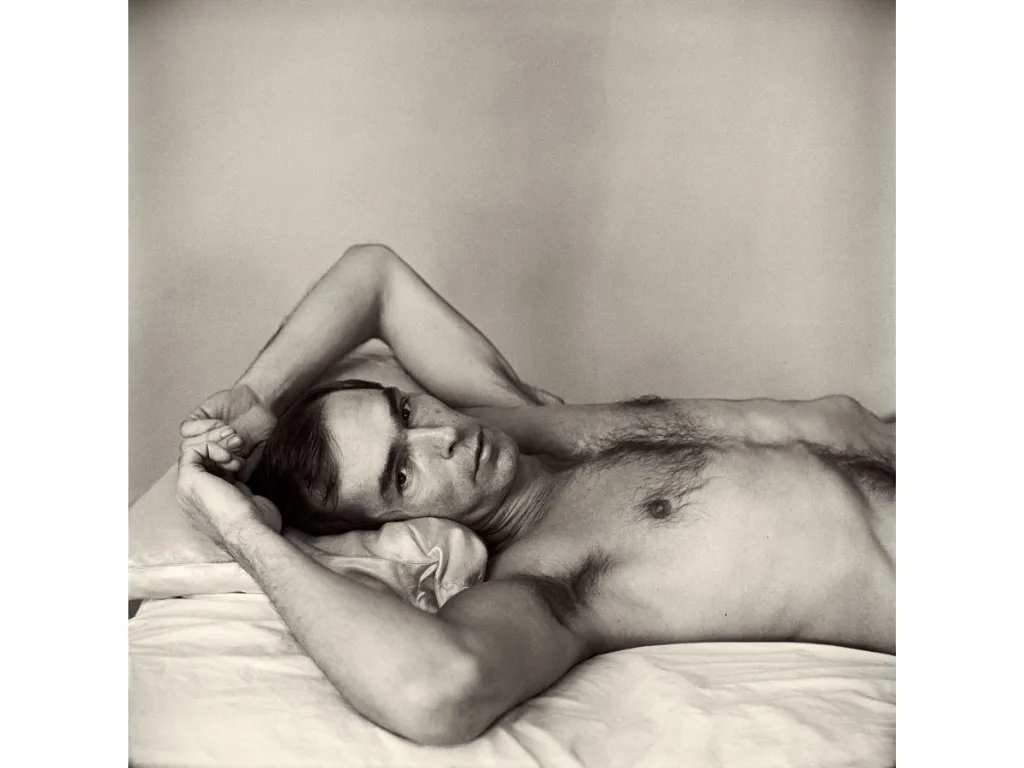
New York–based gallery Ortuzar will now jointly represent the Peter Hujar Archive and Foundation with Fraenkel Gallery in San Francisco. The archive will continue to collaborate with Mai 36 Galerie in Zürich and Maureen Paley in London on select projects.
The news also means that the Hujar Archive will depart its longtime representative, Pace Gallery, which last mounted a solo show for Hujar at its 125 Newbury location in Tribeca in September 2023. The late artist’s archive had been represented by Pace/MacGill, a separate photography-focused gallery that was merged into Pace in 2020, since 2013.
Ales Ortuzar, the gallery’s founder, said he still recalls the first time he saw Hujar’s work nearly two decades ago, when Maureen Paley mounted an exhibition of the artist in London in 2008. “It’s work that has lived with me ever since—in my consciousness,” he said. “I’ve really cared deeply about it.”
He added, “Without sounding cheesy, it’s one of these situations where one has to sort of pinch oneself in excitement because Hujar is an artist I’ve cared about deeply for so long, and it’s a joy to welcome the archive into the gallery.”
The representation deal with Hujar’s archive and foundation, Ortuzar said, “happened in a very natural way. The estate got in touch with us, and we realized we had a lot of shared values. They had seen the work that we’ve done with certain artists in the States, from Joey Terrill to Suzanne Jackson.”
Peter Hujar, David Wojnarowicz Smoking, 1981.
©2026 The Peter Hujar Archive, LLC/Courtesy Fraenkel Gallery, San Francisco, and Ortuzar, New York
Hujar will be the first photographer that Ortuzar will represent since its founding in 2018. “He’s undeniably one of the great photographers of the 20th century—one of the great portraitists,” Ortuzar said, noting his now iconic images of the likes of Susan Sontag, Paul Thek, Fran Lebowitz, William S. Burroughs, John Waters, Candy Darling, and David Wojnarowicz. “In terms of fitting the program, it’s really about excellence, and Hujar’s is undeniable.”
Hujar’s work has recently had a resurgence. Filmmaker Ira Sachs directed a 2025 biopic on the artist, with Ben Whishaw playing Hujar, and Liveright reissued his 1967 book Portraits in Life and Death, which established Hujar as one of the top talents of his generation. This year, the Morgan Library and Museum will open “Hujar: Contact,” focusing on its holdings of over 5,700 of the artist’s contact sheets, while the Gropius Bau will mount an exhibition, curated by Eva Respini, pairing Hujar’s work with that of Liz Deschenes.
Last year also saw his work feature in multiple high-profile museum exhibitions, like “Queer Histories” at the Museu de Arte de São Paulo and “Susan Sontag: Seeing and being seen” at the Kunsthalle Bonn in Germany. Recent solo exhibitions include ones at Raven Row in London (2025), the Art Institute of Chicago (2023), and a collateral event to the 2024 Venice Biennale.

Peter Hujar, Candy Darling on Her Deathbed, 1973.
©2026 The Peter Hujar Archive, LLC/Courtesy Fraenkel Gallery, San Francisco, and Ortuzar, New York
In an Art in America article reflecting on Hujar’s resurrection, art historian Jackson Davidow wrote, “[Hujar] is increasingly becoming a figure of pop art history, a fascinating case study in photographic subjectivity and identity from an era when the New York photography, art, and queer worlds had forged fraught yet flirtatious relationships.”
Ortuzar will mount its two concurrent exhibitions for Hujar this spring. The first, titled “The Gracie Mansion Show Revisited,” will re-create a Hujar exhibition mounted at the East Village gallery Gracie Mansion in 1986, a year before his death from AIDS-related complications. An iteration of that exhibition was mounted by last fall, and Ortuzar said the upcoming 40th anniversary of the now iconic exhibition prompted him to bring it back to New York.
The second will be a group exhibition focusing on artists of Hujar’s circle, curated by critic Andrew Durbin, who in April will publish The Wonderful World That Almost Was: A Life of Peter Hujar and Paul Thek, about the two artists’ decadeslong relationship. The exhibition, Ortuzar said, is “really explaining and reexplaining Peter and his context, his world, and his influence for a new generation of people who are new to the work who might not understand the context out of which this work evolved. That’s what we want to show.”
