


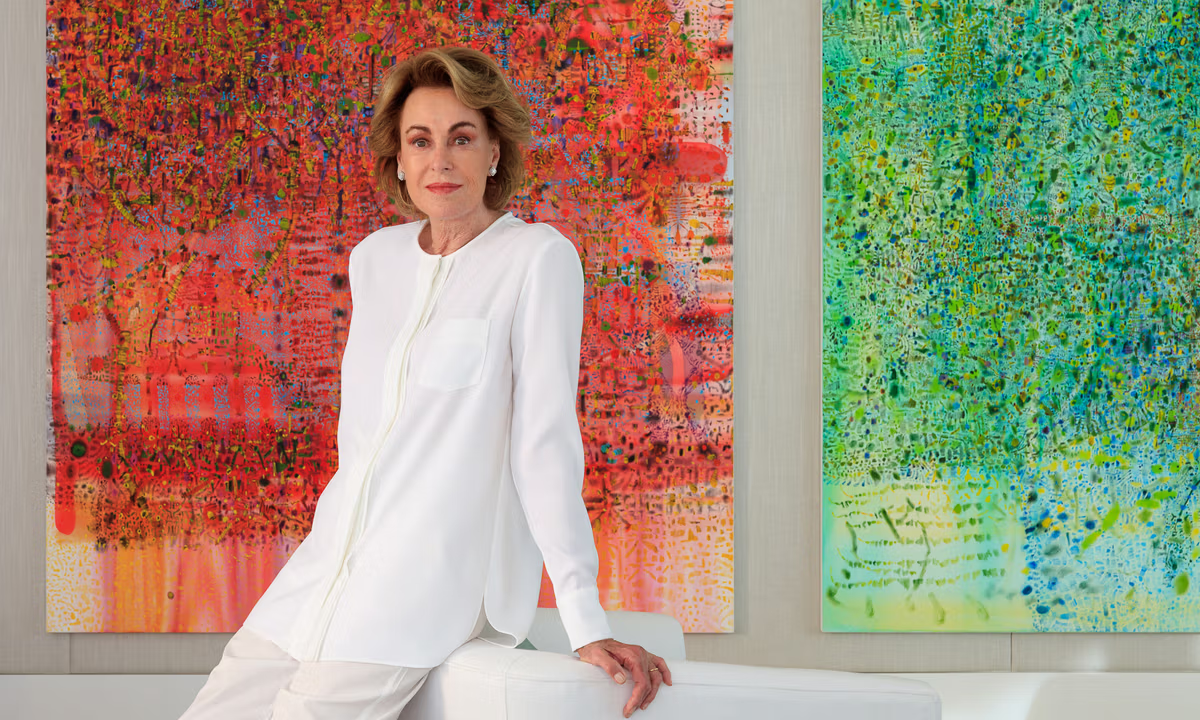
Pilar Crespi knows a thing or two about aesthetics. She worked for years as both a model and a fashion executive for brands like Valentino and Gucci. She later ran her own public-relations agency in New York City. These days, Crespi is a Miami-based philanthropist and sits on the boards of several arts organisations, including the Institute of Contemporary Art Miami, the Peggy Guggenheim Collection in Venice and New York’s Henry Street Settlement, where she serves as vice president. Crespi also co-founded and co-chairs the humanitarian-aid focused Source of Hope Foundation with her husband, Stephen Robert—an investment banker and former chancellor of Brown University.
Born into a fashion dynasty most often associated with Vogue magazine and a few of its international editions, particularly the Italian one, Crespi grew up going to museums. Later, while living in Rome, she became close with artists in the Arte Povera movement. Living in Miami since 2009, she still counts local artists as friends, frequenting their shows at galleries and museums alike.
The Art Newspaper: What was the first work of art you ever bought?
Pilar Crespi: My first art acquisition was when I was very young and lived in Rome. It was an oil painting by Tano Festa, who happened to be a friend. Many of my friends were in the art world, so I was often with painters who were part of the Italian Pop art movement, such as Tano, Cesare Tacchi and Antonio Recalcati.
What was the most recent work you bought?
A work by Sidival Fila, a Franciscan friar represented by Mennour gallery. He has a spectacular studio in a convent that overlooks the Forum in Rome. My husband also just gifted me a work by Yoan Capote, a Cuban conceptual artist represented by Galleria Continua.
What do you regret not buying when you had the chance?
Around 30 years ago there was an auction, I think at Christie’s in New York, selling a work by Jean-Michel Basquiat. It was black and white, and it stole my heart. I could not afford it but, looking back, I should have borrowed the money to buy it. Many years later, a friend invited me for dinner and there it was in his dining room! I was happy it found a lovely home.
If you could have any work from any museum in the world, what would it be?
A painting by Caravaggio—any of his works at the Galleria Borghese in Rome. I think he is the best Baroque painter. If I had a second choice, it would be Jackson Pollock’s Two (1943-45) from the Peggy Guggenheim Collection in Venice.
Where do you like to eat and drink in Miami?
I like Estiatorio Milos in Miami Beach, because the fish is consistently fresh and cooked to perfection. I also love the Greek salad there. Other favourites are Dōma in Wynwood, Mika in Coral Gables and Cipriani in Brickell. I love Mediterranean food, and there are many wonderful restaurants in Miami. However, above all, I like eating and entertaining at home.
What is your least favourite thing about art fairs?
The huge crowds, the frenzy of most collectors and the traffic. My favourite fairs are Art Basel in Paris and in Miami Beach.
What tip would you give to someone visiting Miami for the first time?
I suggest coming to Miami for five full days if you can. This way you can enjoy the museums; the Institute of Contemporary Art is my favourite, but the Bass and Pérez Art Museum Miami also have interesting shows. The galleries are good, too. I particularly like the artist-run space Central Fine; my friends Diego Singh and Tomm El-Saieh help run it. Others I visit often are David Castillo and Spinello Projects. And if you want to chill and you have time, go at sunset to the Boater’s Grill in Key Biscayne; have a drink and enjoy the beach.
