


In the last sentence of the book The Sea Around Us (1950), the biologist, writer and conservationist Rachel Carson declared: “For all at last return to the sea… like the ever-flowing stream of time, the beginning and the end.” It was written more than a decade before her hugely influential book Silent Spring (1962) galvanised the 1960s environmental movement. Today, as our oceans heat up and marine habitats deteriorate, Carson’s emphasis on the planet’s interconnectedness and dependence on the sea as both the beginning and end of all living existence has never been more pertinent.
Homo sapiens may be land dwellers but the oceans that cover more than 70% of the Earth’s surface are essential for our survival. As well as providing food and energy the sea also produces around 50% of the earth’s oxygen and absorbs around 30% of excess carbon dioxide from the atmosphere. However, acting as a carbon sink and climate regulator also comes at the cost of greater acidification and oceanic warming, with additional man-made damage such as plastic and chemical pollution and overfishing all contributing to the overall degradation of our planet’s seas.
For All at Last Return, a major group exhibition at the Baltic Centre for Contemporary Art in Gateshead, northeast England, uses Carson’s clarion call as title and starting point for 13 artists from around the world for whom the health of the oceans is an enduring concern. The show takes the visitor from the ocean’s surface in works such as South African artist Bianca Bondi’s adorned skeletons of two threatened species of dolphin that hover overhead, suspended from the ceiling as if leaping through waves; down to the deepest sea bed in a dramatic installation by Estonian Kristina Ollek, whose rotating, gleaming knobbly sculptures investigate the properties of the slow-growing deep sea polymetallic nodules that are now attracting the potentially devastating interest of mining companies.
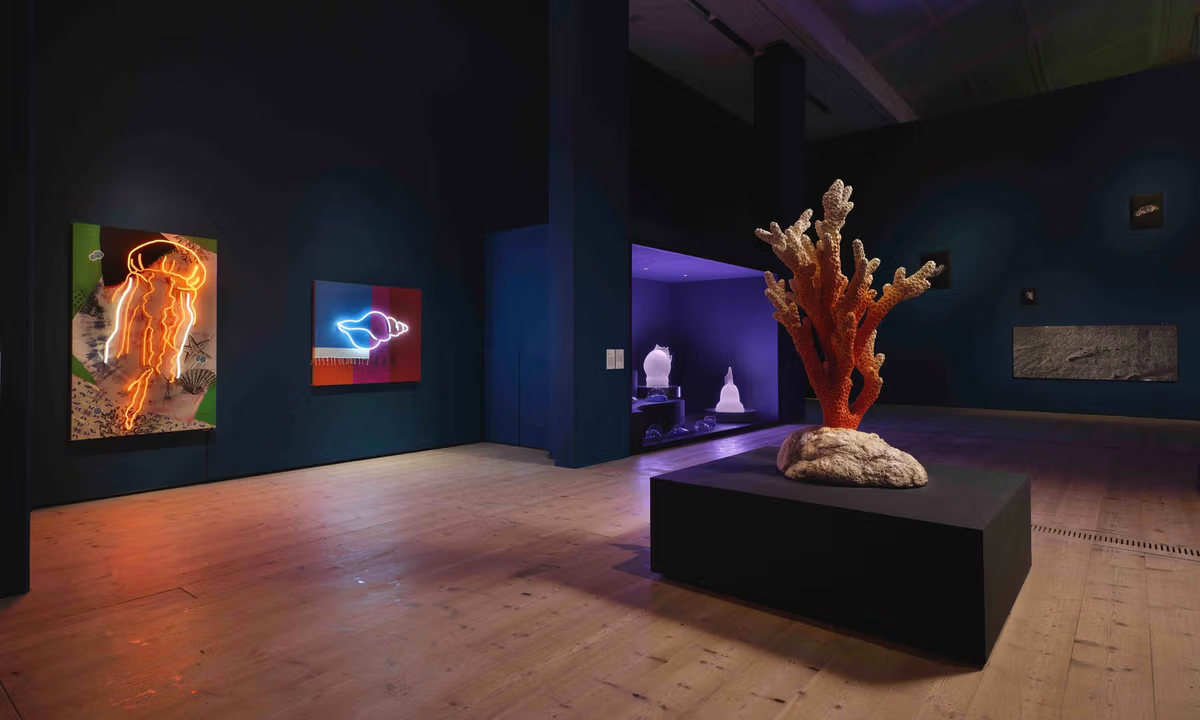
Shezad Dawood’s Disposable mementoes (Crayfish) (2018) © Baltic Centre for Contemporary Art 2025, photo: Tom Carter
In between, the show encompasses multifarious ocean habitats and marine ecosystems from near shore and intertidal zones to coral reefs, the open sea and underwater terrains. Joan Jonas offers an exuberant tribute to the biodiversity, intelligence and complex ecologies of ocean life with Moving Off The Land II (2019), an installation of drawings and films; while Taloi Havini and Michael Toisuta’s videos explore the regeneration of coral reefs at night through mass-coral spawning. Less celebratory is Shezad Dawood’s examination using neon, sculpture and commercial beach towels to address the consequences of both climate change and global beach tourism on marine ecosystems; while Otobong Nkanga—in her enormous, richly detailed woven tapestry of a subaquatic landscape, in which severed limbs and mechanical forms are integrated with luxuriant plant and coral life—offers a stark reminder of the fraught and complicated histories of extraction and displacement that are now indelibly associated with the world’s oceans.
Baltic is located next to the tidal River Tyne, and the ground it sits on was once salt meadow habitat, some eight miles from the North Sea. Chiming with Carson’s core belief in our intrinsic interconnectedness via the earth’s waterways, For All at Last Returns also zeroes in on its vicinity. The Newcastle-based artist and researcher Michele Allen has collaborated with local volunteers, researchers and marine biologists to map the nearby River Tees as it feeds into the North Sea. Using film, audio, collected objects and text, her work examines the past, present and future of the terrain around the Tees estuary as well as the highly fragile balance between industry and ecology on Britain’s North East coast. An ongoing public programme of talks, workshops, performances and films also takes the themes and concerns of For All At Last Return out into its surrounding communities.
Then there is the role of Baltic itself in setting an institutional example of circularity and sustainability. Not only does Baltic have an excellent track record of inviting artists to address environmental matters in its exhibition programme, it has also been a trailblazer in putting these concerns at the centre of all its practices. “We strive to be a leader in environmental sustainability and believe that a successful future for our organisation and visitors depends on the sustainability of the environment, communities and economies in which we operate,” its sustainability statement declares.
In keeping with these aims and as with all Baltic’s exhibitions, For All at Last Returns has been organised to have as light a touch on the environment as possible. An itemised breakdown of the show’s environmental impact reveals a meticulous logging of all its elements, and a prioritising of the greenest options. Whether the four curator research trips to the UK and EU taken by solely by train; the reduction of air travel for the artists attending the show’s installation and opening to just two short haul and one long haul flight; or the exhibition display furniture—plinths, vitrines, benches—all being reused from previous exhibitions, in each case sustainability has been put front and centre. As with all Baltic’s signage, the exhibition labels were printed locally on recyclable card, and even the structure supporting Otobang NKanga’s textile was fabricated from scaffolding already in stock.
Such dedication to minimising its environmental impact has resulted in Baltic being recognised as Best Newcomer in the 2025 Investors in the Environment (iiE) Awards, held annually by this national environmental accreditation scheme that helps more than 300 businesses and organisations throughout the UK to be more sustainable. Announced in November last year, special note was taken of Baltic’s major reductions in electricity, waste and carbon emissions as well as its sustainable travel schemes and biodiversity initiatives. (Apparently the former flour mill is home to the world’s furthest inland kittiwake bird colony and also has more than 200,000 bees residing in its rooftop hives.) Such a rigorously holistic view is to be applauded and should be studied closely by all arts organisations of all sizes and in all locations.
- For All At Last Return, Baltic Centre for Contemporary Art, until 7 June
