






The Museo Nacional del Prado in Madrid has released an AI-assisted video, titled “The Prado by the Light of the Eclipse,” that digitally alters 11 paintings in its collection to show how their scenes might look under the dimming light of a solar eclipse. The one-minute piece, soundtracked by “Summer” from Vivaldi’s The Four Seasons, is timed to Spain’s total solar eclipse on Wednesday, August 12th. The eclipse—which will also pass over parts of the Northern Hemisphere—will be the first to cross Spain in more than a century, with totality expected to last under two minutes.
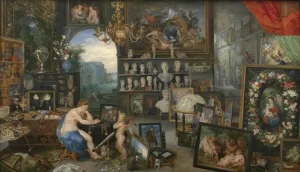
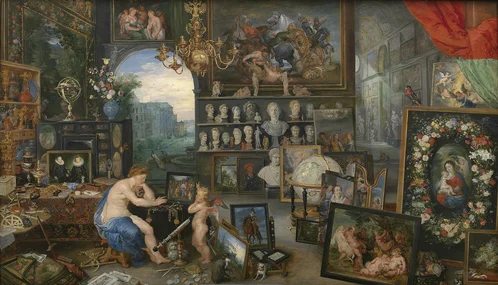
The video opens with Diego Velázquez’s Las Meninas (1656) swept into shadow, and goes on to darken Francisco Goya’s El Quitasol (1777) and La pradera de San Isidro (1788), Peter Paul Rubens and Jan Brueghel the Elder’s La Vista (1617), and Albrecht Dürer’s self-portrait, among other works by José de Ribera, Corrado Giaquinto, Claude Lorrain, José Casado del Alisal, and Carlos de Haes. In a statement, the Prado described Las Meninas’s spatial complexity as owing partly to “the multiplication of the light sources,” while El Quitasol points to Goya’s “mastery at painting light and shadows,” the same qualities the new video sets out to manipulate.
The project was produced by the Madrid studio AMB Piensa, which combined AI video-generation tools with traditional animation and manual review. According to the museum, the technology was used to simulate the eclipse’s gradual darkening, along with shifting shadows and reflections across each painting’s figures, landscapes, and architecture. Every sequence was checked and adjusted by hand to preserve the works’ original composition and technique. The Prado has also framed the effort as a tool for cultural outreach, aimed particularly at audiences who don’t typically visit museums.
This week’s eclipse is the first of three (two total, one partial) forecast to cross Spain and Portugal between now and January 2028, drawing tourists to the Iberian Peninsula for what astronomers describe as a rare run of visibility. It also continues a long tradition of art responding to eclipses. In 1918, the American painter Howard Russell Butler was commissioned by the U.S. Naval Observatory to capture an eclipse on canvas, working from mere seconds of direct observation. Eclipses have also featured in Christian iconography for centuries, tied by some biblical interpretations to the crucifixion.
The Prado’s works span several Old Masters traditions, from Velázquez’s Spanish Golden Age portraiture to Rubens’s Flemish Baroque and Dürer’s Northern Renaissance printmaking. The museum’s eclipse video underscores how radically shifting light can transform even familiar paintings.


