



Art market players ended 2025 in a relatively good mood, but what does 2026 have in store? I have taken a long gaze into the crystal ball and come up with five (and a half) predictions.
The market will not roar back
The autumn marked a distinct improvement on the first half of the year, helped considerably by the November auctions in New York. Yet it doesn’t feel like time to pop the Ruinart corks. Much of the macro-economic and geopolitical uncertainty has not gone away, and there is now the added threat that the artificial intelligence (AI) stock market bubble looks ready to burst. Within the art market, the shift in taste towards lower-priced art (plus a few trophies) seems here to stay as collectors nurse the reality that their “investments” in art have not paid off these past ten years or so. Caution will dominate as the market begins to accept that demand could be just as much of an issue as supply. The numbers have not yet been crunched for 2025 but, given the dismal first half, are likely to be only just ahead of the 2024 low point. I expect more of the same in 2026.
Smaller is beautiful: the late Koyo Kouoh moved away from celebrating the heroic as curator of the 2026 Venice Biennale
Mirjam Kluka
Less is more
This is a Venice Biennale year, and the theme of the main exhibition in 2026 is In Minor Keys, chosen by the late Koyo Kouoh, marking a time to take a breath and shine a light on the unheroic. I expect this sentiment to radiate through the market, whose players will continue to prioritise sustainability over extravagant growth. While there will be fewer galleries that shut down completely, after the slew in 2025, there will be more geographic pruning, in the mould of Sean Kelly scaling back in Los Angeles, Stephen Friedman closing in New York and Almine Rech downsizing in London. The art too is going to get smaller (aka cheaper)—already identified as a trend in 2025 by Artsy. According to Artsy, purchases of work tagged as “miniature and small-scale paintings” were up 66% on the year, while 40% of all purchases on the platform were for small works, defined as measuring under 40 square inches. Flashy stunts, à la Maurizio Cattelan, will disappear, while domestic imagery will proliferate. Among Artsy’s other findings: “The table, and the food on it, is now a place for self-expression, mirroring the contemporary appetite for comfort, nostalgia and meaningful connection in real life.”
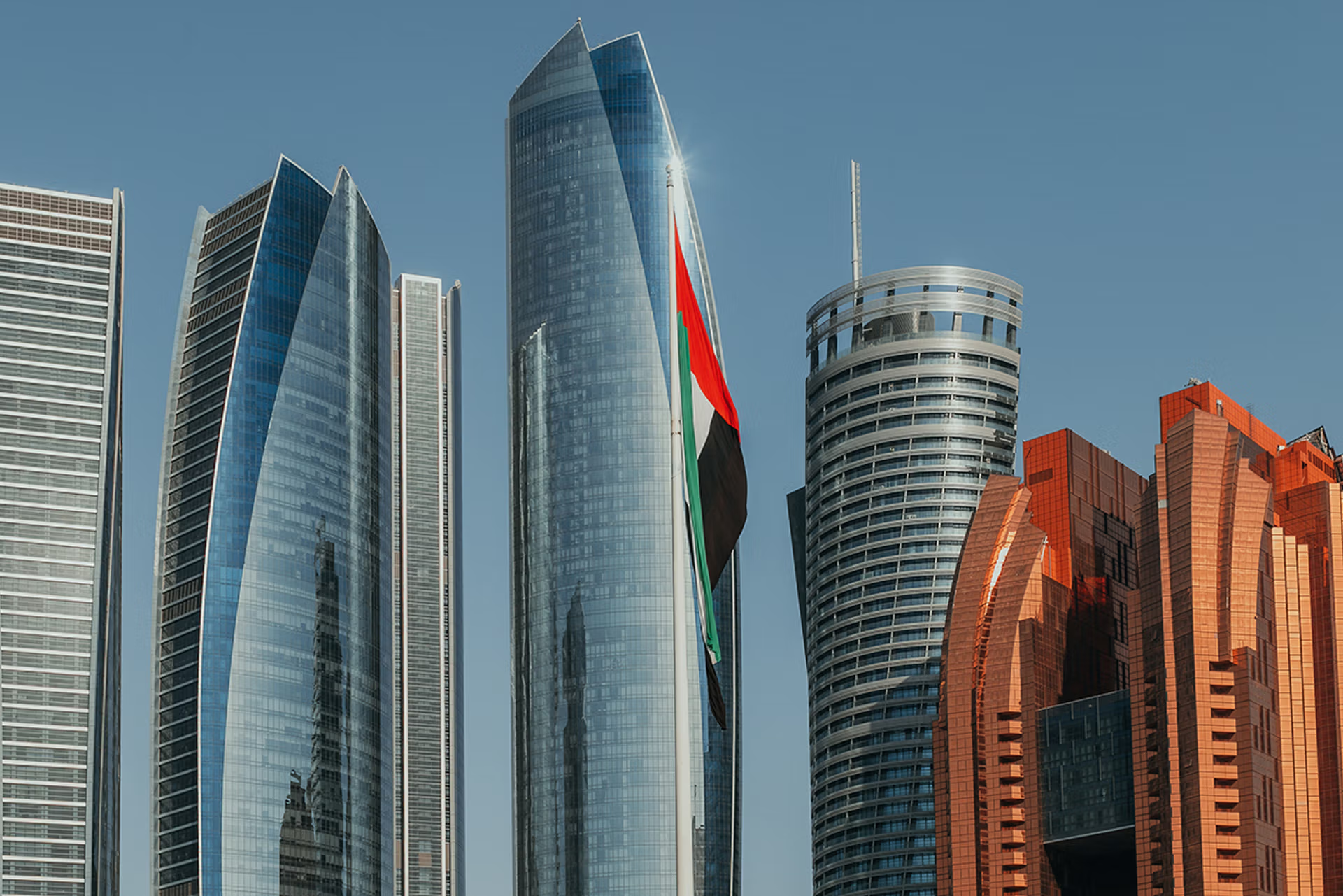
Going for growth: Frieze, which recently acquired the art fair in Abu Dhabi, is in expansionist mode
Kate Trysh/Shutterstock
Frieze will land somewhere else, Art Basel won’t
Under the new-old ownership of Ari Emanuel and his Mari venture, the Frieze fairs have a renewed energy, and I expect them to take control of another existing art event. My further bet (my half prediction) is that this will be in India, which has more potential buyers than the currently in vogue Middle East and is experiencing a meaningful reassessment of art as an aspirational acquisition. Art Basel is likely in more of a consolidating mood. Its Qatar arrangement has not been spelled out but the investment seems to be coming more from the emirate than from the art fair, which is something that would be hard to replicate elsewhere. Overall, the number of art fairs will fall and their exhibitor numbers will shrink, in tandem with galleries’ more prudent strategies.
London will regain its clout
Perhaps as much a hope as a prediction, but London’s credentials as a place where artists like to have exhibitions are making themselves felt again. Sure, some of the wealth has left for the friendlier tax regimes of Milan, Dubai and increasingly Portugal (which has no general wealth tax or inheritance tax for spouses, parents or children). But some wealth has also come into London, notably from the US, in part because of polarised domestic politics on the other side of the Atlantic. Meanwhile, the UK’s museums have received some generous donations this year, topped by the National Gallery’s record-breaking £150m each from Michael Moritz and Harriet Heyman’s Crankstart foundation and the Julia Rausing Trust, boosting confidence in the city’s cultural pull. Auction activity may remain slim compared with New York, but investment in London’s gallery scene will pay off, ranging from newcomers such as Pale Horse in a first-floor Fitzrovia flat to Hauser & Wirth’s forthcoming 18,000 sq. ft building in Mayfair’s South Audley Street.
Continued rise of AI art as a real market segment
I do not, in fact, predict this at all. Rather, it is ChatGPT’s self-serving answer to the query: “What will be the role of AI in the art market in 2026?” Instead—and partly as a refuge from the anonymity of AI—I predict that craft-based work will continue to surge in popularity, although there will be no dramatic reassessment of valuations. AI will continue to improve efficiencies in areas including valuation and research, but slip-ups based on misinformation seem inevitable in the short term.
