


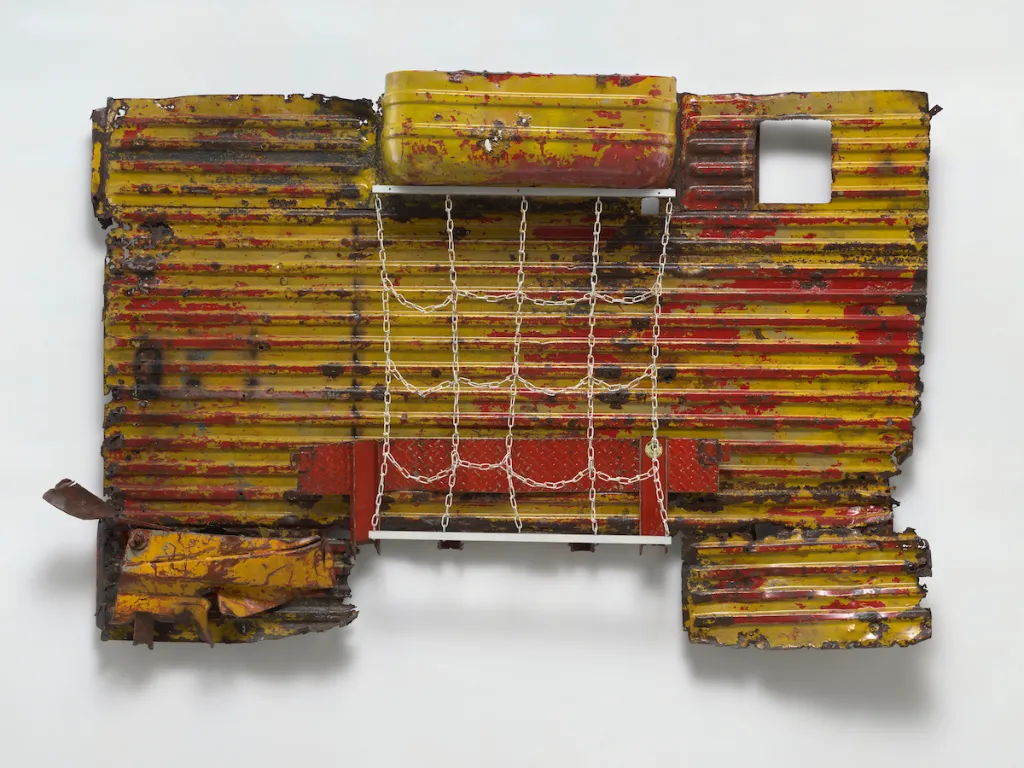
The Robert Rauschenberg Foundation has given three works by the artist to Artist Rooms, a collection that is jointly managed by the London-based Tate museum network and the National Galleries of Scotland.
Though Rauschenberg remains best known for his Combines from the postwar era, all three of the works given to Artist Rooms are part of a 1980s series called “Gluts.” Like his Combines, these sculptures harvest ready-made materials borrowed from everyday life—found pieces of metal, mostly, in this case—and turn them into art.
Rauschenberg considered his “Glut” sculptures a commentary on excess. At the time Rauschenberg made them, the US was facing an oil surplus. He saw the existence of all this waste as a sign of social rot.
“It’s a time of glut,” he once said. “Greed is rampant. I’m just exposing it, trying to wake people up. I simply want to present people with their ruins . . . I think of the ‘Gluts’ as souvenirs without nostalgia. What they are really meant to do is give people an experience of looking at everything in terms of what its many possibilities might be.”
While not necessarily one of Rauschenberg’s most famous series, the sculptures have periodically been seen in major museums. The Guggenheim Museum mounted an entire show of them in 2009, the year after Rauschenberg died.
The sculptures given to Artist Rooms—G-I Glut (1986), Rasputin’s Revenge Early Winter Glut (1987), and Mobile Cluster Glut (Neapolitan), 1987—will go on view this September at Tate Modern, in a gallery of 25 works by Rauschenberg.
“These three Gluts, forged from the remnants of a particular moment, ask us to look squarely at what we value and what we discard,” said Rauschenberg Foundation director Courtney J. Martin in a statement. “Collaboration and intentionality were central to the artist’s ethos.”
