


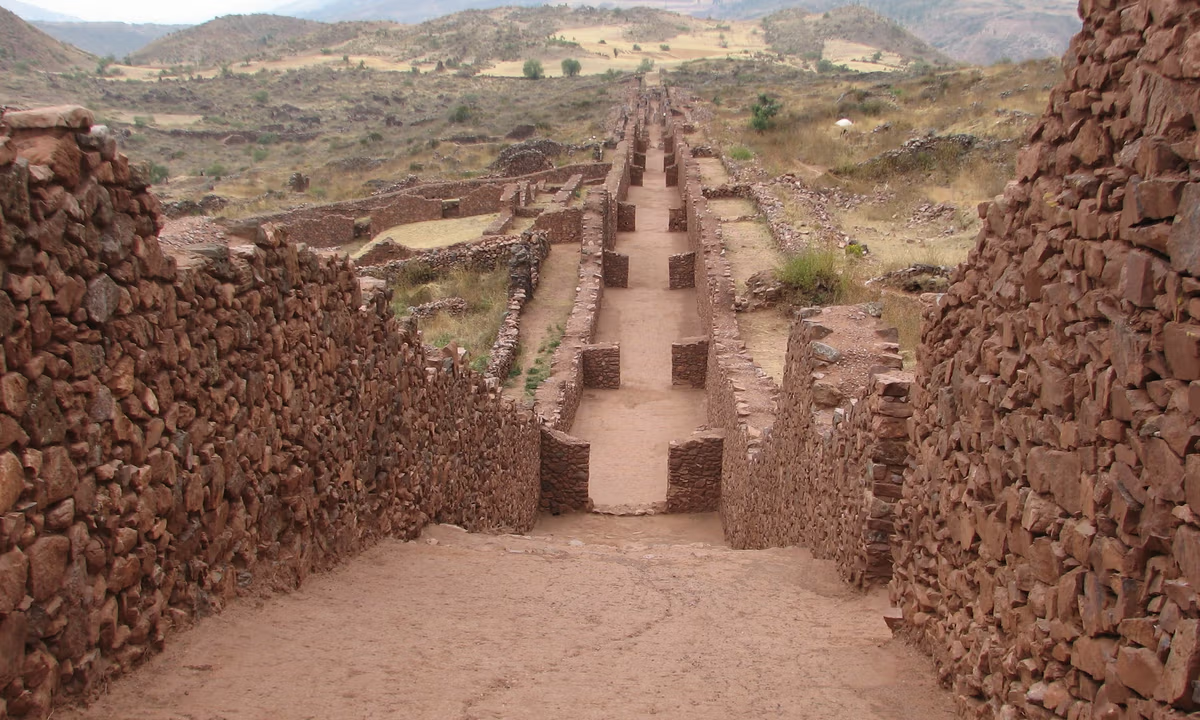
One thousand years ago, the population of Pikillaqta in southern Peru abandoned their homes and left the city to ruin. This had been the greatest city of the Wari, a culture that dominated the region before the rise of the Inca. It had taken over 5,000 people more than 12 years to build this carefully planned city, and for nearly four centuries it had stood as a place of ceremony and administration—a symbol of Wari power. Then, it was nothing.
Why the Wari abandoned Pikillaqta has long puzzled archaeologists. War, disease or a lack of water have all been suggested, but there was no agreement. Now, writing in the journal Geoarchaeology, Briant García of Peru’s Instituto Geológico Minero y Metalúrgico and colleagues have studied the city’s surviving structures and surrounding landscape, and finally revealed Pikillaqta’s probable fate: nature was to blame.
Around AD900, two powerful earthquakes, perhaps in quick succession, shook Pikillaqta. At roughly the same time—as if the population hadn’t suffered enough—there was a massive landslide. Debris flowed down the surrounding hills and into the city’s buildings, in places piling up to 2.5m thick. It was an overwhelming natural disaster. The Wari never recovered.
Mexican mystery
That we are only learning about this now is not surprising. For centuries, archaeologists and historians neglected nature’s impact on world events in favour of human action—the rise and fall of civilisations was down to conflicts, invasions and politics, they argued, not wind and rain. But today, thanks to new technologies and the insights they provide, this has changed. Now, we can better reconstruct how nature has shaped our history.
Like Pikillaqta, a similar mystery long hung over the ancient city of Teotihuacan in Mexico. At its height, around AD500, this was one of the most populous cities on Earth, housing an estimated 150,000 people, but after AD550 it became a ghost town. In papers published in the Journal of Archaeological Science: Reports in 2024 and 2025, Raúl Pérez-López of the Instituto Geológico y Minero de España and colleagues argued that damage visible in the city’s pyramids was likely caused by repeated “megathrust” earthquakes, probably originating somewhere along the Pacific coast. These shook Teotihuacan between the first and sixth centuries AD and may have exacerbated existing problems, speeding the collapse.
But nature’s impact need not be as swift and dramatic as an earthquake to force change. We all understand that natural catastrophes can disrupt or even end a civilisation, but how often do we acknowledge that slower, more subtle and protracted changes—the ones that we hardly notice on a day-to-day basis—can be just as influential on the course of human history?
Take the Shijiahe culture, for example, which thrived in central China from around 2650BC to 1950BC then mysteriously collapsed. Recently, Jin Liao of the China University of Geosciences and colleagues studied a stalagmite from Heshang Cave, which enabled them to reconstruct rainfall levels for this critical period. According to their research, published in the journal National Science Review, the Shijiahe collapse coincided with decades of heavy rainfall. It appears that with the area waterlogged and flooded, and with less and less land to live on and farm, people simply abandoned their homes for higher ground.
Chasing the rain
Conversely, around 1,000 years ago, changing sea surface temperatures across the Pacific Ocean appear to have caused the climate in Western Polynesia to become drier, experts write in the journal Communications Earth & Environment. With reduced rainfall and the threat of water scarcity, the people of Samoa and Tonga took to their boats and sailed east across the ocean, where they settled on Tahiti and other islands, places where the climate had become wetter. David Sear of the University of Southampton, UK, one of the researchers behind the paper, says people “were effectively chasing the rain eastwards.”
Although these events might seem distant to us today, these findings can help researchers to predict the impact of environmental changes around the globe; and significantly, they also reveal how modern populations might react under similar circumstances. By looking to the past, we can see how nature will shape our future.
• Garry Shaw is an archaeologist and writer
