


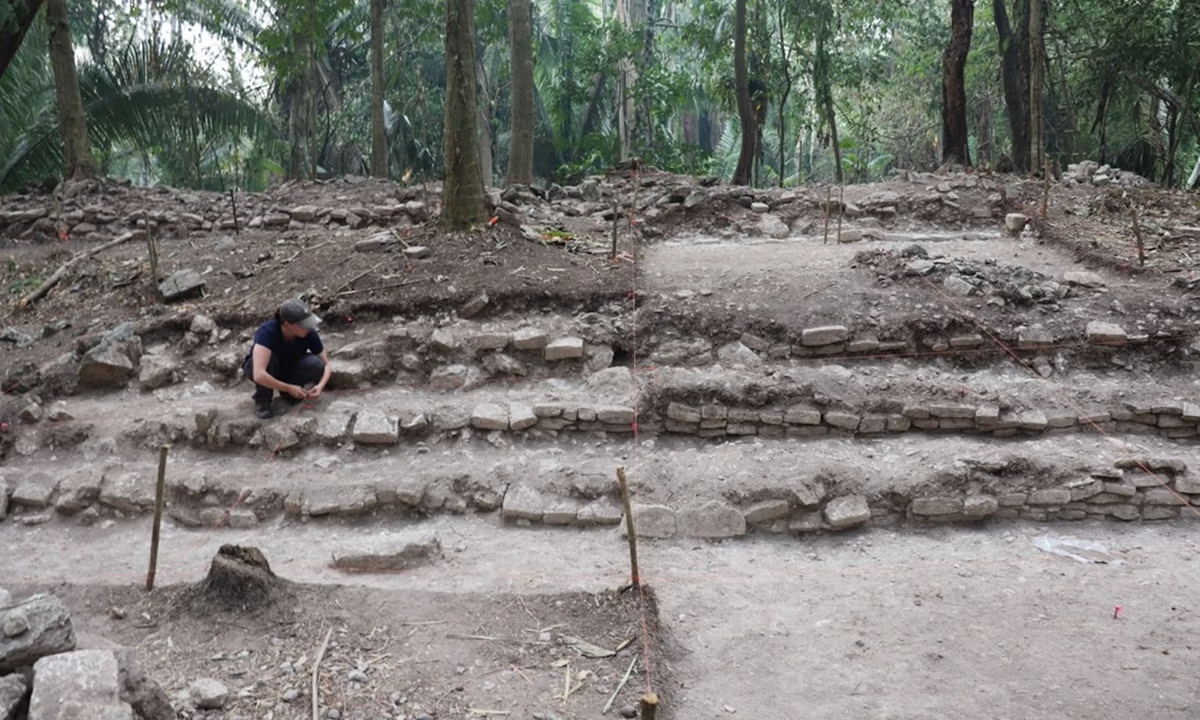
Archaeologists working at the ancient Maya site of Ucanal in Guatemala have identified a building in which leaders may have discussed political decisions more than 1,000 years ago. Described as a council house, it was built during a tumultuous era in Maya history, when consensus and power-sharing among rulers and nobles replaced the decisions of divine kings.
“The popular conception of the ancient Maya society is that they underwent a major collapse,” says archaeologist Christina Halperin of the Université de Montréal in Canada, lead author of the research published in the journal Antiquity. “Archaeological investigations at Ucanal and elsewhere, however, show that there was not a collapse everywhere and that ancient Maya peoples resiliently reworked their governing systems.”
The recently excavated building represents a new form of architecture for its time: a colonnaded open hall, built around AD810-AD1000. Political leaders such as kings, nobles, diplomats and warriors may have met in this council house to make decisions—discussing matters from war, politics and crime to feasts and wedding preparations.
Buildings of this type are uncommon in Guatemala’s Peten region during this era, which was marked by major political upheaval. But as other Maya centres collapsed, the kingdom of K’anwitznal, with its capital at Ucanal, thrived.
“Although colonnaded halls, some of which are interpreted as council houses, are well known for the Late Postclassic period [around AD1200-AD1521], it was unexpected for us to find one dating so early,” Halperin tells The Art Newspaper.
Site drawing and 3D rendering of the open, colonnaded council building at Ucanal Drawing: Christina T. Halperin and Laurianne Gauthier. Rendering: M. Voltaire
In earlier times, kings made most of their government decisions in palaces. But for those entering the palace, the architectural layout made a clear distinction between the kings themselves—regarded as divine by the Maya—and the members of their court. This stark division was also reflected in royal constructions, such as the temple-pyramids in which kings were buried.
But as the Maya entered the Postclassic period (1000-1521), the political landscape changed. Archaeologists have noted a decline in the power and aggrandisement of kings. But how the Maya transitioned from decision-making by divine kingship to consensus and power-sharing has long been unclear. The colonnaded open hall at Ucanal, if indeed a council house, now provides early evidence for this important political shift.
“Although Maya kingship continued into the Postclassic period, fewer monuments were dedicated to ruling elites and images of them largely disappeared,” Halperin says. “Governing systems, however, did not disappear, but rather shifted to more horizontal relationships held together through consensus-based institutions. We need to pay more attention to these less visible and less hierarchal political movements.”
Unlike Maya palaces, the colonnaded council house at Ucanal had an open facade and was situated in a public plaza. Consequently, the meetings held there were likely visible to ordinary people, who could watch and perhaps involve themselves in the decision-making process. This added a level of transparency to proceedings and maybe even some political theatre.
“While kings and queens and their royal courts receive much of the attention, other styles of governing were also in play alongside institutions of kingship,” Halperin says. “These other governing strategies not only included councils of lineage heads and other horizontal networks of power but likely involved common people who were necessary for garnering moral and political consensus.”
Other buildings constructed at Ucanal during this period may also reflect the growing influence of ordinary people over government decisions. A ruler named Papmalil, along with his successors, built public buildings, such as shrines and a ballcourt, and embarked on water infrastructure projects that helped ordinary people. At the same time, the non-elite also had greater access to imported goods than before.
“The construction of what we think might have been council houses that consist of open buildings facing public plazas suggests that the events and negotiations therein were witnessed and commented on by ordinary people,” Halperin says. “We tend to forget that local populations in ancient societies were highly mobile and could vote with their feet if the conditions were too exploitative.”
Halperin adds: “We are excited to be able to show how ancient Maya society evolved and changed over a tumultuous period of their political history.”
