
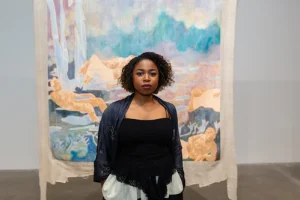






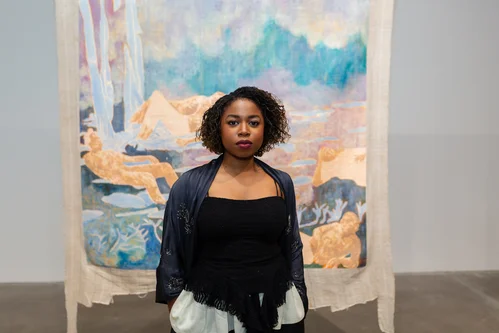
For many years, the artist Nengi Omuku believed that her artworks were hopeful conjurings of a yet-unrealized world, her personal utopias. “I thought I was dreaming of a future,” she recently said on a video call from her studio.
The artist, who splits her time between London and Lagos, creates ecstatic, colorful oil paintings on sanyan, a traditional, pre-colonial Yoruba textile found in Nigeria. She has risen through the art world over the past decade with her spectacular scenes, which present abstracted figures in an Edenic natural world. These visions propose moments of reconciliation, community gathering, and natural beauty following years of international turmoil.
Omuku paints onto strips of gessoed sanyan, the finished works hanging from wooden dowels, like banners that move in the air. Her paintings have earned acclaim with presentations at The Armory Show and 1-54 Contemporary African Art Fair, along with solo shows at Kasmin, New York (2024), and Hastings Contemporary and Arnolfini in the U.K. (2023–24). In 2025, she joined the inaugural Artist Council of the Museum of West African Art, Benin City, Nigeria.
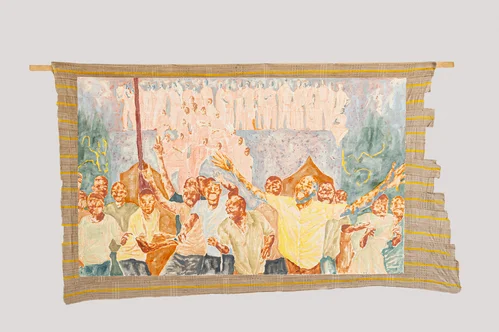

Lately, however, Omuku has started to understand her work differently. Earlier this summer, she opened “The Gathering” at the de Young Museum in San Francisco—her first solo museum exhibition in the U.S. The exhibition, curated by Natasha Becker and on view through May 14, 2028, brings together eight oil paintings made over the past six years. Omuku’s works are installed within the museum’s African art gallery, as part of an ongoing exhibition series focused on cross-generational juxtapositions.
Omuku’s paintings appear alongside 19th-century guardian reliquary sculptures from the Obamba people, 20th-century Asante Kente cloths (historically worn by royalty), and ceremonial masks and costumes. For Omuku, seeing her own works alongside centuries-old artworks and objects has been eye-opening.
“Seeing the historical sculptures in the space, I felt like some sort of ancestral knowledge that had been passed down without me knowing,” said Omuku. “It felt like a kind of remembering that I was not conscious of.”
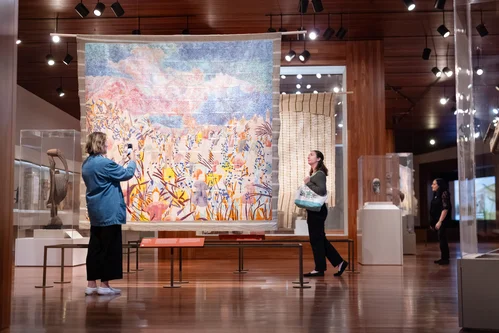

Omuku was caught off guard by her reaction. “It wasn’t until this show that I started thinking about my works as ancestral memory,” she said. “Grappling with the concept of memory was, on some level, scary for me, but very real. When I walked into the room, there was a kind of conversation. It felt like there was a communion that Natasha [Becker] had orchestrated for the work to come and meet each other.”
In recent years, amid a period of global tumult, she had been struggling to understand the significance of her work in the world. Her paintings suggest nature as a site of reprieve and place of beauty. Florals, inspired by the artist’s mother’s work as a florist and gardener, factor heavily into her works, with figures often dwarfed by botanicals.
“For a long time, I thought, what right do I have as a Black African woman making work today and painting flowers? I felt there was much more that’s pressing to be discussed,” she said. “Now I see my work through a different lens. I’m trusting myself a bit more, now knowing that while it still goes back to nature, it also goes back further than my own consciousness.”
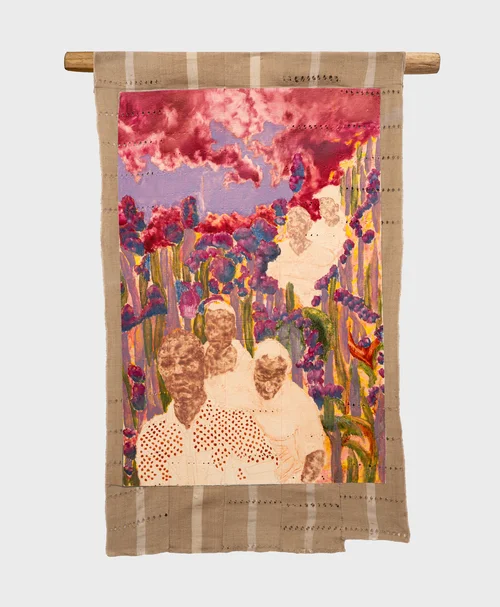

Omuku’s material choices have been changing alongside her shifting conceptual framework. Some of the more recent works in the exhibition, made in 2025, use newly woven sanyan fabric, commissioned by sewing weavers the artist found in the Middle Belt of Nigeria. Previously, the artist had worked almost exclusively with vintage sanyan repurposed from dresses and other articles of clothing. For instance, a few works in the show are painted on sanyan taken from vintage wrap skirts. The shift to newly woven sanyan has liberated her painting from the confines of bodily scale.
The largest painting in the show, New Haven (2025), is made on new sanyan, and the work marks new territory for the artist, who found herself able to “go beyond and start dreaming even more through painting.” In the composition, an apocalyptic-looking, multicolored sky looms above a sprawling landscape. Plants tower over figures, with yellow fuel cans scattered about. The image is inspired by a collage of press photographs of people queuing for fuel in Lagos, where scarcities are common though the nation produces oil. “I wanted to create this landscape where these people have walked into this very strange space and have left jerry cans behind,” said Omuku. “They’re leaving their woes behind and wandering into this new space, but it’s also flat and unreal, from a dream.”
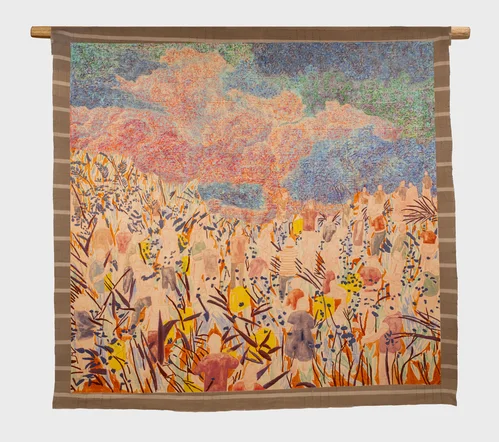

As in this work, Omuku’s works sometimes reimagine scenes from contemporary Lagos in aspirational ways. She sees herself moving further into this dream world. Lately, she’s embraced bright, layered colors and an approach she describes as almost pointillist. Her process is meditative. “I realized that as an artist, I actually have to first take care of myself and my mind through the process of making art, for it to truly be effective,” she said, “and for people to truly feel the things that I’m trying to say.”
A growing part of her practice happens outside the studio, in community building. In 2019, she founded The Art of Healing, a charity that supports mental well-being for Nigerians.
“We install art in intensive-care psychiatric wards, and we do workshops every month as well, as a form of therapy,” the artist explained. “I realized I had been overburdening my paintings with the task of healing the world. Extracting this part from my practice and having it be a real-world application solved that problem for me and allowed my painting to have its own autonomy and exist however it chooses to materialize.”
Now, the artist is leaning into her instincts as she prepares for two more upcoming U.S. museum shows: an exhibition of figurative works, “There We Sat Down,” at the SCAD Museum of Art in Savannah, Georgia, and an exhibition at the Frye Art Museum in Seattle rooted entirely in landscape.
With one show looking back at the figures she painted before, and one pressing further into the dreamed-up worlds she paints now, Omuku is testing her ability to innovate and honor cultural memory all at once.


