


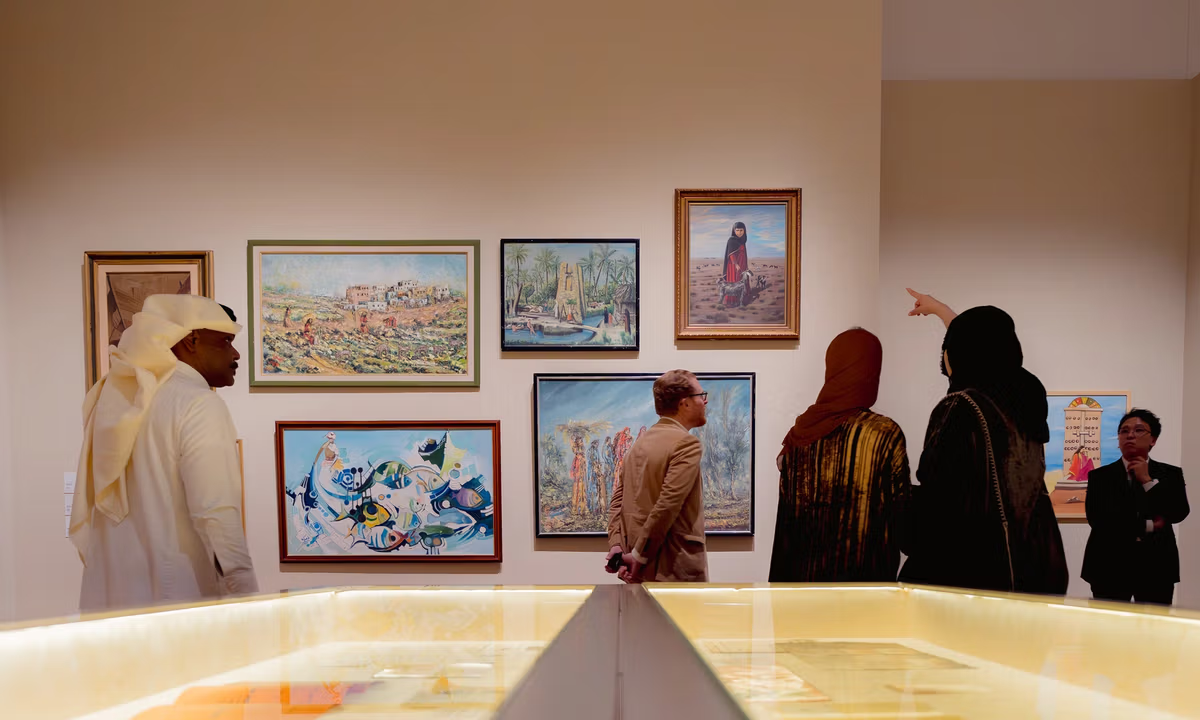
As the art world eyes up its future in the Middle East, Saudi Arabia is looking to its past with several exhibitions and sales that focus on the Kingdom’s Modern art history and its pioneering artists.
At the National Museum of Saudi Arabia in Riyadh, Beginnings of Saudi Art Movement (until 11 April) surveys a key moment in the sovereign state’s history, from the 1960s to the 1980s—a period of rapid societal transformation and relative liberation. More than 250 works, plus a trove of archival material, by 73 artists chart the development of Modern and abstract art at a moment when institutional support and cultural infrastructure began to grow in Saudi. At the same time, local artists started to travel to the US and Europe among other places to study. It is the first time the Kingdom’s Modern masters have been exhibited on this scale together.
“It’s been important to capture these artists and their histories while we can still gather first-hand accounts,” says Reem Yassin, the director of exhibitions and fairs at the Visual Arts Commission (VAC). A catalogue and documentary will follow the exhibition, which is also being recorded in the Saudi National Archives.
Mounirah Mosly and Safeya Binzagr, who met each other while studying in Cairo, were two of the period’s greatest pioneers, collaborating on the first-ever public exhibition by female artists at the Dar Al-Tarbiya girls’ school in Jeddah in 1968. Born in 1943, Mosly also went on to become the first Saudi woman to hold solo exhibitions in both Jeddah and Riyadh, in 1972 and 1973. Binzagr was born in 1940 in Harat Al-Sham, in northern Jeddah; after her return from Cairo in 1963, the artist sought to preserve her memories of the district which had undergone almost complete transformation while she was gone.
Mosly’s niece Rajaa Moumena recalls how her aunt believed in freedom for women. “She thought that women should be liberated and allowed to make their own choices. I think she found an escape in art,” Moumena says. Influenced by her aunt, Moumena went on to found the Future Institute of Higher Education and Training, which was intended to empower women.
The exhibition is the culmination of two years of research by the VAC, a government body established in 2020 as part of the Kingdom’s $2tn Vision 2030—a framework to diversify the country’s economy (at current export rates, Saudi is expected to run out of oil in the next 60 to 80 years), modernise society and develop public service sectors such as health, education and tourism. Culture is a key component in this push for economic diversification—the Diriyah cultural complex where the eponymous biennial is held has reportedly had a $60bn cash injection—though critics and campaigners say that art is being used to launder Saudi’s human rights record and surge in capital punishment. Reports are also surfacing that investment deals with international cultural institutions, including the Metropolitan Opera in New York, have ground to a halt as Saudi faces a funding crunch.
Another cornerstone of Vision 2030 is the AlUla Project, which aims to transform the ancient city of AlUla into a global art and cultural destination via initiatives such as Desert X. Here, too, Modern art is in sharp focus for the fourth edition of the open-air exhibition (until 14 February), which includes five monumental works by the Saudi Modernist artist Mohammed AlSaleem. They have not been on public view for more than 30 years.
Originally conceived in the late 1980s for public squares in Riyadh, the sculptures were made entirely by hand in a purpose-built workshop. The project was ultimately abandoned as the city moved away from commissioning large-scale public works, and the sculptures were placed in storage in 1990. They remained unseen until their acquisition in 2022 by the Royal Commission for the City of Riyadh, after which they underwent restoration overseen by the artist’s daughter, Najla Mohammed AlSaleem.
As ever, the market is following the institutional lead and Modern masters are getting their dues at auction in the Kingdom. After its first sale in Saudi in February 2025, which featured a mixture of luxury goods and international fine art, Sotheby’s pivoted to include more Saudi Modern art for its second auction in the Kingdom on 31 January. Binzagr’s Coffee Shop in Madina Road went ten times over its high estimate to achieve $2.1m, nearly doubling the previous auction record for a Saudi artist, set at Sotheby’s London in October 2023. It also became the third highest price for a work by an Arab artist ever sold at auction. According to sources, the auction house was in contact with the VAC in the run up to the sale though their timings are a coincidence, according to a spokeswoman for the VAC.
In a statement, Sotheby’s head of sale Ashkan Baghestani described the auction’s results as “a clear validation of the growing appetite among collectors in the Kingdom”, adding that the sale had “introduced local and regional artists to a wider collector base, expanding visibility and sparking deeper interest in the cultural and artistic expression of the region”.
