


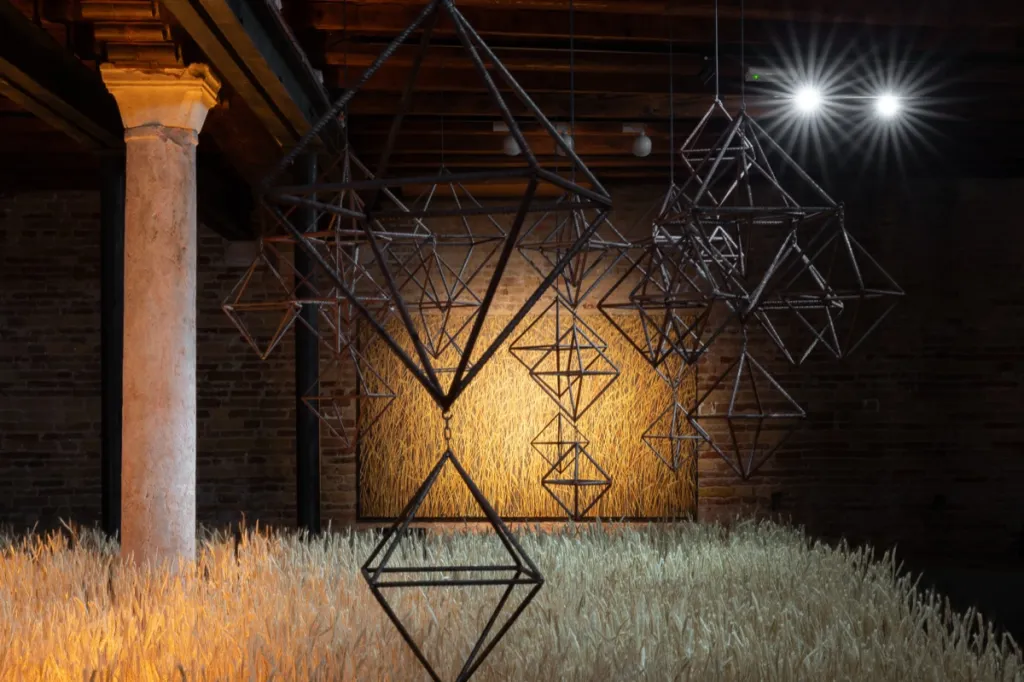
When the Belarus Free Theatre opened “Official. Unofficial. Belarus.” at La Chiesa di San Giovanni Evangelista di Venezia earlier this month, it marked the first time Belarus had a presence at the Venice Biennale in six years—and the first time it appeared there not as a state, but, as curator Daniella Kaliada put it, as “a self-governing, self-authored cultural body.”
The distinction matters enormously. Belarus has only appeared at the Biennale a handful of times, and not since President Alexander Lukashenko’s brutal crackdown on pro-democracy protesters in 2020. In exile since those protests, the Belarus Free Theatre has been at the forefront of efforts to counter the dictatorial Lukashenko regime and telling the country’s story on the international stage.
In Venice, the Theatre translates its approach to visual art, stepping away from the plays and theater productions that have become its calling card, to stage an exhibition featuring Belarusian artists working across painting, installations, and large-scale sculptures. The aim is to make the experience of living under authoritarianism viscerally legible—not just visible.
“We didn’t want visitors simply to learn about a situation,” cofounder Natalia Kaliada told ARTnews in April. “We wanted them to pass through it: the architecture, feeling, sound, scent, sculpture, obstruction, surveillance, ritual, and bodily experience.”
The works on view draw on Belarus’s decades-long experience of repression as both a specific history and a wider warning. As Kaliada said, what once read as a story from the periphery “can now be understood as a warning from the edge of a condition that is spreading.”
Below, see inside the exhibition and the artworks at its heart.
