


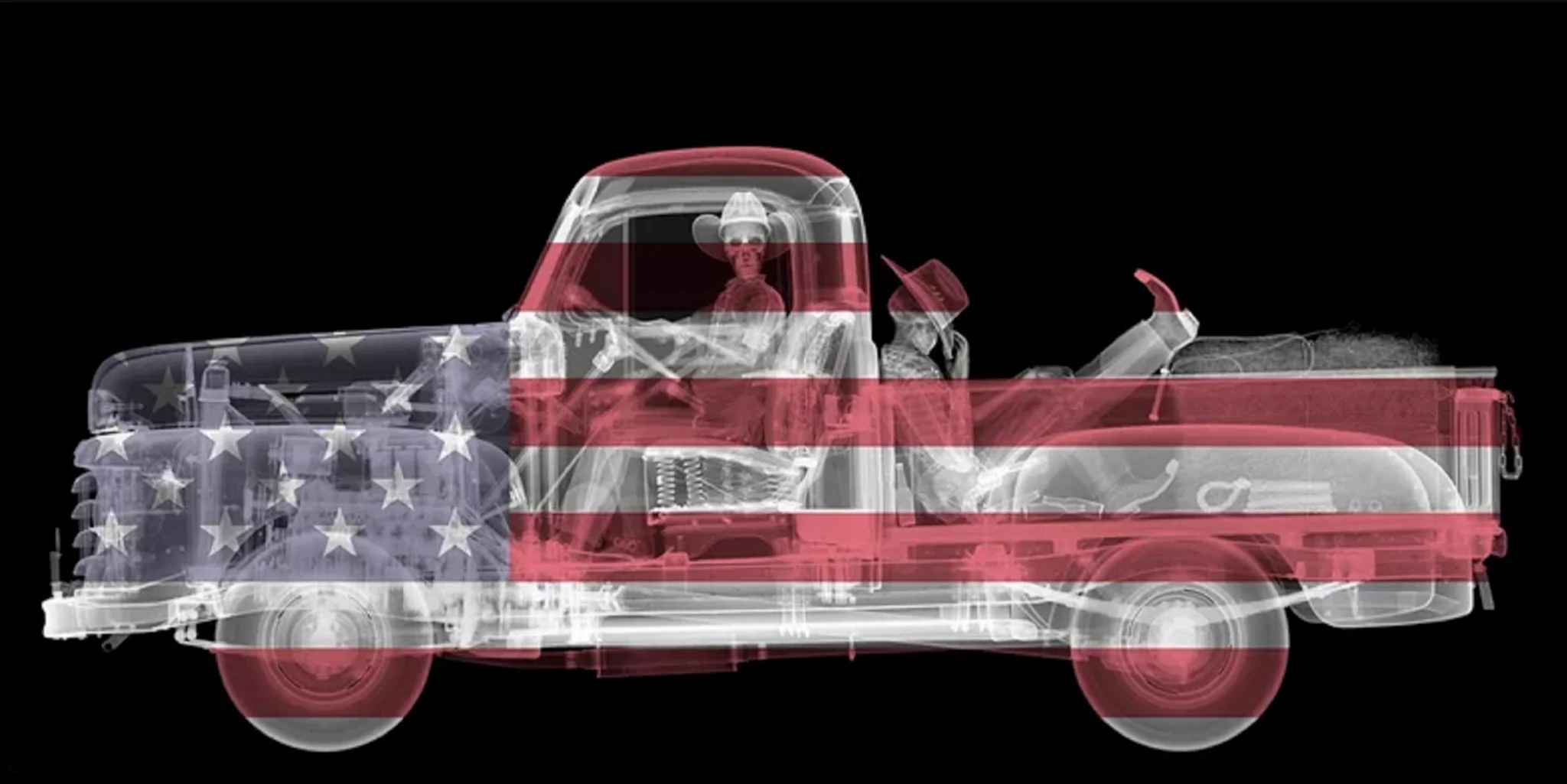
A Ferrari F40 GTE hangs suspended in space, its iconic body dissolved into skeletal transparency. Every fuel line, every gear, every mechanical element that makes the supercar legendary becomes visible. The radiation has stripped away the paint, the sheet metal, the surface that normally defines the object. What remains is pure engineering truth, a revelation that transforms industrial design into intimate anatomy.
This is the art of seeing through.
For over two decades, British artist Nick Veasey has been using X-ray technology to create photographs that transcend conventional imaging. Working from a purpose-built concrete bunker in Kent, England, Veasey doesn’t capture light reflecting off surfaces. He captures radiation passing through objects, revealing internal structures invisible to the naked eye. The result is work that exists in the fascinating space between art and science, photography and revelation, the banal and the beguiling.
The Accidental Discovery
Veasey arrived at his medium through circumstance rather than plan. Asked to X-ray a Coca-Cola can for a television program years ago, he found himself captivated by what the radiation revealed. The familiar object became something else entirely when its interior structure became visible. He X-rayed the shoes he was wearing that day and showed the result to an art director. The enthusiastic response convinced him he’d discovered something significant.
“We all know we shouldn’t judge a book by its cover, that beauty is more than skin deep,” Veasey explains. “By revealing the inside, the quintessential element of my art speculates upon what the manufactured and natural world really consists of.”
This philosophical foundation distinguishes Veasey from photographers using X-ray as a novelty or gimmick. He’s not simply making things transparent. He’s investigating essence, questioning surface, revealing the hidden structures that make objects function. The work asks viewers to reconsider their relationship to everyday things, to recognize that reality consists of multiple layers, and that truth often hides beneath attractive exteriors.
The Technical Challenge
Creating X-ray art at Veasey’s scale and quality requires substantial technical infrastructure. He works from a concrete bunker designed specifically for radiographic imaging, with X-ray equipment suspended from the ceiling and film positioned below subjects. The concrete walls contain the radiation, making the process safe while allowing for extended exposure times necessary to capture complex subjects.
The technical challenges are considerable. Unlike conventional photography, where light cooperates predictably, radiation behaves differently depending on material density. Metal appears white, organic material gray, and air black. Creating readable images requires understanding how various materials interact with X-rays and planning compositions that account for these interactions.
Large subjects, such as automobiles, present particular difficulties. A complete car cannot be X-rayed in a single exposure. Instead, Veasey captures hundreds of separate images, each focusing on specific sections. These component images must then be composited digitally into coherent wholes. The process is painstaking, requiring weeks or months for complex subjects.
But the technical difficulty serves the artistic vision. The elaborate process ensures each piece demonstrates genuine revelation rather than simple transparency. When viewers see a Veasey X-ray of a vintage camera or musical instrument, they’re witnessing something that required both technical expertise and artistic judgment, not just equipment application.


Subject Range and Evolution
Veasey’s portfolio demonstrates an impressive range. His automotive work includes not just the Ferrari F40 GTE but Lamborghinis, Porsches, Jeeps, and VW Beetles. Each vehicle becomes a study in engineering philosophy, revealing how different manufacturers approached similar problems. A Porsche’s mechanical elegance differs fundamentally from a Jeep’s utilitarian robustness, differences that become obvious when the styling is stripped away.
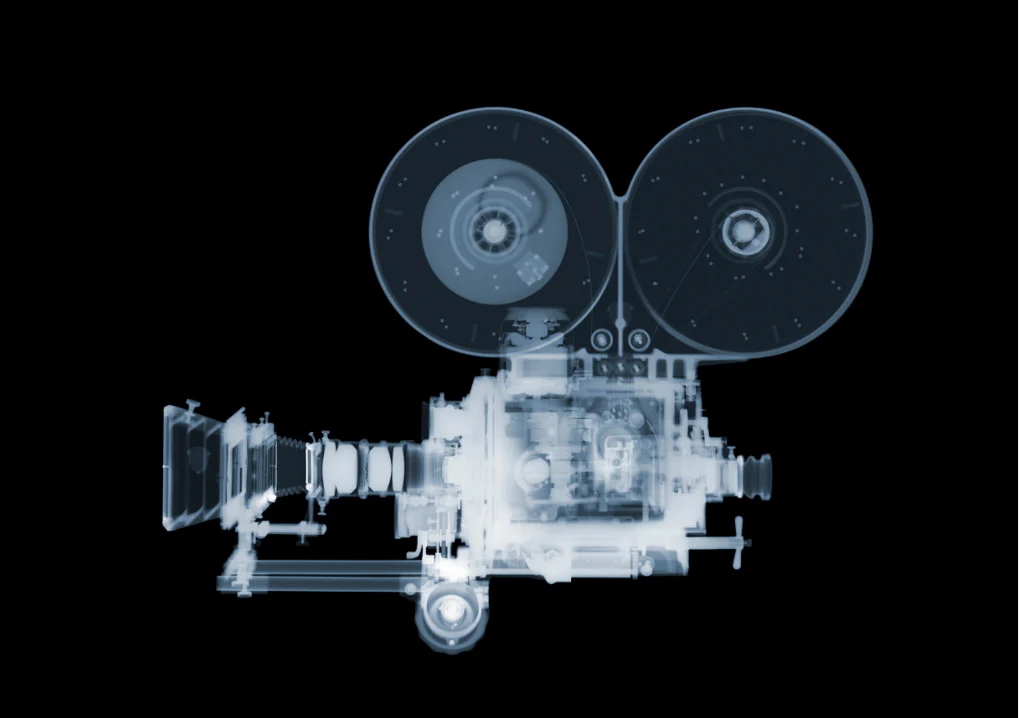
His vintage camera series transforms tools of image-making into subjects themselves. The Moy Film Camera, Newman G Camera, Mitchell Film Camera, and Arriflex 16 BL appear as intricate mechanical systems, with their gears, shutters, and film paths laid bare. These pieces possess particular poignancy. Cameras that once captured surfaces now have their own surfaces stripped away, revealing the mechanisms that made photography possible.
Musical instruments receive similar treatment. His Piano Accordion, Brass French Horn, Brass Saxophone, and Brass Cornet become studies in both form and function. The radiation reveals every key, every valve, every twist of tubing that transforms breath or finger pressure into sound. The pieces speak to human ingenuity, our ability to build beauty from metal and air.
His floral work explores different territory. Flowers evolved to attract through color and scent, but X-ray them and architectural beauty emerges. Structural integrity, symmetry, and the scaffolding that makes softness possible become visible. Works like his various tulip, peony, and dahlia studies reveal nature’s engineering with the same clarity as his automotive pieces reveal human engineering.
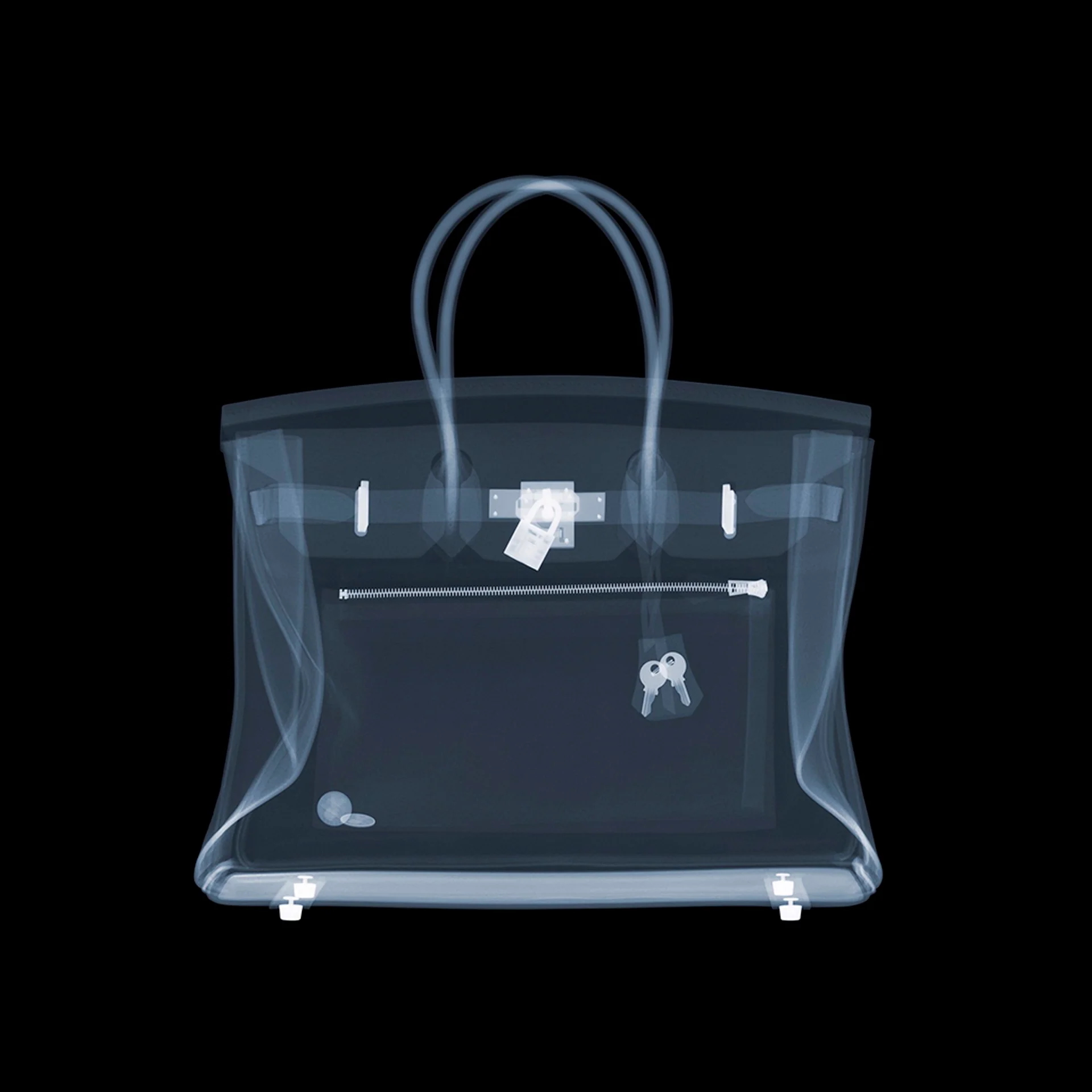
The luxury goods series adds contemporary cultural commentary. His Hermès Birkin Bag X-ray examines an object valued primarily for surface appearance and brand association. Stripped to its internal structure, the bag becomes a study in craftsmanship and materials rather than a status symbol. Similarly, his piece “BanXsy Caveat Emptor” questions authenticity and value in the art market itself.
Market Positioning and Collector Appeal
Veasey’s work occupies a unique position in the photography market.
The photographs appeal to multiple collecting constituencies. Contemporary art collectors respond to the conceptual sophistication and technical innovation. Photography collectors recognize the medium’s expansion beyond traditional boundaries. Design enthusiasts appreciate the revelation of engineering and manufacturing processes. Medical and scientific institutions acquire pieces to demonstrate imaging technology’s aesthetic potential.
Corporate collectors particularly favor the automotive and luxury goods pieces. A Veasey Ferrari or Porsche X-ray speaks to engineering excellence and design philosophy in ways conventional automotive photography cannot. Tech companies respond to the fusion of art and science that the work represents. Architecture and design firms recognize how the pieces reveal structure and function.
The Science Museum Connection
Unlike most fine art photographers, Veasey’s work finds homes in science museums and educational institutions as well as in art galleries. This crossover validates his claim that the pieces transcend simple classification as photographs. They’re documents of material reality, educational tools, aesthetic objects, and conceptual investigations, all at once.
Major science institutions, including the Science Museum in London, have acquired his work. Medical schools use pieces to teach anatomy and imaging technology. Museums of natural history display his botanical X-rays alongside conventional botanical illustrations, showing how different imaging modalities reveal different truths about the same subjects.
This institutional validation provides collectors with additional confidence. When science museums with rigorous acquisition standards purchase Veasey’s work, they confirm its documentary and educational value beyond aesthetic appeal. The pieces become resources, not just decorations.

Collecting Strategies
For collectors interested in Veasey’s work, several approaches make sense. Those drawn to specific subjects can focus on automotive pieces, musical instruments, or botanical studies. Automotive collectors appreciate how X-rays reveal the engineering philosophy and design decisions. Music enthusiasts respond to the mechanical poetry of brass instruments and cameras rendered transparent.
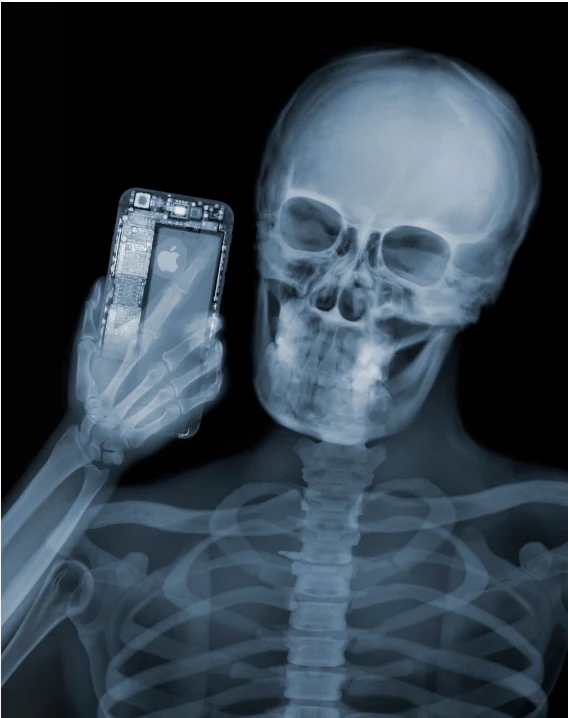
Some collectors focus on the memento mori dimension, acquiring pieces that meditate on mortality and the essence of life. Others emphasize the fusion of art and science, choosing works that demonstrate imaging technology’s aesthetic potential. Corporate collections often feature automotive and luxury goods, which complement contemporary commercial spaces while providing conversation starters about engineering and design.
Entry-level collectors can acquire smaller floral or object studies at accessible prices, experiencing Veasey’s vision while building toward larger automotive or figurative pieces. Established collectors find in works like “BanXsy Caveat Emptor” photographs that rival any contemporary art at similar price points, while offering unique technical and conceptual dimensions.
The Cultural Impact
Veasey’s influence extends beyond collectors and institutions. His images appear in advertising, editorial contexts, and educational materials. The visual language he’s developed for X-ray imaging has become widely recognized, influencing how commercial and editorial photographers approach transparency and revelation.
Television programs and documentary films regularly feature his work when discussing technology, engineering, or art-science fusion. His studio welcomes journalists and filmmakers, resulting in substantial media coverage that introduces his work to audiences beyond traditional art collectors.
This broad cultural presence raises awareness while potentially creating risks. Popular exposure can diminish perceived value in the art market. But Veasey’s work has avoided this trap. The technical difficulty of creating authentic X-ray art at his level of quality, combined with the substantial infrastructure required, means his pieces cannot be easily copied or cheapened through widespread reproduction.
Gallery Representation and Access
Sorrel Sky Gallery’s representation of Veasey provides American collectors with access to work that might otherwise remain primarily in British and European collections. The gallery’s locations in Durango, Santa Fe, New York, and East Hampton position the photographs before diverse audiences: Southwest collectors interested in automotive and Western subjects, and East Coast collectors drawn to the photographs’ conceptual and technical sophistication.
The representation also provides a curatorial context. Pairing Veasey’s X-rays with David Yarrow’s photography creates dialogues about different approaches to revelation and documentation. Placing them alongside traditional Western art raises questions about technology’s role in contemporary artistic practice. The gallery context invites comparisons and conversations that deepen appreciation for what Veasey accomplishes.
Collecting Strategies
For collectors interested in Veasey’s work, several approaches make sense. Those drawn to specific subjects can focus on automotive pieces, musical instruments, or botanical studies. Automotive collectors appreciate how X-rays reveal the engineering philosophy and design decisions. Music enthusiasts respond to the mechanical poetry of brass instruments and cameras rendered transparent.
Some collectors focus on the memento mori dimension, acquiring pieces that meditate on mortality and the essence of life. Others emphasize the fusion of art and science, choosing works that demonstrate imaging technology’s aesthetic potential. Corporate collections often feature automotive and luxury goods, which complement contemporary commercial spaces while providing conversation starters about engineering and design.
Entry-level collectors can acquire smaller floral or object studies at accessible prices, experiencing Veasey’s vision while building toward larger automotive or figurative pieces. Established collectors find in works like “BanXsy Caveat Emptor” photographs that rival any contemporary art at similar price points, while offering unique technical and conceptual dimensions.
The Cultural Impact
Veasey’s influence extends beyond collectors and institutions. His images appear in advertising, editorial contexts, and educational materials. The visual language he’s developed for X-ray imaging has become widely recognized, influencing how commercial and editorial photographers approach transparency and revelation.
Television programs and documentary films regularly feature his work when discussing technology, engineering, or art-science fusion. His studio welcomes journalists and filmmakers, resulting in substantial media coverage that introduces his work to audiences beyond traditional art collectors.
This broad cultural presence raises awareness while potentially creating risks. Popular exposure can diminish perceived value in the art market. But Veasey’s work has avoided this trap. The technical difficulty of creating authentic X-ray art at his level of quality, combined with the substantial infrastructure required, means his pieces cannot be easily copied or cheapened through widespread reproduction.
Gallery Representation and Access
Sorrel Sky Gallery’s representation of Veasey provides American collectors with access to work that might otherwise remain primarily in British and European collections. The gallery’s locations in Durango, Santa Fe, New York, and East Hampton position the photographs before diverse audiences: Southwest collectors interested in automotive and Western subjects, and East Coast collectors drawn to the photographs’ conceptual and technical sophistication.
The representation also provides a curatorial context. Pairing Veasey’s X-rays with David Yarrow’s photography creates dialogues about different approaches to revelation and documentation. Placing them alongside traditional Western art raises questions about technology’s role in contemporary artistic practice. The gallery context invites comparisons and conversations that deepen appreciation for what Veasey accomplishes.

Looking Forward
As Veasey continues his practice, the technical possibilities expand. Digital X-ray sensors offer new options for image capture and manipulation. Three-dimensional X-ray imaging (CT scanning) suggests potential directions for future work. But the core investigation remains constant: what do things really consist of when we strip away surface appearance?
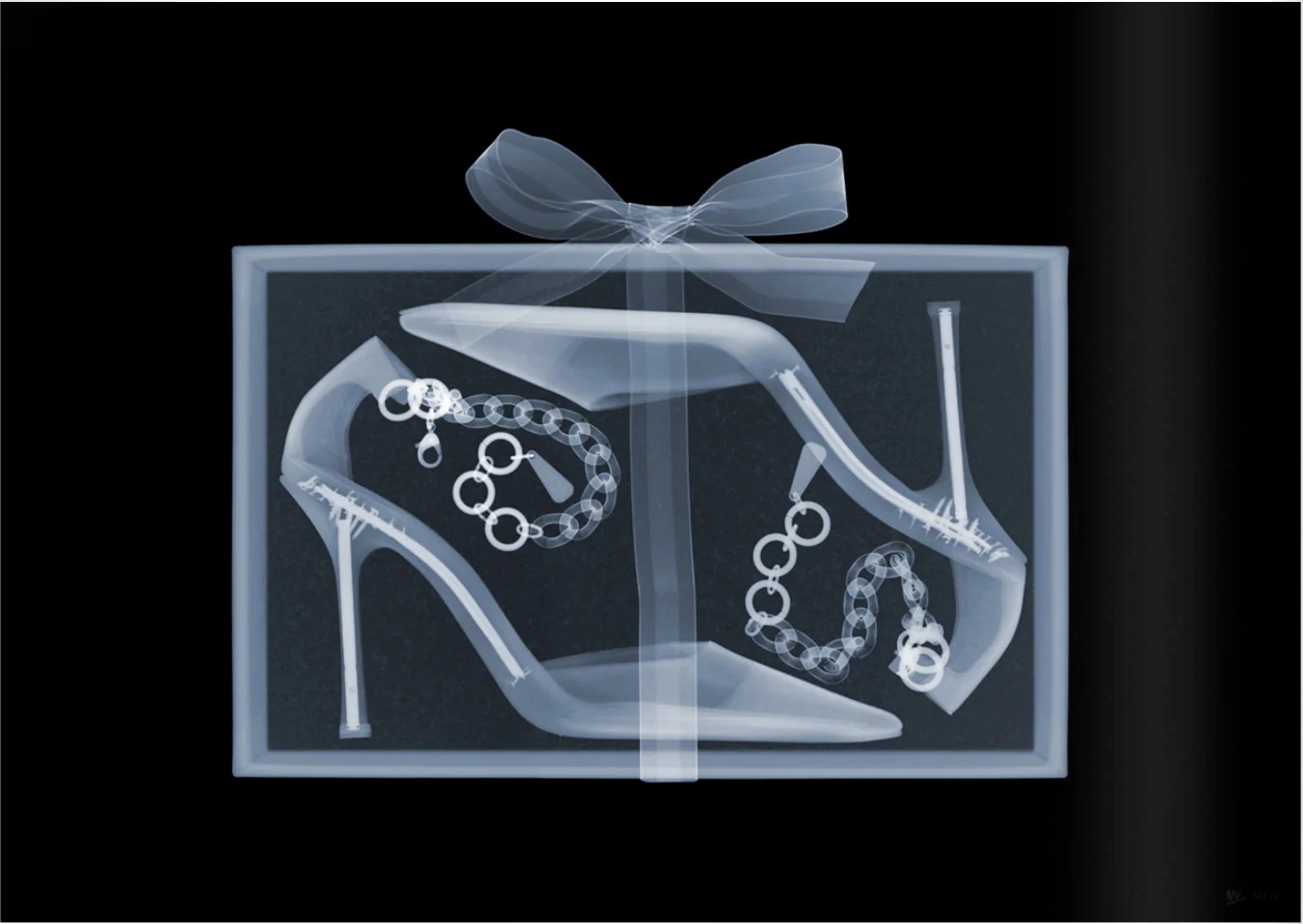
His recent series continues exploring this question across diverse subjects. Fashion photography reveals garment construction and body shapes. Consumer electronics expose the miniaturization that makes modern technology possible. Archaeological objects disclose hidden structures and construction methods without destructive analysis.
Each new series demonstrates Veasey’s commitment to revelation, his belief that understanding requires seeing through, that truth often hides beneath attractive surfaces. For collectors, this consistency provides confidence. Veasey isn’t chasing trends or manufacturing novelty. He’s pursuing a clear artistic vision with technical means few others can match.
The Fusion Achievement
What distinguishes Veasey from other photographers using alternative imaging technologies is his complete fusion of technical means and artistic vision. The X-ray isn’t a gimmick or special effect. It’s the appropriate tool for investigating questions about essence, structure, and hidden reality. The technical difficulty enhances rather than distracts from the artistic statement.
“These works are a classic example of the fusion between art and science,” his artist statement notes. “The results transcend classification as photographs, having the gravitas to motivate science institutions, museums, and art galleries to acquire the artworks.”
This transcendence of classification matters. Veasey has created a body of work that belongs simultaneously in art galleries, science museums, educational institutions, and private collections. The pieces function as art, documentation, education, and cultural commentary without privileging any single purpose.
Working from his concrete bunker, with radiation as paintbrush and industrial film as canvas, Nick Veasey continues to investigate what things really consist of when appearance gives way to essence. His X-ray photographs insist that reality contains multiple layers, that truth often lies beneath the surface, and that revelation requires unusual tools and a persistent vision. For collectors seeking work that fuses technical innovation with conceptual depth, that bridges art and science while maintaining aesthetic power, Veasey’s photographs offer exactly that synthesis. Twenty years into his practice, he remains committed to seeing through, to showing us what’s really inside, to transforming the invisible into art.
The post Seeing Inside: Nick Veasey’s X-Ray Photography Transforms the Invisible Into Art appeared first on Art Business News.
