


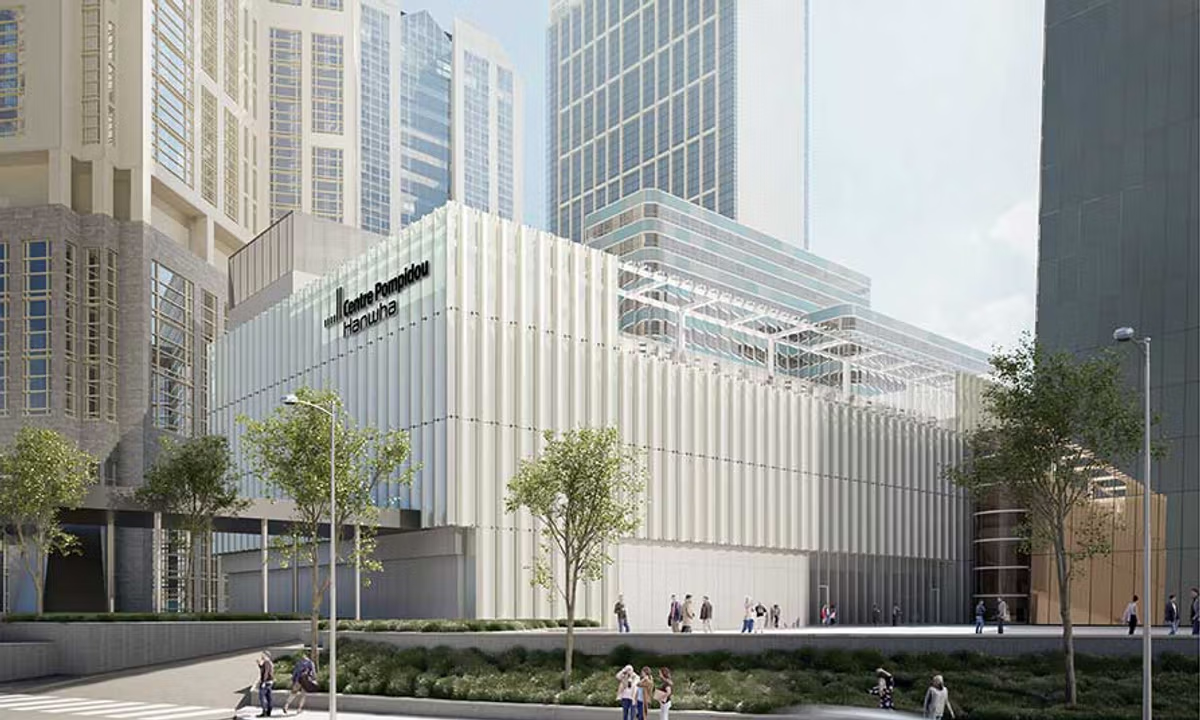
Seoul’s new Centre Pompidou Hanwha is due to open to the public on 4 June: it marks the Pompidou’s second branch in Asia following a collaboration with Shanghai’s West Bund Museum that launched in 2019. Pompidou also announced this month a multi-year strategic partnership with Hong Kong institution M+.
Centre Pompidou Hanwha will operate as a four-year partnership between the Hanwha Foundation of Culture and the Centre Pompidou. Two exhibitions per year from the Centre Pompidou’s collection will tour to South Korea, starting with The Cubists: Inventing Modern Vision (until 4 October).
Centre Pompidou’s “spirit of interdisciplinarity and contemporaneity strongly aligns with the Hanwha Foundation of Culture’s mission, since 2007, to support emerging artists and connect Korean culture with the world,” a spokesperson for the foundation tells The Art Newspaper. They add that the collaboration is “not intended as a one-way introduction of Western art, but as a reciprocal exchange in which Korean and Asian art can generate new interpretations and questions within global art discourse.”
The new museum, which French President Emmanuel Macron toured on 3 April, occupies 11,000 sq. m over four floors of the Korean conglomerate Hanwha Group’s headquarters, 63 Building—Korea’s highest building until 2003. Of the two main exhibition halls, each around 1,600 sq. m, one gallery will present early 20th-century European art from the Centre Pompidou collection, the Hanwha Foundation spokesperson says. The other will exhibit global contemporary art with a 21st-century Korean focus, curated in-house. The inaugural Korea Focus section brings local context to Western Cubism through artists such as Kim Whanki and Yoo Youngkuk.
The show’s 90-plus works by 40 artists will explore the full Cubist movement “as a collective experiment shaped by a wider artistic community responding to rapid social and cultural change,” the spokesperson says. It aims to provide attention to historically sidelined female artists including Sonia Delaunay, Natalia Goncharova, Suzanne Duchamp and María Blanchard, “presenting them not as peripheral figures but as original contributors to a new visual language”.
The Pompidou Centre in Paris, which closed in September 2025 for five years, is mounting a series of exhibitions at locations in France and abroad during this period.
Strengthening ties
“The opening of Centre Pompidou Hanwha in Seoul, which coincides with the 140th anniversary of diplomatic relations between France and the Republic of Korea, fits perfectly into this dynamic,” a spokesperson for the Pompidou says. “This opening will allow us to strengthen ties with Korean audiences and artistic communities.” The museum “is not a copy-paste of the Paris museum, but rather a true collaboration tailor-made with our Korean partners and stakeholders, to create a cultural offering that will be fine-tuned to the local audience”, the spokesperson adds.
The Hanwha Foundation declined to comment on reports that Hanhwa is paying Centre Pompidou around $21m over four years. The reports that the foundation is spending on European loans instead of supporting Korean talent has sparked some controversy domestically, while Hanwha Group’s ties to the Israeli and American militaries have attracted global criticism.
Chung Joonmo, a cultural policy specialist who was previously the chief curator of Korea’s National Museum of Modern and Contemporary Art, applauds Centre Pompidou Hanwha’s mission but fears that “by relying on the ‘Pompidou’ brand to draw audiences, we risk turning the Korean art scene into a passive conduit for consuming Western masterpieces—a kind of cultural dependency. My concern is more about what comes after; given the tendency of Korean corporations to follow each other’s lead, I worry that once Hanhwa launches Pompidou Seoul, other companies will scramble to bring in their own museum branches from abroad.”
Last year the city of Busan signed its own memorandum of understanding (MOU) with Centre Pompidou for a branch to open in 2031, but faces public protest over the ecological impact of the 15,000 sq. m building at Igidae Park and the 108.3 billion won ($78m) public price tag. London’s Victoria & Albert Museum is reported to have in January signed an MOU with Seoul’s Dongjak district to open a branch there.
Seoul is becoming a destination for overseas art institutions, with Centre Pompidou Hanwha leading the charge © JinChang
“Within Korea’s art scene, the general view is that the Pompidou licensing model is a highly wasteful use of resources, and that there are many better alternatives,” Chung says.
As The Art Newspaper reported in 2024, the Hanwha Group has ties to the Israel Defense Forces through Israeli radar and drone companies Elta Systems and Elbit Systems. At the time, the Hanwha Foundation issued a statement that all Hanwha’s exports accord with the law and foreign policy of the Republic of Korea, a staunch US ally. “Hanwha has never been involved in the development of any inhumane weapons,” the statement read. Hanwha has “no record of exporting weapons to Israel.” More recently, as a US military supplier, Hanwha Aerospace saw its stocks surge after the US-Israeli attacks on Iran and Lebanon began at the end of February.
Chung says that, locally, armament companies are largely embraced as essential to defence against North Korea. “While there are signs of growing humanitarian empathy, the dominant reaction remains one of acute sensitivity to how the conflict affects the domestic economy and daily life.” The museum’s preview on 19 May was greeted by a number of protesters from the group Artists Solidarity Against Censorship expressing their opposition to “genocide artwashing” in Israel and Hanwha’s military industry.
The foundation spokesperson stresses that the Hanwha Foundation and the Centre Pompidou Hanwha operate independently of Hanwha Group. The foundation also runs the Youngmin International Artist Residency Grant and New York’s Space ZeroOne, both boosting contemporary Korean artists’ global profile.
