







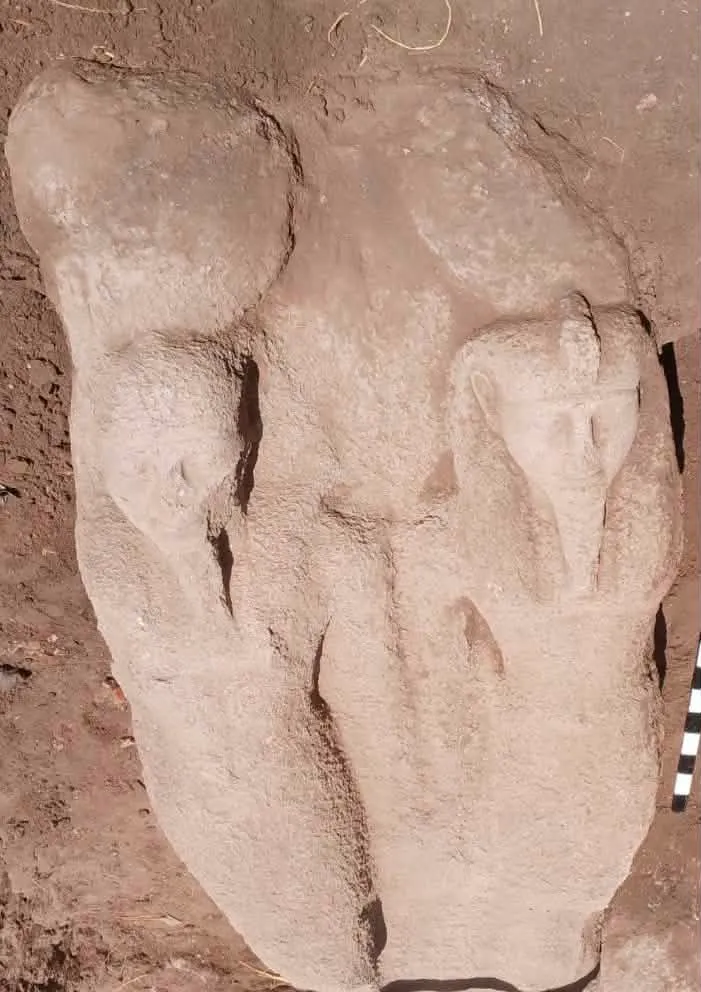
The top half of a large statue of the ancient Egyptian king Ramses II was discovered in northeastern Egypt at an archaeological site called Tell El-Faraoun. The fragment weights over 5 tons and is about 7 feet tall.
Ahram Online reported that the monument was likely part of a group of three statues that once adorned a temple, though likely not the one at Tell El-Faraoun, where it was uncovered. Rather, it is believed to have initially been carved for a temple in Per-Ramesses, an ancient capital city built by Ramses II in the 13th century BCE.
Hisham El-Leithy, Secretary-General of the Supreme Council of Antiquities, said in a statement, “The find provides valuable evidence of how statues were relocated and repurposed during the New Kingdom, particularly in regional centers connected to major royal capitals.”
Ramses II lived between about 1279 BCE and 1213 BCE and is generally considered one of the most powerful Egyptian pharaohs. He is the subject of the Ramesseum, a sandstone funerary temple near Luxor. In 2024, a 12.5-foot-tall section of a statue of Ramses II (also the top half) was discovered at the archaeological site El Ashmunein as part of an Egyptian-American mission. In that instance, the fragment is believed to match a lower section discovered by German archaeologist Gunther Roeder in 1930.
This latest partial monument was quickly transported to San El-Hagar, a different archaeological site about 10 miles north of where it was uncovered, to a storage facility.


