


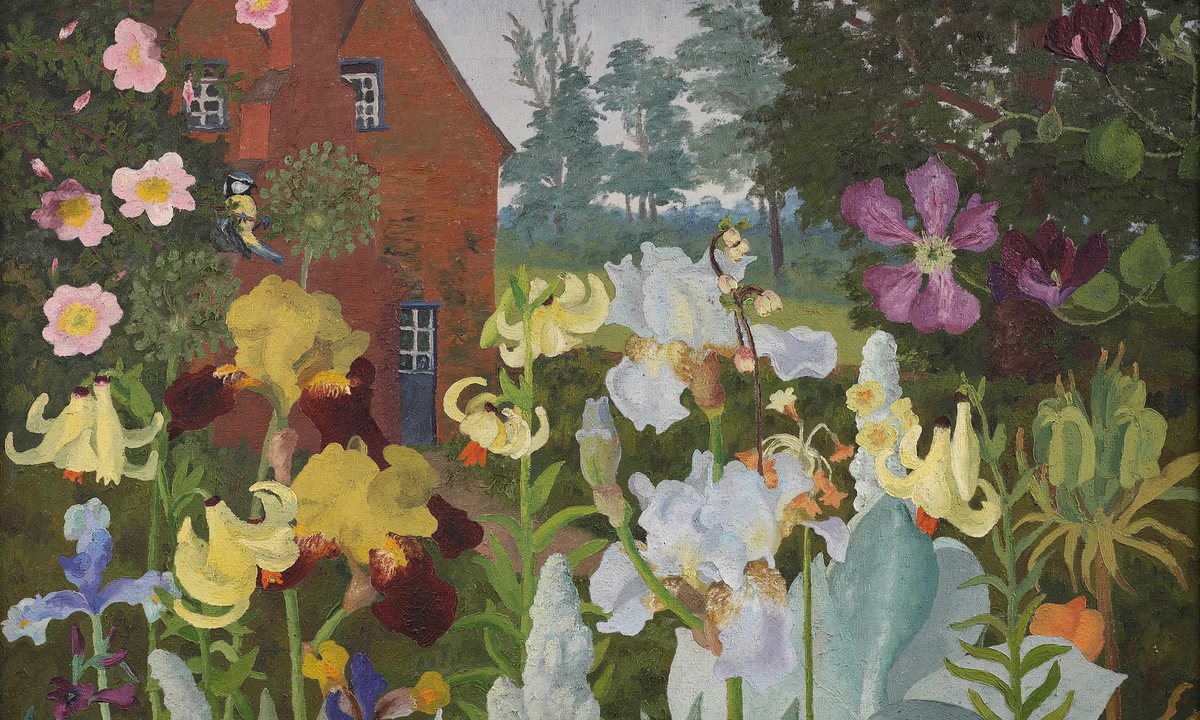
Rumour has it that a young Lucian Freud was to blame for burning down the East Anglian School of Painting and Drawing in Dedham, in 1939. The 17-year-old enfant terrible had apparently been careless with a cigarette in one of the studios and that was that, so the story (that he cultivated himself) goes. If Freud truly was the culprit, he may have done the art school an accidental favour since it was then forced to relocate to Benton End—a Tudor manor house in Suffolk surrounded by a three-acre garden.
This setting was a perfect home and workspace for the school’s founders, the British artists Cedric Morris and Arthur Lett-Haines, and their unique union of horticulture and art. An exhibition at London’s Garden Museum this month will explore what Morris and Lett (as he was known) made of this 16th-century home in the four decades that they lived, painted, gardened, cooked and hosted creatives there. The Garden Museum is particularly well poised to mount the show as it was handed ownership of Benton End in 2021 by the Pinchbeck Charitable Trust. The museum has since been working to turn Benton End into a cultural centre.
The East Anglian School operated out of Benton End between 1940 and the 1970s, and the freedom and minimal instruction provided by Morris and Lett attracted a wide array of students, including Maggi Hambling. “The school’s emphasis on observation, independence and a close engagement with the natural world had a lasting impact on pupils,” says Christopher Woodward, the director of the Garden Museum.
Benton End: A Paradise of Pollen and Paint will be a multisensory exhibition (including sound and smell) organised by the guest curator Patricia Hardy, who recently curated a two-artist exhibition devoted to Morris and Lett at Gainsborough’s House museum in Suffolk. The show will include immersive reconstructions of each section of the house and original objects such as photographs, letters, personal belongings, and even Morris’s dining table and chairs, which hosted dinners made with produce from the garden. Six people associated with Benton End will be especially highlighted: Morris, Lett, Freud, the artist Joan Warburton, the culinary writer Elizabeth David, and the gardener Beth Chatto.
One of the exhibition highlights will be Man in Black Scarf (1939), a portrait (somewhat contentiously) attributed to Freud in 2016 on the BBC One show Fake or Fortune?, now being publicly exhibited for the first time. Although Freud denied making the painting, which was apparently created during his first year at the East Anglian School, it was attributed to him through materials found in the Cedric Morris Archives at the Tate. Alongside the painting, Freud’s paintbrushes and a selection of his drawings showing the impact of Benton End on his work will also be on view.
Strong atmosphere
Freud studied with Morris at an early point in his career, when he was just starting to take art seriously and his style was still solidifying. After initially taking some classes at the Slade School of Fine Art, it was at the East Anglian School that he found his place. It was a setting “where people were working seriously and there was a very strong atmosphere,” Freud later said.
The Garden Museum has been working on reviving that very atmosphere. Four successive families owned the home over a period of around 40 years following Morris’s death in 1982, but the garden was relatively untouched in that time. Restoration of the garden has been ongoing since 2023, including efforts to collect seeds and cuttings from people once given plants grown by Morris. Morris was especially known for growing irises, for instance, and cultivated many varieties of them. The next step will be a £5m capital project to repair and restore the house and grounds.
In tandem with the exhibition, Benton End’s walled garden will reopen to visitors this summer. “Together, they form two complementary experiences,” Woodward says. “The exhibition in London introduces audiences to the history, atmosphere, and creative legacy of Benton End, while the garden is presented as a revival and interpretation of the garden Cedric and Lett developed.”
• Benton End: A Paradise of Pollen and Paint, Garden Museum, London, 2 June-20 September
