


Singapore’s place in the world has always been a nuanced one, as a Malayan, Nusantaran and Southeast Asian former British colony with a mostly Han Chinese, South Asian and Malayan population. The multitudes contained within the city-state receive full exploration with the 2026 edition of Singapore Art Week (SAW), with its broad range of artistic offerings in terms of both geography and concept.
“We take immense pride in being the definitive home for Southeast Asian Art and as a space where the regional arts community connects,” says Low Eng Teong, the chief executive officer of Singapore’s National Arts Council, which organises Singapore Art Week.
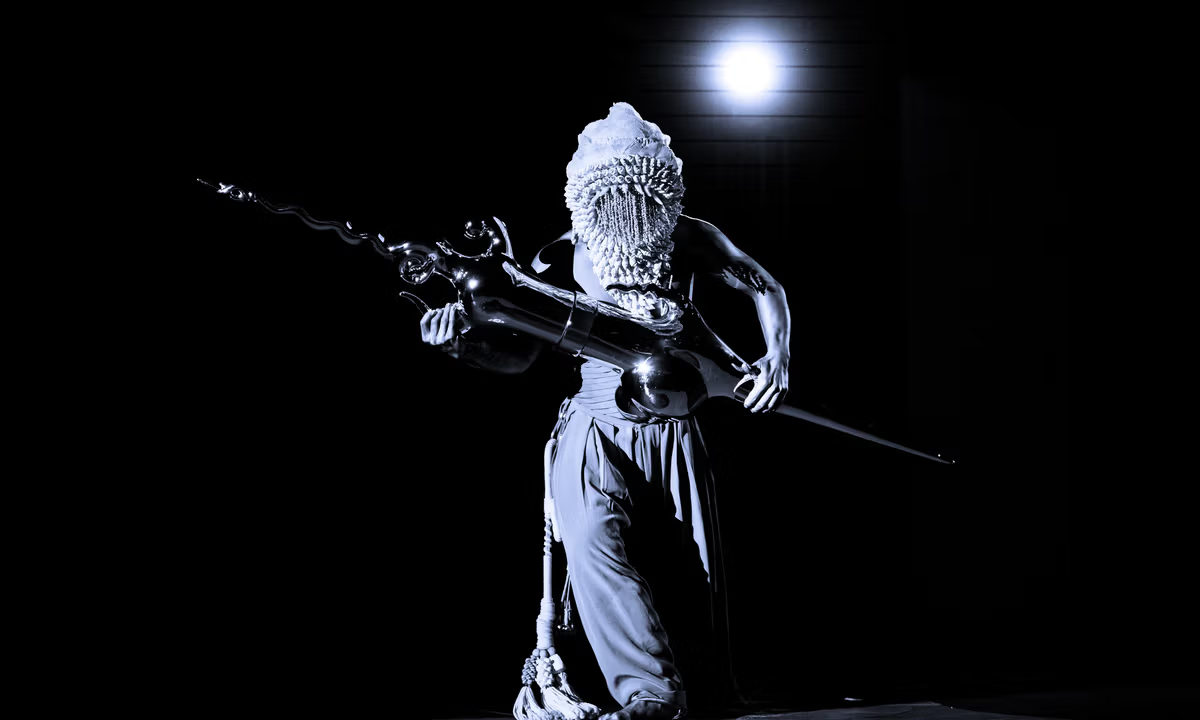
That diversity is demonstrated in the second iteration of Wan Hai Hotel, adapted from an inaugural Shanghai edition at Rockbund Art Museum (RAM) in 2024. “The core ideas,” says X Zhu-Nowell, RAM’s director and the curator of both editions, “remain grounded in our original proposition: bodies of water are not borders but ways of sensing and inhabiting the world. As in Shanghai, we draw from [the Tongan and Fijian writer] Epeli Hau‘ofa’s vision of the Pacific as a ‘sea of islands’, shaped by relations, memory and movement.”
The underlying concept will travel to Singapore’s The Warehouse Hotel, running from 20-31 January. Artists include Singaporeans like Ho Tzu Nyen, Dawn Ng and Robert Zhao Renhui, diaspora Singaporean Ming Wong, and regional artists like Thailand’s Wantanee Siripattananuntakul. Ideas of diaspora are expanded with the inclusion of Japan-based Chinese artist Han Ishu and Guatemalan-Chinese artist Esvin Alarcón Lam. “We are inviting artists whose practices think with tides, straits, migration routes and maritime infrastructures,” says Zhu-Nowell. “Their works allow the Singapore iteration to become not a repetition of Shanghai, but an expansion shaped by another shoreline—one that bears the weight of global circulation and the memories of those who once lived and worked along its waters.”
Art SG (23-25 January) is Singapore’s premier art fair and is now in its fourth edition Courtesy Art SG
Singapore’s art scene has seen particular growth since the art fair Art SG’s launch in 2023. This year, it will be held alongside S.E.A. Focus, a smaller fair which has run since 2019. The move “provides expanded market access and networks by bringing Art SG’s significantly larger visitor numbers,” Emi Eu, the founder of S.E.A. Focus, told The Art Newspaper last year. The combined event will “cement both platforms as a mega-anchor for SAW, expanding opportunities for Singapore to grow the Southeast Asian art market on a global scale”.
According to Jasmine Prasetio, Sotheby’s senior director, Asia, and managing director, Southeast Asia, “autumn 2025 was a fantastic moment for art” worldwide, with “euphoria and energy from collectors, and we hope to see this in SAW 2026. Separately from the market aspect, there have been a lot of international patrons and institutional interest in Southeast Asian art, from the perspective of both collecting as well as philanthropy.” Singapore, she says, is experiencing “more and more philanthropists and non-profit organisations being established or become more vocal in championing the arts”.
Prasetio says the current climate has been long fomenting, even before the creation of SAW in 2013 or of Singapore’s National Arts Council in 1991. “Singapore and the greater Southeast Asia region is not a new market, but one that has been established since as early as the 1950s, when Indo-European artists such as Adrien-Jean Le Mayeur travelled and exhibited in Singapore, Indonesia and Malaysia. As early as the 80s, there were exhibitions of works by Chu Teh Chun, Zao Wou-Ki and Basquiat in Indonesia,” which also launched two of Asia’s oldest biennials, respectively in Jakarta and Yogyakarta.
Within Singapore and its neighbours, “there is a strong affiliation to support artists from the region, but with an open-mindedness to also collect across various geographies and categories. The market was sophisticated, with seasoned, knowledgeable collectors quietly collecting, and while that remains true, the scene is also bustling with new art enthusiasts and passionate patrons who care not only about art but also the community.”
Sotheby’s will hold a modern and contemporary auction during SAW for the second year running, with the preview (21-24 January) and auction (25 January) both at The Edition Hotel, and will also hold a showcase emphasising women artists.
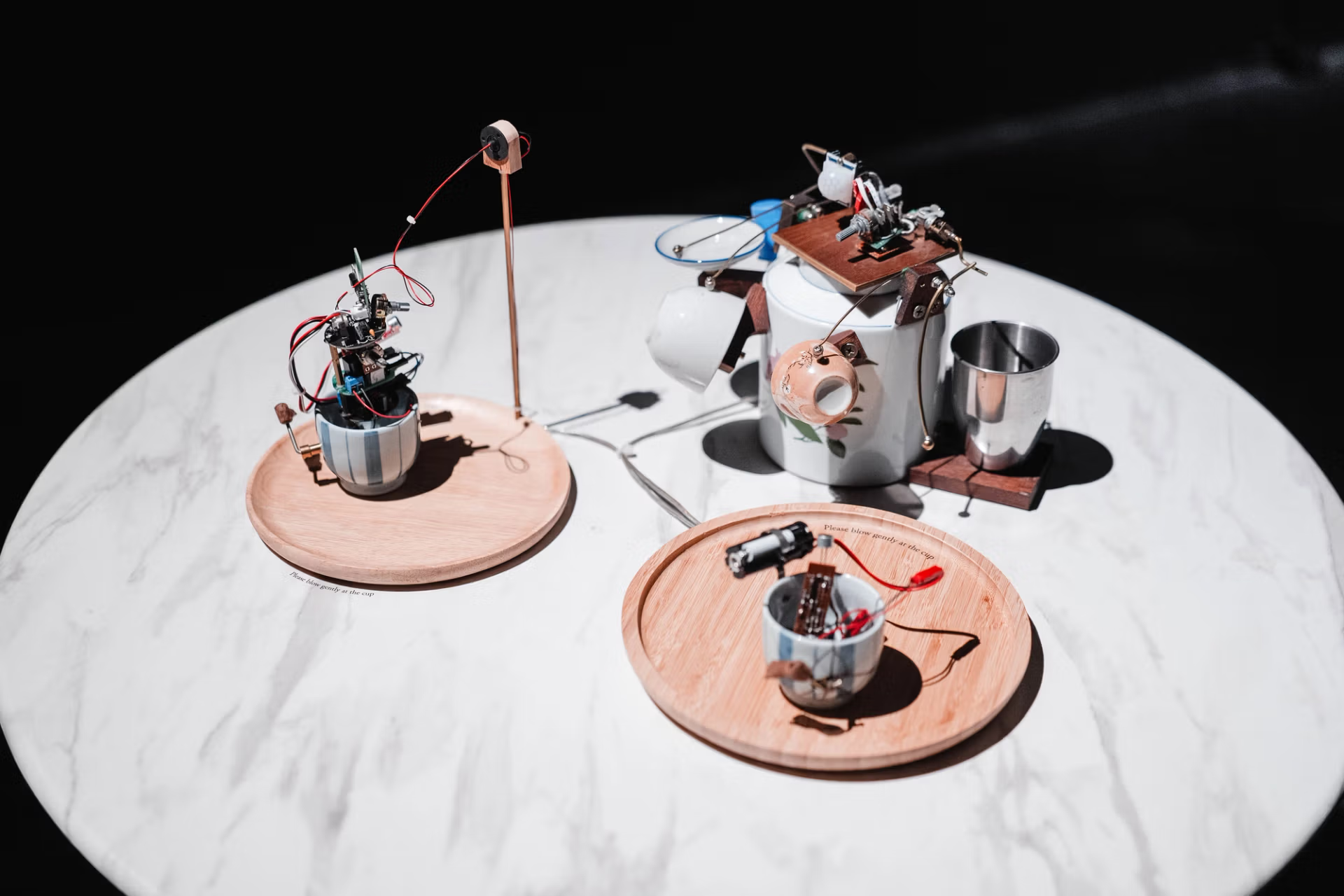
chapalang, curated by Gunalan Nadarajan and Roopesh Sitharan, is at Artspace@Helutrans, 22 January-1 February Image courtesy of Gunalan Nadarajan
There are dozens more events across the week. There is still time to catch this year’s Singapore Biennale (until 29 March). Titled Pure Intention it includes more than 100 works spread over five neighbourhoods, exposing the hidden personal narratives behind various systems, exploring what the curators call “the incidental and the peripheral”.
One focus for SAW is the convergence of technology and art, such as in the exhibition chapalang, curated by Gunalan Nadarajan and Roopesh Sitharan (Artspace@Helutrans, 22 January-1 February). It’s the second iteration of a concept that started at Kuala Lumpur’s Ilham Gallery last August, and looks at the different ways in which creatives in Southeast Asia have used technology. The Singapore show takes its name from a Singlish word meaning a mix of disparate elements and includes ten artists from around the region, including Witaya Junma (Thailand), Margaret Tan (Singapore) and Giang Nguyen Hoang (Vietnam), and explores how Southeast Asian creatives negotiate technologies in everyday cultural contexts.

The exhibition Fear No Power: Women Imagining Otherwise at National Gallery Singapore includes Dolorosa Sinaga’s Solidarity (2000/2025) Image courtesy of National Gallery Singapore
Other highlights picked out by Low include: “Tanoto Art Foundation’s Rituals of Perception for its profound tactile exploration, and Isang Dipang Langit: Fragments of Memory, Fields of Now, for its powerful amplification of Filipino voices. Together with the Singapore Biennale 2025, the National Gallery’s Fear No Power: Women Imagining Otherwise, and STPI’s inaugural The Print Show & Symposium Singapore, these exhibitions prove that art in Singapore is a catalyst for dialogue and positive change.”
Low concludes: “Looking back at where we were last year, the shift is clear. We have moved from being a gateway to a nexus for art. By integrating world-class fairs, cutting-edge technology and heartland accessibility, SAW 2026 demonstrates Singapore is a definitive nexus for Southeast Asian art.”
Singapore Art Week, 22-31 January, artweek.sg
