


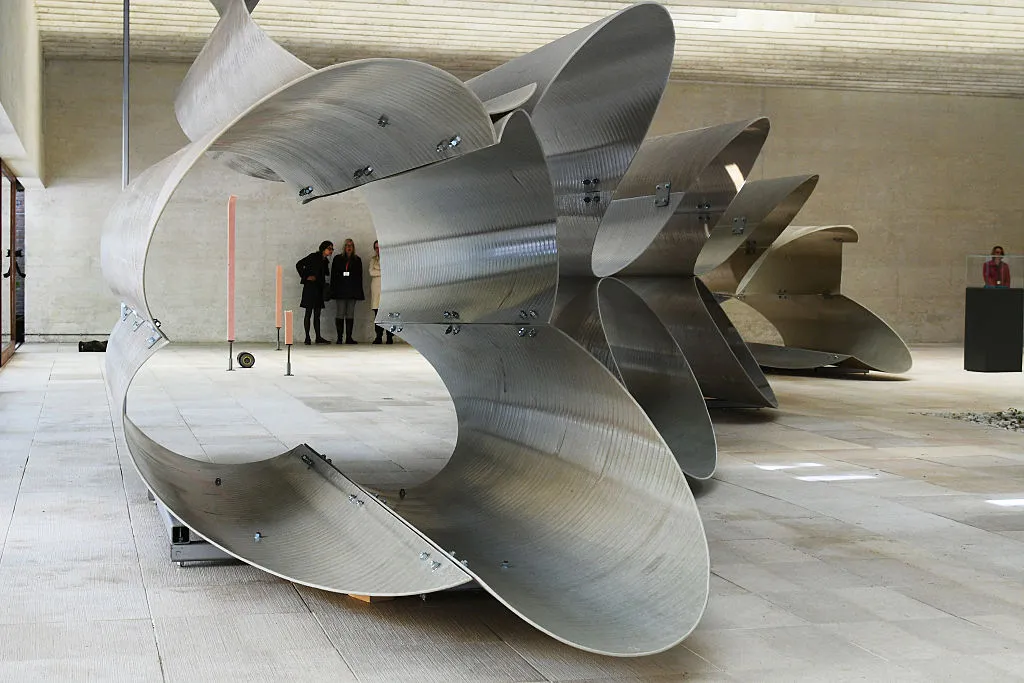
Siri Aurdal, a Norwegian sculptor and painter who elevated industrial materials into sleek expressions of art’s social imperative, died on March 31. She was 88. Galleri Riis, her representative, announced her death on social media, writing that she died in Oslo surrounded by friends and family.
Though born in 1937 to two prominent Scandinavian artists—Synnøve Anker Aurdal (1908–2000), a textile artist who represented Norway at the 1982 Venice Biennale, and painter Leon Aurdal (1890–1949)—Siri Aurdal forged a visual identity uniquely her own within the Scandinavian art scene of the late 1960s. A core concern of her practice was the potential for change in people, places, and materials—a preoccupation that first took shape in her manipulation of plexiglass and a reinforced fiberglass engineered for Norway’s oil sector.
Aurdal was raised in the orbit of Scandinavian’s leading architects and initially intended to follow them—the father of her childhood best friend worked on the 1952 Winter Olympics. Her art carried forward that modular sensibility: She cut and reassembled fiberglass elements into undulating ribbons, and later turned them into monumental public installations, including ones meant for playing children.
In 1969, a year after appearing in the Nordic Biennial in Helsinki, she was commissioned to create interactive works for Oslo’s schools and playgrounds. One such piece, dubbed Havbølger (“ocean waves”) by students at Trosterud Elementary School for its rolling slopes, was constructed from prefabricated, fiberglass-coated polyester pipes originally engineered for the oil industry. A 1972 archival photograph shows students at Trosterud Elementary School scaling its surface.
For Aurdal, movement via material was a means of linking individuals to one another, to their environment, and to the broader sociopolitical conditions that structure shared reality. Her practice was also overtly political: Januar 67, a painted polystyrene work also known as February 67, was conceived in response to the Vietnam War and is now held by the National Museum in Oslo.
She took long breaks between art-marking, but demonstrated that even a seemingly distinct body of sculpture was “an entirely new moment in an infinite work,” as an Artforum review of her 2018 exhibition at the Malmö Konsthall put it. As the title implied, the group of precise-cut plexiglass forms encompassing rectangles, waves, and circles in fluorescent red, green, and pink belong to Interview, a work begun in 1968 and reprised that year.
Aurdal was among six artists who showed at the Nordic Pavilion for the 2017 Venice Biennale. On the occasion, she spoke with Hans Ulrich Obrist in a career-spanning interview. Asked about her decision to use plexiglass, she replied that it “takes light” well: “I wanted also to make something you could go in between and reflect. You can see yourself and others reflected, in green or orange.”
Reflecting on the shapes that defined her oeuvre, she recalled how her father, the painter Leon Aurdal, “would extrapolate from simple things to explain the world.” She continued: “For instance, after this circle we made on the floor, I got a little ball and a little lamp. He showed me how to imagine that we’re living on this little ball, which is going around the lamp in an ellipse. That was an initiation to understanding time, daylight, years, seasons.”
She was less inclined to define art herself, favoring a line often attributed to Gerhard Richter: “Art is the highest form of hope.”
