


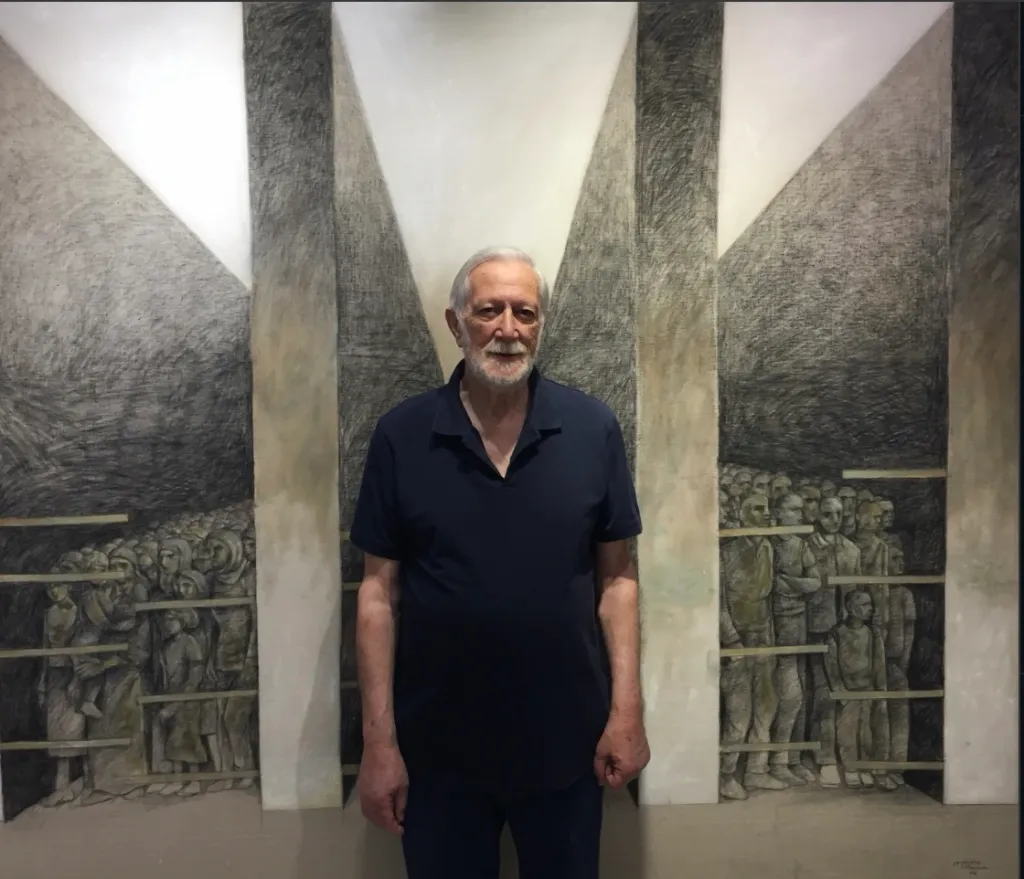
Sliman Mansour, a pivotal painter in contemporary Arab art history, with an oeuvre synonymous with the struggle for Palestinian statehood, has died at 79. The news was announced yesterday by Mansour’s family, who had previously shared that he was in critical condition.
“The final chapter has been written,” the Mansour family said on Instagram. “With hearts heavy beyond words, we share that our beloved father has passed away. … To the world, he leaves behind a life filled with beauty, memory, and a legacy that will continue to live through all those he touched. But to us, we lost a father, our source of love, strength and home.”
Like the work of other Palestinian artists of his generation, Mansour’s paintings helped carry the dreams and testimony of his people beyond the walls enclosing Gaza and the West Bank. One of his best-known works, 1973’s Jamal Al Mahamel (Camel of Hardship), depicts an elderly Palestinian porter carrying the city of Jerusalem on his back, one foot forward. The golden dome of the Al-Aqsa Mosque in East Jerusalem rests in the center. The work captures Mansour’s unmistakable signature: imagery that is at once surreal, epically emotive, and unmistakably Palestinian.
His works continuously countered Western media depictions of Palestine. For Mansour, the country was not one defined by death. In Perseverance and Hope (1976), three Palestinians in a razed refugee camp gaze upward at a dove.
“We lost a giant today,” wrote Emily Jacir, the Golden Lion–winning Palestinian artist, beneath a photograph of her and Mansour. “My friend, collaborator, mentor on this road since we met 30 years ago … In deep pain and loss tonight. But then I remember your warm smile, heart, and that smile—that smile that always made me smile.”
Zawyeh Gallery, founded in Ramallah in 2013 as the first gallery dedicated to Palestinian artists, wrote: “His influence reached far beyond his own practice. As an artist, educator, and mentor, he helped shape generations of Palestinian artists and played a defining role in the development of Palestinian visual culture. With his passing, Palestine and the Arab world lose a towering artistic figure.”
The Sharjah Art Foundation, Mathaf: Arab Museum of Modern Art in Dubai, and London’s Mosaic Rooms also mourned his death in separate statements, describing it as a loss to the international art community.
Sliman Mansour was born in Birzeit, a town near Ramallah, in 1947, one year before the mass displacement and dispossession of Palestinian Arabs that accompanied the creation of the State of Israel (an event known in Arabic as the Nakba, or “catastrophe”). Its legacy of occupation defined both Mansour’s life and artistic practice, the two inextricably intertwined.
He graduated from the Bezalel Academy of Arts and Design in Jerusalem in 1970, a member of the first generation of Palestinians raised there under occupation. “The Palestinian art movement started effectively in 1972. Before that date there was no infrastructure or any framework for art,” Mansour once told Arab Weekly of that period. “We were living in a kind of cultural ghetto, isolated from cultural developments. Movement was difficult. Many artists were banned from traveling. Artists were often arrested and their works confiscated. I, myself, was thrown in jail four or five times.”
In 1972, Mansour and his peers staged the first art exhibition in occupied Palestine, a group show of roughly 18 artists based in the West Bank and Gaza. The following year they established the League of Palestinian Artists (he served as its leader from 1986 to 1990). Later he cofounded Gallery 79, the first art space in the West Bank.
According to Mansour, Israel initiated a legal crackdown on “political art” in the 1980s that included a ban on red, black, green, and white paint. “These colors are the colors of the Palestinian flag, and the flag is a symbol of the people,” Mansour told Al Jazeera in 2024. The restriction, he explained, inadvertently gave rise to one of the most enduring symbols of Palestinian resistance: the watermelon, whose similar colors tested the bounds of the ban.
In 1989, two years into the first Palestinian uprising against Israeli occupation, Mansour and three fellow artists—Nabil Anani, Vera Tamari, and Tayseer Barakat—made art history, cofounding the New Visions movement. “The first Intifada had brought a philosophy of self-reliance,” Mansour told the Institute for Middle East Understanding of the movement’s beginnings.
New Visions forewent imported art supplies from Israel and the West in favor of materials found or sourced locally, undertaking, as their 1989 manifesto states, “an aesthetic quest to elevate artistic vision to a level that affirms the artist’s inner freedom and ability to envision beauty and truth in the midst of their daily struggle for freedom.” Recent scholarship has situated the movement prominently within the history of Palestinian nonviolent resistance, describing it as an “artists’ precursor to Boycott, Divestment and Sanctions (BDS).”
Beginning in 1989, oil and acrylic paints gave way to olive oil, henna, tea, spices, and coffee, while animal glue, mud, and leather also shaped the group’s posters, paintings, and mixed-media assemblages. In his aesthetic response to the movement’s stance, Mansour made mud his medium, layering and molding it for pottery. “I remember being anxious at first, worried about the cracks in the clay I was using,” he once told Al Jazeera. “But in time, I saw the symbolism in those cracks. They carried something honest and powerful.”
Thinking about this approach more broadly, he added, “I believe that was the link between traditional and modern art that the younger generation is producing now.”
Mansour devoted much of his life to building an art infrastructure for future generations of Palestinians. In 1994, he cofounded Al-Wasiti Art Centre in East Jerusalem, which maintained a network between artists in Palestine and those in the diaspora. With his New Visions compatriots, he also established the Palestinian Association of Contemporary Art and later founded the first international academy of fine arts in the Palestinian territories (eventually integrated with Birzeit University).
“He was always incredibly generous with his time, his thoughts, and his willingness to help the artists who came after him,” wrote the artist Sama Alshaibi, who shared on Instagram that she first met Mansour during her first trip to Palestine in 2004. “Yes, he is a legend, but also just an incredible family man and friend. I can’t imagine a world in which he isn’t in it.”
The Palestine Museum praised Mansour as a “beloved face of Palestine and one of those who, over decades, taught us how to see it.” His paintings, the Birzeit-based museum continued, “became one of the ways we preserved and imagined this country.”
That institution marked the 37th anniversary of the First Intifada and the 35th anniversary of the New Visions group’s founding with four murals created with the help of young artists and faculty from the art, music, and design departments at Birzeit University. Mansour’s mural, titled Ala Janah AlMalak (On the Wings of An Angel), features the Old City of Jerusalem.
“Born as the foundation of the Palestinian Museum’s permanent exhibition,” the museum announced upon their unveiling, the commissioned works “will remain on its walls as long as it lasts, as a token of gratitude to the New Visions group artists who led a movement of renewal while drawing strength from their people’s magnificent heritage.”
Mansour maintained his studio practice until his condition grew dire, regularly posting new artworks on Instagram through last year. He used his public platform to criticize Israel’s response to Hamas’s October 7 attack. (As of this writing, at least 70,000 Palestinians have been killed in the Gaza Strip by Israeli forces, a military campaign deemed a genocide by UN independent commission earlier this year.)
Art and politics were a frequent interview topic for Mansour, who never shied away from responding.
“I think I’m siding with the right side of history and I’m doing my best in my ability to show that. I don’t think there is a formula for what artists should do,” he told Al Jazeera. “But they should be truthful with their feelings, and they should feel with other people. I can easily go and work in my studio and forget about anything else and make flowers and nice girls and make exhibitions and sell and so on. But that’s not how I am built. And artists should not do that. They should be more active in their society.
He added, “I believe in art as a social instrument, not as decoration for wealthy people’s houses.”
