


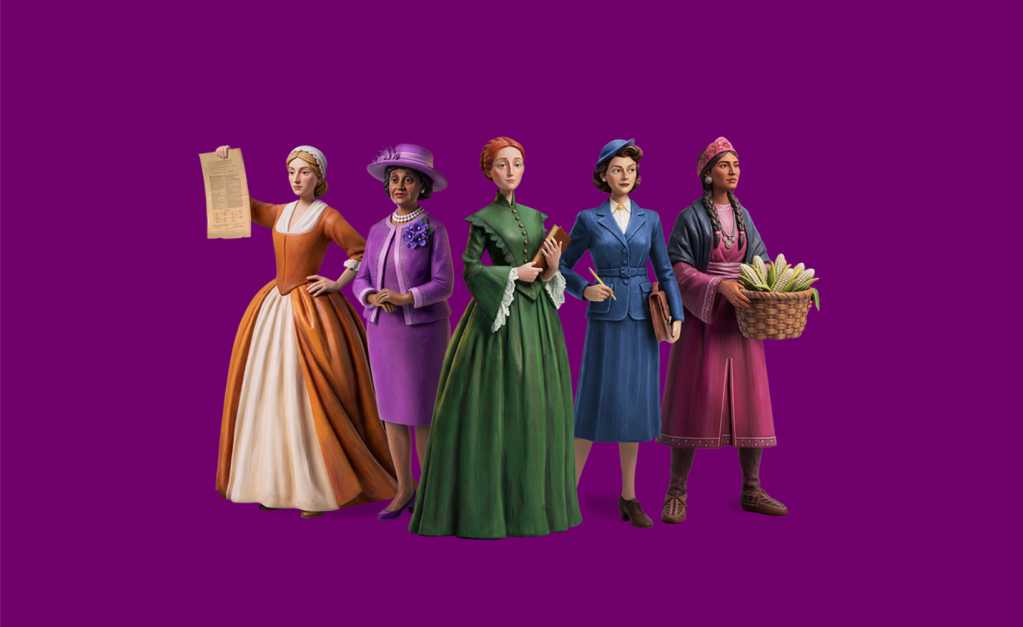
The Smithsonian American Women’s History Museum, a museum-without-walls whose stated mission is to center women’s history on the National Mall in Washington, D.C., has launched a new augmented reality project called “Unhidden Heroines.” Starting on June 18, anyone with a smartphone (or a computer) will be able to conjure the presence of five women who helped shape the country over the past 250 years and learn about their history and influence.
The five virtual monuments will join those honoring iconic (male) figures from American history on the Mall, from Abraham Lincoln to Thomas Jefferson to Martin Luther King, Jr. They are dedicated to Julia Ward Howe (poet who wrote “The Battle Hymn of the Republic”), Polly Cooper (Oneida cook for the Revolutionary Army) Mary Katharine Goddard (publisher), Elizebeth Smith Friedman (WWI and WWII codebreaker), and Dorothy Height (civil rights activist). The program will pair an illustration of each figure with a pre-existing monument, eg. Height adjacent to the MLK Memorial or Howe within the Lincoln Memorial.
Visitors can scan a QR code for each of the five historical female figures; the visual experience will differ slightly depending if you are on site at the National Mall or not. (There is also a non-interactive version.) The app will teach you about each woman’s background and how she influenced, and was connected to, the more well-known historical figure she is paired with. Mary Katharine Goddard, paired with the monument to founding father Thomas Jefferson, for example, published the first official signed copy of the Declaration of Independence.
The American Women’s History Museum was established by Congress in 2020, after more than two decades of advocacy. At the time, it was expected to take approximately 10 years and cost about $375 million to come to fruition; those figures have certainly grown over the past six years; the museum’s website still notes that it will be “at least 10 years” before a museum building is open to the public.
Access to “Unhidden Heroines” will run through Dec. 31, the end of America’s 250th birthday year.
